Anne Besnier from the Committee of the Regions says the current proposal for the next programme lacks a place-based approach
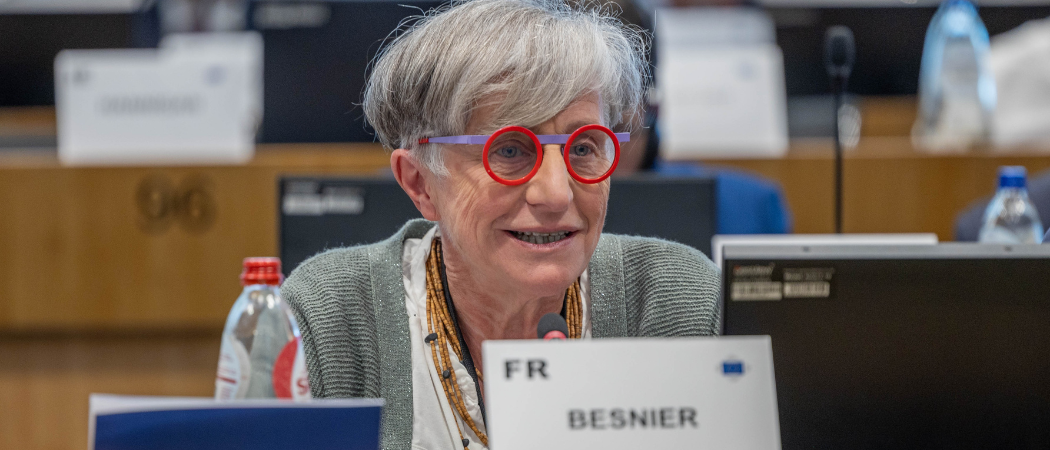
Anne Besnier, rapporteur for the EU’s next R&I framework programme for the Committee of the Regions and vice-president of the Centre-Val de Loire region in France. Photo credits: European Union
The next Horizon Europe must do more to support place-based innovation across Europe or risk undermining efforts to increase competitiveness, says Anne Besnier, the Committee of the Regions rapporteur on the proposal, which is also known as the tenth Framework Programme (FP10).
Besnier, who is vice-president of the Centre-Val de Loire region in France, believes the EU’s full innovation potential is not being reached in the current Horizon Europe programme, and this will not improve in FP10 if the programme doesn’t strongly support links to on-the-ground actors in local research and innovation scenes.
“Reading the current text you see Europe and the national level mentioned, [but] it doesn’t speak about the role of cities and regions,” she told Science|Business, speaking about the European Commission’s proposal for FP10.
“It’s very important to insist on that, because innovation doesn’t appear out of nowhere, it all starts at the regional level and we, our universities, our researchers, our companies, we know how to build innovation ecosystems,” she added.
Besnier is set to present the committee’s opinion on FP10 on May 7, with many of the amendments in the draft version aimed at increasing the focus on regions and cities.
The committee’s opinion will feed into broader negotiations on the next Horizon Europe programme, with the European Parliament and member states also having their say before it is finalised ahead of its start in January 2028.
Discussions around FP10 have centred heavily on European competitiveness, and how R&D funding can increase Europe’s position globally. But the role that cities and regions play in competitiveness is, for Besnier, too often missing.
“Innovations start at a regional level, and that can be from anywhere. Europe then needs to catch the spark from there and help take it to a national level and then to a European level,” she said. “If we don’t succeed in working with Europe’s regions, we will not succeed in increasing competitiveness.”
Her call comes at a time when support is growing for a more place-based approach to innovation and competitiveness in Europe. A recent paper by the Joint Research Centre, the European Commission’s science-based knowledge service, argues that “place-sensitive strategies offer a more robust trajectory for sustaining Europe’s economic future.”
“Rather than imposing a one-size-fits-all approach to industrial policy and technological adoption, a more nuanced path beckons; one that builds on the continent’s endogenous capacities, using emerging tools like AI, digitalisation and automation as catalysts for reinvention, rather than mere instruments of catch-up,” the report, titled Capitalism, Sustainability and Democracy, states.
Include the competitiveness fund
According to Besnier, this logic should also apply to the proposed €409 billion European Competitiveness Fund (ECF), which will be closely linked to FP10.
That link, however, remains unclear. There has been talk about Pillar 2 of FP10, which funds large-scale collaborative research projects in various scientific domains, being a bridge to the ECF.
But Besnier says the connections have to go deeper, and link basic research through the European Research Council to early-stage start-up support through the European Innovation Council, and connect that to the ECF.
“But we don’t know yet how it is going to work,” she said. “What we’re asking in the Committee of the Regions is to be more present in all the discussions because we know how to help start-ups and help them scale up.”
Related articles
- Outgoing CNRS chief bemoans low levels of French R&D spending
- Viewpoint: Europe should turn researcher mobility into a development strategy
She also pointed to the need for Europe, through FP10 and the ECF, not to fall into the trap of only supporting regions that are already performing well in research and innovation.
The EU introduced Widening measures in 2014 to help support EU countries that are lagging behind in research and innovation. Besnier has previously argued that these measures should be for regions, and not just nations, because even in strong performing countries there can be regions that are far behind in terms of research and innovation.
She accepts now that this is unlikely to happen, with the member states generally preferring to keep the measures at a national level. But she wants more attention paid to the EU’s Regional Innovation Scoreboard to make sure that all regions are given the support in the areas that they need.
Another major concern is the budget for FP10. The Commission has proposed €175 billion, while the Parliament has suggested €200 billion. Besnier has said that the Commission’s proposal must be the absolute minimum amount, noting that over the course of the current €95.5 billion Framework Programme, the introduction of new calls and strategies has seen that total diluted.
Besnier is hopeful that the committee’s calls for more emphasis on the regions will be heeded during FP10 negotiations. “We still have time to make the proposal stronger,” she said.

 Receive the Funding Newswire [full access requires a subscription] each Tuesday, our Policy Bulletin each Thursday, and the fortnightly R&D Express, tracking reforms and investments in central and eastern Europe.
 A unique international forum for public research organisations and companies to connect their external engagement with strategic interests around their R&D system.