Leaked documents contain measures calculated to strengthen role of EU member states in strategic priority setting

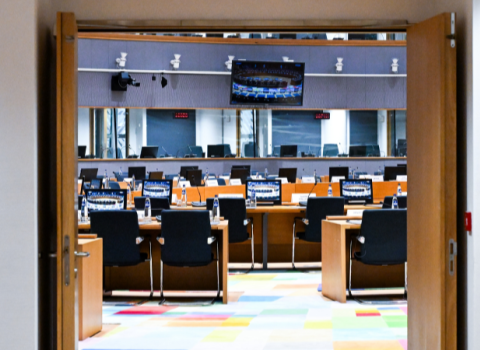
The Europa building in Brussels, seat of the EU Council. Photo credits: European Union
EU governments are working on a plan that would ensure they are closely involved in the strategic priority-setting process under the next Horizon Europe programme for 2028-34, according to draft documents obtained by Science|Business.
The latest draft compromise texts for the Horizon Europe regulation and specific programme, prepared by the Cypriot presidency of the EU Council, would see EU member states advise the European Commission on the overall direction and priorities for research funding at least once a year through a Horizon Europe Strategic Committee.
This demand runs counter to proposals in the European Parliament for expert councils to be set up to steer collaborative research in the next Horizon Europe programme.
The draft Council documents are dated April 15 and are currently under discussion by research diplomats from EU governments. They could still be subject to major changes before an agreement is reached within the Council.
The original proposal from the Commission does include a committee procedure, where member state delegates and the Commission would meet in different configurations to discuss individual parts of the programme and adopt work programmes, as well as a “general configuration” where they would discuss the implementation of the specific programme.
It is this general configuration that would become the Strategic Committee under the Council’s plans, with a more clearly defined advisory role as well as coordination with the European Competitiveness Fund’s General Committee to strengthen the links between the two programmes.
This would bring future Horizon Europe governance more closely in line with the current programme, in which member states contribute to a multi-annual strategic planning process setting broad priorities for a three or four-year period.
Member states have moved to further strengthen their role by inserting a “no-opinion clause,” meaning that a work programme cannot be adopted if the programme committee does not give an opinion.
National governments had been waiting for the Commission to provide more information about its planned steering mechanism and competitiveness coordination tool, which are expected to contribute to top-down priority setting in Horizon Europe, but that clarity has so far not been forthcoming, so they are moving ahead with their own plans.
The texts also call for member states to play an important role in the identification, selection and development of European partnerships.
They further stipulate that infrastructures receiving support from Horizon Europe should be jointly identified by the EU and member states in an open and competitive process. The Commission proposal would allow the programme to contribute up to 20% of the costs of constructing or upgrading critical research and technology infrastructures.
Associated country contributions
Meanwhile, EU governments want to ensure that financial contributions from non-EU countries associated to Horizon Europe are used to top up the budgets of programmes in which researchers from those countries are most involved.
“The Commission shall, on an annual basis, provide the programme committee with information on the financial contributions from third countries associated to the programme and their allocations to the different components of the programme,” the draft compromise text reads.
In February, Science|Business reported that the Commission was considering reshuffling money paid into the EU budget by countries associated to Horizon Europe. This would see funds redirected towards EU policy priorities such as a call for biodiversity research projects, rather than programmes favoured by associated country researchers.
In response to concerns raised by the research community and MEPs, research Commissioner Ekaterina Zaharieva said it was not possible to distribute associated countries’ budget contributions according to their participation in specific Horizon programmes on a yearly basis.
Associated countries’ contributions are added to the overall Horizon budget, making it difficult to trace where the money ends up, but EU governments want to ensure that funding is able to respond to trends in participation.
The European Parliament has proposed its own safeguards. Christian Ehler’s draft report on the legislation states that the allocation of financial contributions shall “strictly follow” the level of associated countries’ participation in each part of the programme, whereas the Commission’s proposal and the current Horizon Europe programme only require it to “take into account” participation levels.
Widening debate
The draft compromise texts do not address the programme’s budget, which is being discussed elsewhere as it forms part of the overall EU budget for 2028-34.
Nor do they address Widening measures for countries with less well-developed research systems. Last year, the Danish presidency of the Council bracketed the Widening part of the proposal, meaning it would also be discussed as part of broader negotiations on the next budget.
However, research diplomats have now begun discussing elements related to Widening, after several research ministers called for the programme to be put back on the table as part of the Horizon Europe talks.
Related articles
- Research lobbies reject reassurances over Horizon Europe budget reshuffle
- Widening, ECF links and priority setting top list of Horizon Europe sticking points
According to documents seen by Science|Business, the Cypriot presidency has chosen to retain key aspects within the brackets. These are the division of Widening countries into a Widening group and a Transition group; the definition of Transition countries as member states with an innovation scoreboard index above 75 that have increased their participation in Horizon Europe; and the restriction from 2030 of capacity building measures to Widening countries that have increased their public R&D investments in the last year.
These provisions will continue to be discussed by diplomats working more closely with ministries of finance and foreign affairs, while research diplomats and ministers will discuss other elements of the Widening scheme.
Ministers are hoping to reach an agreement on key aspects of the next Horizon Europe, known as a partial general approach, at their next meeting on May 29.
As it stands, there are several key points on which member states diverge from the positions included in the European Parliament’s draft reports, currently being scrutinised by MEPs, including the role of independent experts and the financing of research infrastructures.
But there are also areas of common ground. For instance, both institutions support maintaining the terms of the European Research Council and European Innovation Council presidents at four years, renewable once, after the Commission proposed reducing them to two years.


 Receive the Funding Newswire [full access requires a subscription] each Tuesday, our Policy Bulletin each Thursday, and the fortnightly R&D Express, tracking reforms and investments in central and eastern Europe.
 A unique international forum for public research organisations and companies to connect their external engagement with strategic interests around their R&D system.