MEPs are calling for a Horizon Europe budget of at least €200 million, but know this will be difficult to deliver without new sources of funding
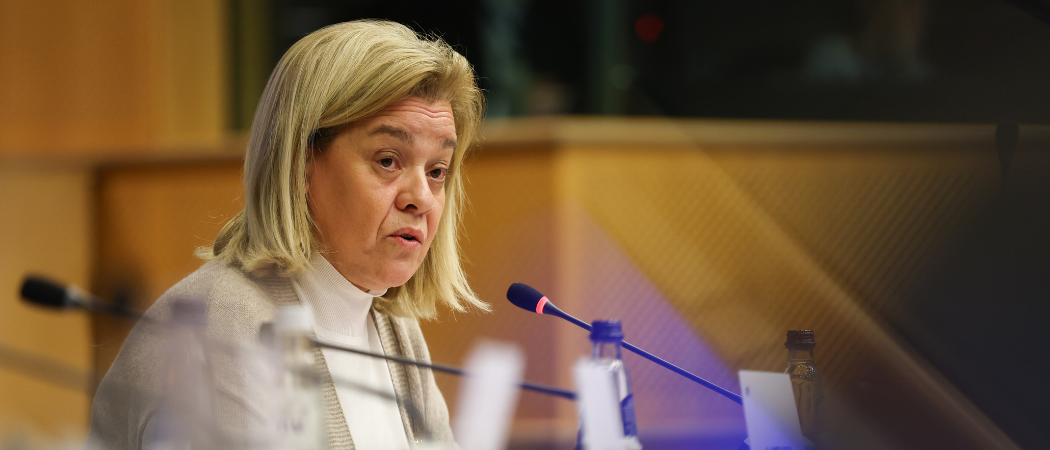
MEP Carla Tavares, co-rapporteur on the next EU budget, backs a strong research programme. Photo credits: Johanna Geron / European Union
MEPs negotiating the next long-term EU budget want to secure strong funding for the next Horizon Europe, the tenth Framework Programme for research and innovation (FP10), but know they face an uphill battle to convince EU governments.
According to Carla Tavares, one of the MEPs leading on the long-term budget, FP10 is “a very important instrument” in the next Multiannual Financial Framework (MFF) for 2028-34. “FP10 is not one policy instrument among many. This is the foundational capability that makes the other instruments work,” she said on April 20, at an event organised in the European Parliament by a group of European university networks.
She went on to highlight the importance of research for strategic autonomy, the green transition and a competitive industry. “Cutting research does not save money, it creates costs in other areas. This is a clear position from the Parliament,” she said, adding that FP10 is precisely the kind of programme that produces European added value that cannot be replicated at national level.
Last week, the Parliament’s budget committee endorsed its position on the MFF, for which Tavares of the Socialists and Democrats (S&D) group is co-rapporteur. It would see FP10’s budget rise from €175 billion under the European Commission’s proposal to €200 billion.
According to Tavares, the next Horizon Europe must be a priority during the budget negotiations, as Europe’s innovation gap represents “an existential challenge for our prosperity, our social model and our global standing.”
Council pushback
There are supportive noises coming from EU capitals on the importance of research and innovation, but they are also likely to resist a significant increase in EU spending. Reducing the overall EU budget during negotiations would be “the greatest possible mistake we could make in this moment,” Lina Gálvez, also of the S&D group, told the meeting. “The road of austerity is not the road that will bring us to be more competitive.”
When push comes to shove, it’s easier for governments to cut the EU research budget, which is based on open competition and therefore does not guarantee each country a return on their investment, than it is to cut funding for cohesion or agriculture.
“We have to be very loud, and we have to have the society on our side,” said Gálvez. “We need to shift the narrative from abstract science [. . .] to this idea of tangible prosperity.”
Horizon Europe should not be seen as being in opposition to the Common Agricultural Policy, she continued. “The best way for [farmers] to be more productive is through innovation, through science.”
René Repasi, Parliament’s lead rapporteur for the specific programme implementing FP10 and a further S&D voice, recommended realism when it comes to budgets. “The €175 billion from the Commission is already quite something,” while the Parliament’s €200 billion proposal is “quite daring,” he said.
“The €220 billion, which might be the absolute minimum, I totally agree, is not realistic,” he continued. “We have to do our work in capitals to convince them even to agree to the €175 billion.”
Policymakers are facing an “impossible equation,” said Hélder Sousa Silva, rapporteur for the budgetary assessment of FP10, who sits with the European People's Party group. “On the one hand, member states want to decrease their annual contribution. On the other hand, we are raising our level of ambition.”
The budget committee’s report sends a “strong message” that Horizon Europe is a key priority in the next MFF, he said.
For Sousa Silva, it is also crucial to ensure the full envelope allocated to research and innovation is used for this purpose. That means, for example, that unspent money in the form of decommitments should be fully reused to support research, along with reflows from investments.
Own resources
The Parliament’s report suggests raising the overall EU budget by 10% compared to the Commission’s proposal. This should be financed partly by at least €60 billion per year in new own resources, which are revenues collected at EU level in contrast to national contributions to the EU budget.
Joint borrowing, which the EU previously used to finance its Covid recovery fund, is one option, but there is not currently a majority in Parliament for this, Tavares told Science|Business following the event. She suggested first looking at other possibilities such as a tax on major digital platforms or online gambling, or the extension of the Carbon Border Adjustment Mechanism.
“For my political group [Socialists and Democrats], we think that we need to be prepared to use joint borrowing if we need it, not just for security and defence, but all areas, including competitiveness,” she said. “But at same time, we know that when we have joint borrowing, we need to pay the debt in the end.”
Related articles
- MEPs adopt long-term budget report with €200 billion for next Horizon Europe
- Commission pushes back against MEPs’ Horizon Europe proposals
Manuel Heitor, whose expert group on FP10 recommended a €220 billion budget, insisted this is a realistic figure. “This was not just a number, it was a very serious calculation, just looking at the trends of the success rates,” he told Science|Business following the meeting.
EU research programmes are under increasing pressure, with the European Research Council recently announcing stricter eligibility rules in response to a rise in applications. Marie Skłodowska-Curie Actions postdoctoral grants have also seen decreasing success rates. “If we don’t increase the budget, it will provoke an enormous frustration in Europe,” Heitor said.
The former Portuguese science minister believes that what’s at stake is not just which research projects get funded, but faith in the European model. “Being realistic is not just to have a financial approach, it’s to understand how we can build trust in future generations,” he said.
It is also essential to increase investments to respond to growing geopolitical competition, he said. “We are facing a world which, in ten years’ time, will be dramatically different, with the rise of Chinese science and the expected rise of Chinese investment in research at about 7-10% a year.”
Heitor said that new own resources should include joint borrowing, which should be used to finance issues related to competitiveness, including the European Competitiveness Fund. “It is clear that going to debt for research, there is no experience worldwide. Going to debt for competitiveness, there is a lot of experience, also in Europe,” he said.
It’s not just about increasing budgets. Shifting Europe’s economy towards high-tech sectors requires a new attitude of risk taking, Heitor went on. “Going to the financial markets will put pressure to develop higher-added-value products and systems,” he said.
Parliament is scheduled to vote on its MFF stance during the plenary session in Strasbourg on April 29, ahead of negotiations with the Council, which MEPs hope to conclude by the end of the year.



 Receive the Funding Newswire [full access requires a subscription] each Tuesday, our Policy Bulletin each Thursday, and the fortnightly R&D Express, tracking reforms and investments in central and eastern Europe.
 A unique international forum for public research organisations and companies to connect their external engagement with strategic interests around their R&D system.