Expert councils governing Horizon Europe could mean longer waits for grants and more complexity, says Zaharieva staffer Manuel Aleixo
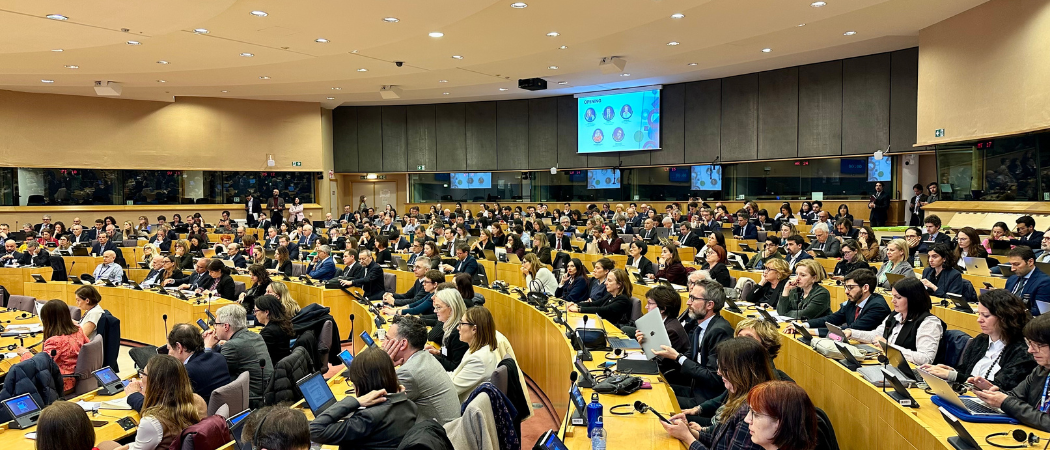
Event of the Italian Agency for the Promotion of European Research on April 21. Photo credits: APRE
Officials at the European Commission have reiterated their objection to the inclusion of formal expert councils in governance structures for the next Horizon Europe, saying they could compromise simplification of the programme.
Initially recommended by the Heitor expert group, the idea of creating expert councils was left out of the Horizon Europe proposal published in 2025 by the Commission. The councils have now been reintroduced by Christian Ehler, the European Parliament’s lead rapporteur on the Horizon Europe legislation.
In a March report, Ehler recommended that two councils comprising experts from science, innovation, industry and civil society be appointed for five years to advise on the design of calls for proposals for collaborative research and innovation. One council would be focused on European competitiveness, the other on global societal challenges.
This move has already been rejected by Marc Lemaître, head of the Commission’s directorate general for research and innovation, who told MEPs in March that the councils would add “more complexity, heaviness and costly coordination, while undermining Commission implementation prerogatives and financial accountability.”
Now Manuel Aleixo, a senior official in the office of research Commissioner Ekaterina Zaharieva, has spoken out against the councils.
Speaking on April 21, at an event held by the Italian Agency for the Promotion of European Research, Aleixo said the Commission planned to involve “strategic stakeholders” in Horizon Europe, but he was concerned the proposed expert councils would compromise the aim of making the programme simpler and faster for applicants.
“If we add a layer of complexity to the process of preparing for our programme, I fear that we will have potentially two negative effects,” he said. “One, we will increase the time that is necessary, and therefore the time that applicants have to wait; [and two], if we have an expert-led approach, I fear that the content of our programme will become more complex and more prescriptive, which is again exactly the opposite of what we are trying to do at the moment.”
Addressing repeated concerns that research funding risked being directed by Commission policy priorities, Aleixo recalled that both Horizon Europe and the European Competitiveness Fund would be “legally and financially separate programmes.” Their links, he said, will enable more coherence between research and industry.
“That we can plan our research, especially collaborative top-down research, and our industrial policy together, means that we can ensure coherence in all areas,” he said.



 Receive the Funding Newswire [full access requires a subscription] each Tuesday, our Policy Bulletin each Thursday, and the fortnightly R&D Express, tracking reforms and investments in central and eastern Europe.
 A unique international forum for public research organisations and companies to connect their external engagement with strategic interests around their R&D system.