Lead rapporteur explains in detail how the Parliament wants to shape the EU’s next research and innovation programme
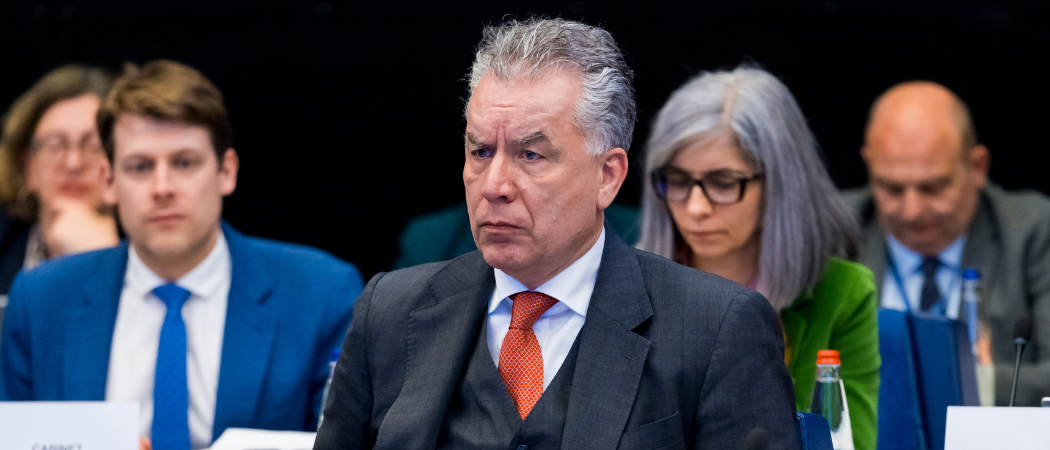
MEP Christian Ehler. Photo credits: Daina Le Lardic / European Union
The European Parliament’s research and industry committee is making moves towards creating a more bottom-up Horizon Europe, which would see the European Commission’s services have less influence on the design of specific research funding calls.
Christian Ehler, the Parliament’s lead rapporteur on the Horizon Europe draft legislation, is planning to introduce structures recommended by the Heitor report but passed over by the Commission.
The Heitor report suggested the creation two new councils with independent boards, one on industrial competitiveness and technology, and the other on societal challenges, to steer collaborative research.
Ehler, who sits with the European People’s Party, says such a system would give more freedom to researchers and innovators while still keeping a role for public servants to set broad funding directions. “The principle is that the public authorities set the priorities and that experts lead on the implementation,” he said.
Ehler made the comments in an exclusive written Q&A with Science|Business, which took place as his draft report on the Horizon Europe regulation was being prepared for publication by the Parliament’s committee on industry, research and energy (ITRE) on March 13.
Here we reproduce an edited version of that Q&A.
Q: What do you propose for the ECF-Horizon Europe joint governance? What are the gaps that the Commission left and how do you propose to fill them?
A: The Commission effectively left a gap for most of the governance of Pillar 2 in Horizon Europe [which covers collaborative research] by subjecting it to a completely unclear governance system for the European Competitiveness Fund (ECF). To fill this gap, I propose a governance system that shifts the implementation of Pillar 2 towards more agility and expertise. It would also improve the tight connection to the ECF by focusing it more on creating pathways from Horizon Europe to the ECF rather than giving in to the illusion that top-down planning of innovation policy is attainable or feasible.
For the general implementation of Pillar 2, i.e. all activities outside the partnerships, I propose that we follow the Heitor recommendation to set up two councils, but I further specify the implementation by proposing that these councils should oversee the work of expert teams and by specifying the role of work programmes. Concretely I am proposing an expert-led structure built around three core components.
First, work programmes set broad thematic research priorities, with multi-billion-euro budgets allocated per theme, jointly decided by the Commission and member states. These should cover three years, with the last year overlapping with the first year of the next work programme.
Second, two expert councils, one focused on European competitiveness, the other on global societal challenges, are appointed for five years to advise on priorities, oversee expert team appointments and be the sounding board for the experts when preparing the calls.
Third, expert teams of around four to six specialists, led by a senior expert from science or industry, are appointed for each thematic priority. They design calls for proposals, guide project selection through independent evaluators and actively manage the portfolio of funded projects. The expert guidance of the projects should also allow for consortia to more easily change the direction of a project if called for by developments in science and innovation.
By having work programmes that only decide on broad thematic priorities, have a general budget allocation and that cover three years, we can break away from the structural limitations that come from an annually adopted work programme that decides on the details of the calls. Under the model I propose, the experts can propose calls throughout the three-year period, which makes the system far more agile. The model aims to shift programme implementation away from bureaucratic processes centred around the Commission and member states towards an agile, expert-led implementation.
This does not mean giving up public control. The principle is that the public authorities set the priorities and that experts lead on the implementation. However, the Commission still has to adopt the calls and can also decide to alter them. If the Commission adopts the call as proposed by the experts, it can send it to the Programme Committee immediately. If the Commission decides to alter the text, the system would revert back to the current situation with comitology under the examination procedure. The Commission also remains in full control on the application of research security considerations in calls.
Q: What is the best way to ensure European Research Council and European Innovation Council gain more autonomy?
A: It starts with recognising that, while the autonomy of these councils might be a political risk for the Commission, it is also a key ingredient of their success. If we simply look at the national level, we know that the independence of research councils and disruptive innovation agencies is essential. That is, for example, why the German Bundestag had to adopt the Sprind Freedom Act to ensure that the Sprind agency could act autonomously. In this regard, the Commission is really the outlier in Europe with its detailed control over the allocation of research and innovation subsidies; at national level, ministries are at much more of a distance from these decisions.
So, we need to ensure that the ERC and EIC can act more autonomously. This starts by reversing the Commission’s proposal to undermine the independence of the ERC president and the EIC chair. They need longer terms and a clearly defined employment position inside the Commission apparatus. Both councils also need a dedicated implementation structure without undefined control mechanisms like the need to “follow Commission policies.” This proposal is an unnecessary attack from the Commission on the autonomy of the ERC; we cannot stand for this. Furthermore, we need the expertise of the leadership of these two councils so both the ERC Scientific Council and the EIC Board should be free in their communication with the outside world.
Q: Does the Parliament have the technical and legal capacity to fill the gaps left by those who drafted the proposals in the first place? Is the ITRE committee fully backing this?
A: The Parliament has to fill this gap with whatever means it has. I am under no illusion that our proposal is flawless, but at least it is more detailed and concrete than what the Commission proposed. It is more aligned with the realities of science and innovation in this new geopolitical context than the Commission proposal, which mostly seems like a reaction to the needs of its budget directorate general for greater budgetary control. So far, the EU Council also seems to be unable to deal with the question of whether this is really the best way to implement Horizon Europe. They have repaired technical gaps in the Commission proposal. While the ministers were quite critical in their latest [Council] meeting and some member states gave a presentation on priority setting and governance, no member state has made concrete proposals for an alternative in the same detail as I do in my report.
Regarding ITRE support, my proposal is in line with my own initiative report on the next Horizon Europe, which the Parliament adopted last year. In the report, the Parliament called for Horizon Europe to focus on a limited number of priorities as well as for an expanded space for bottom-up collaborative research. It also called for self-governance by the field to be the main principle for implementing Horizon Europe. Furthermore, the debates in ITRE so far have shown broad support for improving the tight connection between ECF and Horizon Europe, for more expert involvement in the implementation of Horizon Europe and for the independence of the ERC and EIC. This all seems to indicate that there will be broad support for this direction.
Q: How do you think this will land with the Commission?
A: We have had a very good working relationship with the Commission, and in particular with research Commissioner [Ekaterina] Zaharieva, throughout this procedure so far. The commissioner is very committed, clearly driving towards a simpler and more effective programme. The Commission has been providing us with the details of how it thinks about the implementation of its proposal. I expect that we will continue that interinstitutional cooperation on the [ITRE] draft report.
The situation is that the proposal of the Commission is not complete and that the Commission does not have a full plan for implementation yet. This creates space for an interinstitutional collaboration to develop a full programme. The draft report is our contribution to concrete debates on the implementation of Horizon Europe.
I could understand it if the proposals are a bit complex for the Commission, because it asks it to fundamentally change its role in the programme. It asks of the Commission to become more like national ministries overseeing national funding agencies. However, my expectation is that the EU institutions will work collegially together. Last term, we had a similar situation with the Net-Zero Industry Act. The Commission proposal was incomplete and this triggered a spirit of cooperation in the institutions that helped us to establish an act that could be implemented in a pragmatic way. I see a similar dynamic emerging here.
Q: What do you expect the member states will say? Have you tested the waters with science counsellors or research ministers?
I think the member states will be happy to engage with a concrete proposal. Happy to engage with a proposal on which they can ask questions and actually get answers. They will be critical of the details and will question the level of control they have. Particularly on the tight connection with the ECF we will have to engage with ministries that normally do not deal with research funding at all, often the ministries of finance. This will not be a simple conversation, but it will be constructive. I am convinced that the member states are more aware of the actual needs for change in the European funding landscape than the Commission.
Q: How did we end up here? The Commission seems to be plagued by internal conflicts that have delayed important work in these negotiations. Who is to blame? How do you think we could overcome this political impasse?
A: It is a public secret that the preparation of this proposal for Horizon Europe did not follow the normal approach. The proposal is also part of a much bigger reform of the European budget in general. Such big changes are complex and are never done perfectly. This again means that, more than ever, the institutions have to work together collegially to ensure that the legislation for all the programmes [in the next multiannual EU budget] is not only legally sound but also underpinned by a clear vision of what the implementation should look like. As co-legislators we have to give the Commission clear guidance, clear responsibilities and clear limitations. I do not think we are at a political impasse, but rather that we face a joint challenge to fill in the blanks.



 Receive the Funding Newswire [full access requires a subscription] each Tuesday, our Policy Bulletin each Thursday, and the fortnightly R&D Express, tracking reforms and investments in central and eastern Europe.
 A unique international forum for public research organisations and companies to connect their external engagement with strategic interests around their R&D system.