As Australia agrees to associate, questions remain over whether the programme will be genuinely international, or EU-first
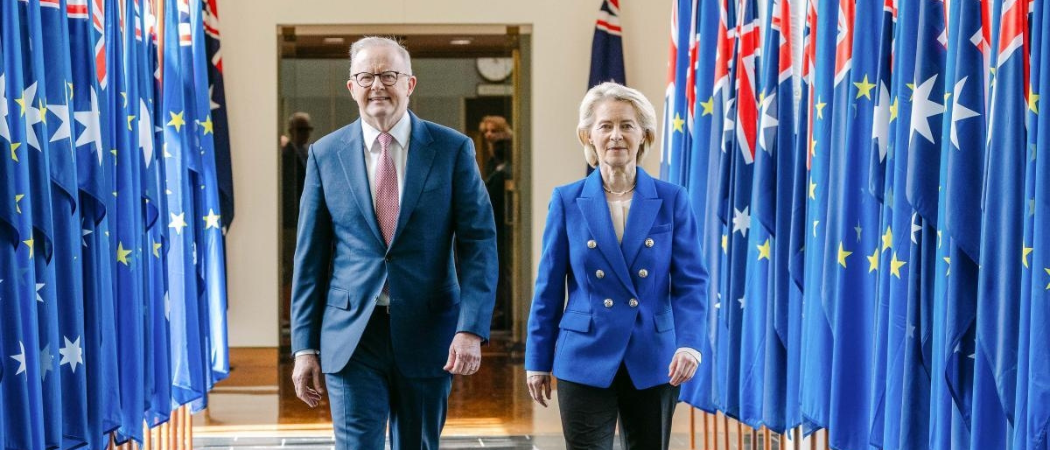
Anthony Albanese (left), prime minister of Australia, and Ursula von der Leyen (right), president of the European Commission, during her visit to Australia on March 24. Photo credits: Christophe Licoppe / European Union
Australia has agreed to associate to Horizon Europe, capping the global expansion of the EU’s €93.5 billion research and innovation programme.
A programme whose predecessors started in the 1980s as a way to link up scientists and companies across Europe is now arguably the world’s premier vehicle for cross-border research, having also brought in New Zealand, Canada, South Korea and Japan. India may also join in the near future.
With ever tenser geopolitics and outright war straining international academic ties, Horizon Europe’s expansion is a rare counter-weight to the splintering of global research.
Yet the current programme expires next year, and its successor is set to have a stronger focus on EU industrial and military strength, leaving the role in the programme of countries outside the bloc less clear.
“The EU faces a once-in-a-century opportunity to leverage a truly global and powerful research and innovation network,” said Andrea Renda, director of research at the Brussels-based Centre for European Policy Studies think tank. If India and Singapore joined too, the combined GDP and public R&D budgets of associated countries would slightly outweigh that of the EU. “This is an impressive prospect,” he said.
However, this “opportunity” could “easily be missed” if the EU “places excessive emphasis on research and innovation ‘made in the EU’ and on narrowly EU-centric strategic priorities,” said Renda, who is currently drafting a report on Horizon Europe’s international future.
Horizon Europe, which began in 2021, is the first EU research programme to offer association to democracies with strong science systems outside the European region. After some stops and starts, the European Commission has managed to seal association deals with almost all countries on its target list.
Association means that countries pay Brussels to join and, in return, their researchers can apply to grant calls on an equal footing to those from the EU, and receive money directly from the EU, making it much less of a bureaucratic hassle to participate in research consortia.
Australia still needs to formally negotiate the full terms of its association. But during a visit to Australia this week by Commission President Ursula von der Leyen, Canberra and Brussels presented it as a done deal.
“This is a great example of international research cooperation at a time when the world needs more constructive collaboration,” said Australia’s science minister Tim Ayres in a statement.
Complications
The announcement has been cheered by Australian universities, and Australian researchers are expected to have access to the programme from early 2027, according to the government.
However, 2027 will be the last year of the current programme. From 2028, the EU will begin a mooted €175 billion successor, the tenth Framework Programme (FP10), which will also be known as Horizon Europe. Asked whether Australia will associate to FP10 as well, a spokesperson for the Department of Industry, Science and Resources said the government would consider this in “due course.”
FP10, however, is set to change in several ways that could cause complications for non-EU associated countries.
For a start, under Commission proposals put out last July, some of the programme will be made to serve the goals of an overarching €409 billion European Competitiveness Fund, which aims to “accelerate strategic technologies in Europe” as the bloc frets about reliance on the US and China.
Exactly how the fund’s priorities will impact FP10 calls remains hazy. The Commission is still to spell out the details, and the worry is it could make the future research programme much more about EU goals, not global collaboration.
Dual use
Another sticking point could be military-related projects. Research Commissioner Ekaterina Zaharieva has said FP10 will be “dual use by default” but this risks creating a quagmire of exclusions, as the bloc will have to decide which non-EU countries are allowed to join sensitive, defence-related projects.
Complicating matters further, Australia and the UK are also members of AUKUS, a defence partnership with the US that involves working together on military technology. This issue has sharpened after the US threatened to seize the Danish territory of Greenland by force earlier this year.
Governance quandary
Then there’s the issue of FP10’s governance. Even as associated countries make an ever greater contribution to the programme’s budget, they don’t get a vote when deciding on work programmes, which set out grant calls. And EU countries alone decide whether to exclude those from outside the bloc from certain projects. Previously, the Commission has excluded Switzerland and the UK from sensitive quantum and space calls. In FP10, the worry is that exclusions could become ever more frequent.
Christian Ehler, the European Parliament’s rapporteur for FP10, earlier this month submitted amendments to the Commission’s proposals that would force it to publicly justify any exclusions. “Without predictability, the offer the Union makes by opening the programme for association by our international allies becomes meaningless,” the MEP, who sits with the European People’s Party group, said.
Money diverted
Another bugbear for associated countries is that the Commission can unilaterally reshuffle their budget contributions from one part of the programme to another.
In the current programme, the Commission is mulling using largely Swiss money to fund a biodiversity call and a newly created Scale Up Europe Fund, designed to boost start-ups, rather than using this cash for Marie Skłodowska-Curie Actions, which train networks of early-career researchers. Türkiye, a longstanding associated country, has hit out at the plans, as it fears it’s less likely to win money from the Scale Up Fund.
Related articles
- Research lobbies reject reassurances over Horizon Europe budget reshuffle
- Türkiye hits out at plan to divert Horizon Europe contributions to Scale Up fund
- Horizon Europe will be ‘dual use by default,’ Zaharieva says
This kind of bickering over the flow of funds to different priorities may only grow as the programme becomes more international. In his amendment, Ehler wants to bind the Commission’s hands so that associated country contributions “strictly follow” their participation levels in different parts of the programme.
Partial association
And despite the fanfare about the association of countries outside Europe, they are only joining part of Horizon Europe, so-called Pillar 2, which dishes out grants to consortia of researchers and companies.
The likes of Australia, Canada and South Korea remain excluded from hosting researchers with grants from the prestigious European Research Council (ERC), which gives out grants of up to €7 million to individuals. By contrast, EU neighbours such as the UK and Switzerland are allowed to host ERC grantees.
Making this exclusion more acute, plans for FP10 currently see the budget share of Pillar 2 shrink from 54% of the programme to 43.4%. Pillar 2 collaborative grants are also the most scrutinised part of the programme, with critics arguing they are spread too thinly across unmanageably big consortia, with evidence they do little to boost the revenue of collaborating companies. So in reality, under FP10, Australia and others would be associating to less than half the programme, and to a part that’s increasingly under fire.
One idea floating around in Brussels is to somehow combine EU and associated country’s research budgets into an ERC+, which would bring non-European states into the ERC orbit. But so far, this has not made it into any formal proposals.

Data woes
A final challenge is the flow of data. While Australian academics are generally very happy with the association announcement, the EU’s General Data Protection Regulation (GDPR) has seriously hindered the sharing of medical data essential for research, said Jane Andrews (right), an expert in inflammatory bowel and Crohn’s disease at Adeleide University.
GDPR rules had limited the integration of European patient data into two recent projects, she said. “A privacy concern is actually limiting approaches to solving complex medical and scientific problems,” she said.
Cautious optimism
Despite all these hurdles, there’s optimism in Australia and in other associated countries that Horizon can pave the way for a permanent boost to cross-border work.
New Zealand, the first non-European country to secure association, says it’s happy with the results so far after officially joining in 2023. It’s researchers can apply for domestic funding to cover the overhead costs of joining Horizon projects, and these applications have risen from 43 for projects starting in 2024, to 142 for projects starting in 2026, according to a spokesperson for the country’s Ministry of Business, Innovation and Employment, suggesting a steady ramping up of interest.
“New Zealand’s research sector remains keenly engaged with Horizon Europe,” said Hugo Bussell, the ministry’s international science partnerships manager.
However, the Commission’s official data portal shows less encouraging results. New Zealand’s participation in Pillar 2 grew from five projects signed in 2023 to 11 in 2024, suggesting an association boost, but dropped down to six projects last year.
Yet some successful projects have not yet been added in to the data, said Bussell, so it would be premature to judge 2025. The Commission did not respond to requests to clarify the data.
It is too early to judge the extent to which Australian association will boost collaboration, said Chennupati Jagadish, president of the Australian Academy of Science. “But experience from other associated countries suggests participation and engagement grows over time as researchers build partnerships and make use of new eligibility pathways,” he said.



 Receive the Funding Newswire [full access requires a subscription] each Tuesday, our Policy Bulletin each Thursday, and the fortnightly R&D Express, tracking reforms and investments in central and eastern Europe.
 A unique international forum for public research organisations and companies to connect their external engagement with strategic interests around their R&D system.