A leaked document shows plans to form a joint university association, promote research partnerships and attract Hungarian students to Russia
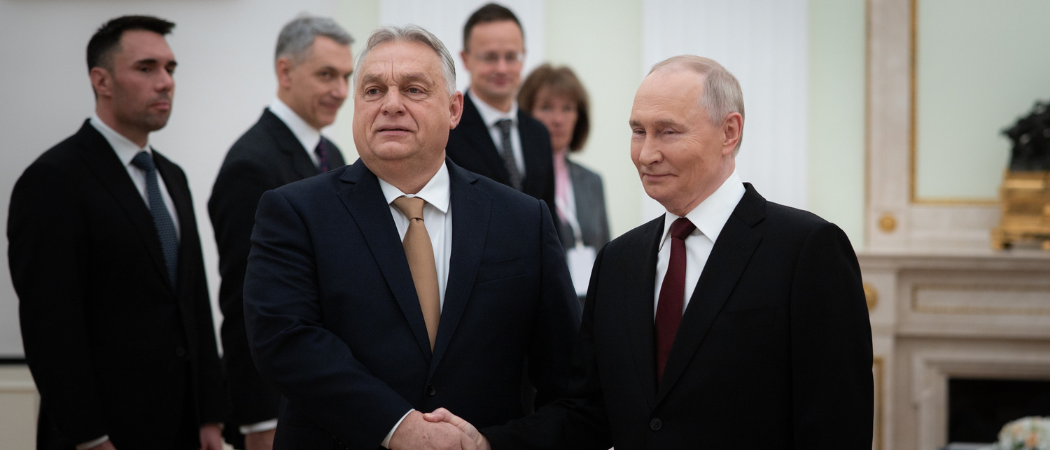
Meeting between Prime Minister Viktor Orbán and Russian President Vladimir Putin in the Moscow Kremlin on November 28, 2025. Photo credits: MTI
Hungary is planning a series of initiatives with Russia to create closer ties in academia and research, according to a leaked document first obtained by Politico.
This includes plans to form a rectors’ forum for both countries’ universities, establish a Russian-Hungarian university association by November this year, increase the attractiveness of Russian universities for Hungarian students and promote joint university research projects.
There are also plans to collaborate further on nuclear energy and nuclear medicine, including conducting joint research in this area. “Both sides support the exchange of information on innovative medicines with a view to their possible subsequent application in Russia and Hungary,” the document, seen by Science|Business, states.
This is in spite of the EU suspending cooperation with Russia on research and innovation following the country’s full-scale invasion of Ukraine in 2022. This ban relates to projects funded by the EU, for example through Horizon Europe or Erasmus+.
Separately, many EU governments made individual moves to cut scientific ties, followed by institutional networks or individual institutions. While large-scale scientific collaboration between the EU and Russia has all but ended since 2022, pockets of joint research activities remain.
The Hungary-Russia plans outlining the proposed increase in cooperation are set out in two documents. The first covers the proceedings of a meeting that took place in Moscow between Hungarian foreign minister Péter Szijjártó and Russian health minister Mikhail Murashko.
The second, added as an annex to the proceedings and dated 5 November 2025, comes from a “list of instructions” signed by Russian deputy prime minister Dmitry Chernyshenko on developing closer scientific and educational cooperation with Hungary.
That list mentions a request for a package of measures to assist Hungarian students in enrolling in Russian universities following an EU ban, introduced in 2023, that prevents 21 Hungarian universities from receiving Horizon Europe and Erasmus+ funds due to concerns their governance structures breach rule-of-law principles.
The list also includes a request to increase the number of Hungarian students allowed to study in Russia under the country’s quota rules, and to regularly inform Hungary of the possibility of grant support for talented foreign nationals who wish to study in Russia.
Further details on the rectors’ forum and joint university association, also called a consortium in the documents, are sparse.
Science|Business contacted the Hungarian government to ask about these plans but did not receive a response by time of publication.
Related articles
- Attacks on academic freedom are spreading to democracies, report shows
- Hungarian researchers push back against transfer of humanities institutes
Hungary is set to hold parliamentary elections this coming Sunday, April 12, with several polls suggesting opposition party Tisza, led by Péter Magyar, holds a significant lead over Viktor Orbán’s ruling party Fidesz.
Orbán, who has been in power since 2010, has created what he has described as an “illiberal democracy” in Hungary. His critics have accused him of eroding the independence of democratic institutions, including capturing the media and judiciary.
His impact on academic freedom has also been widely criticised. “Authorities have increasingly threatened the academic autonomy of well-established institutions, pulling support, interfering in their affairs and landing pro-government supporters in leading positions”, the EU’s 2025 Academic Freedom Monitor report states.



 Receive the Funding Newswire [full access requires a subscription] each Tuesday, our Policy Bulletin each Thursday, and the fortnightly R&D Express, tracking reforms and investments in central and eastern Europe.
 A unique international forum for public research organisations and companies to connect their external engagement with strategic interests around their R&D system.