The presidents of two leading European technological universities share how AI is transforming their teaching and research activities

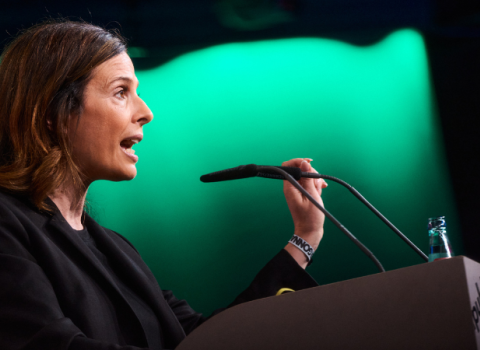
Thierry Coulhon, president of IP Paris, and Anna Fontcuberta i Morral, EPFL president. Photo credits: IP Paris and EPFL
The widespread use of artificial intelligence in universities has raised existential questions about the future of transmitting and evaluating knowledge. At the same time, universities are increasingly thinking about how they can harness the benefits of these new tools.
The École Polytechnique Fédérale de Lausanne (EPFL) and Institut Polytechnique de Paris (IP Paris) are two leading technological universities that have chosen to embrace AI and want to help students and researchers exploit it in a responsible way.
“AI has completely transformed how we teach, how we think, how we train our engineers, how we do science and how we think our impact on society,” said EPFL president Anna Fontcuberta i Morral.
Thierry Coulhon, president of IP Paris, agrees that AI will upend how universities elaborate and transmit knowledge. He summarises his approach as one of “vigilance and optimism.” The university leaders spoke to Science|Business on the sidelines of the Adopt AI Summit in Paris on November 25.
“Every student graduating from IP Paris will have some exposure to AI,” Coulhon said. That’s in addition to master’s and PhD programmes developed for specialists in AI, and AI in specific fields. The university already counts among its alumni the likes of Arthur Mensch, co-founder of Mistral AI.
EPFL is experimenting with how AI can support learning in fields such as physics and mathematics and is testing its effectiveness in exam grading. At the same time, it is rethinking teaching to prioritise critical thinking and ethics.
Universities across Europe are facing similar challenges when it comes to AI and are coming together to share insights. Last year, the European University Association held a conference on the topic, while in 2023 the Russell Group of UK universities adopted a set of principles on generative AI in education.
Collaborative R&D
AI is also changing how research is performed. “Even for experimental science that used to be very serial, now, you can do things in parallel,” said Fontcuberta i Morral. “This is a complete transformation of how we think about science.”
For instance, the Swiss Cat+ project, a collaboration between EPFL and ETH Zurich, uses robotics and machine learning to accelerate the discovery of new catalysts.
The same two universities collaborated as part of the Swiss AI initiative to develop Apertus, an open-source large language model trained on the Alps supercomputer at the Swiss National Supercomputing Centre, a significant milestone in the development of open AI models.
Many observers believe Europe has already lost the race to develop large language models, which are trained to recognise and generate vast quantities of text, and should instead focus on building sector-specific applications of AI that will drive industrial adoption.
There’s little doubt that specialised AI systems will be needed, but when it comes to large language models, according to Fontcuberta i Morral, “It’s never too late.”
Apertus, which is trained on 1,000 languages, is an example of how Europe can develop tools that are adapted to its cultural diversity and can become less dependent on models that aren’t as open, she said. One of Switzerland’s hopes for Apertus is that it will ensure future educational AI tools are built on transparent and trustworthy foundations.
Related articles:
- France leads push for widespread adoption of European AI
- State of AI 2025: five key charts for Europeans
But European countries must work together if they want to keep up with the pace of innovation and not be left behind. “We were able to build [Alps] with 10,000 graphics processing units. The next generation is going to be 100, maybe 1,000 times larger. There is not one country that can pay for this,” Fontcuberta i Morral said.
Meanwhile, EPFL collaborates with IP Paris and four other universities within the EuroTech Universities Alliance on topics including AI, and now is the moment to work even more closely together, she said. “AI evolves very fast, and only by doing it together will we really do something exceptional and put Europe at the top.”
That will also require the agility to keep up with rapid technological evolution. Fontcuberta i Morral compared AI to the discovery of fire. “[Fire] completely changed humanity for several reasons. At the same time, it was dangerous, but we needed it. I think [AI] is similar, and we’re still playing with fire.”
IP Paris is also working with local research institutions. Together with HEC Paris business school, it has launched Hi! Paris, an interdisciplinary and inter-institutional centre combining education, research and innovation. Hi! Paris was awarded €70 million under the France 2030 innovation programme, which selected nine AI clusters to receive public funding.
“For us, partnerships are not an auxiliary strategy, they’re the name of the game,” said Coulhon. New international partnerships are also being formed around AI. That includes an agreement with Harvard which saw IP Paris oversee a special issue of the Harvard Data Science Review dedicated to trustworthy AI. “Two years earlier, I would not have dreamt of having a partnership with Harvard on this,” he said.
In July, IP Paris, HEC Paris and Université Paris-Saclay announced the Entente CordIAle partnership with Oxford and Cambridge, which will see cross-Channel collaboration on AI research, training and innovation. For Coulhon, this is a “superb opportunity,” but it’s just the start. “I would like partnerships to be built on other topics, such as climate change or energy,” he said.
Public-private collaboration
The private sector is also involved, with TotalEnergies, L’Oréal and Capgemini among the corporate donors to Hi! Paris. And IP Paris is increasingly reaching out to new types of private partners.
“A few years back, the big French companies would wait outside our schools until the students came out. Now, we want to discuss not only with big French companies, but with start-ups and companies that are not French,” Coulhon said. “We also want innovation to come out directly from the labs.”
The public and private sectors are increasingly intertwined, with large tech companies and start-ups looking to advance frontier research in AI. “It’s the first time that fundamental research is done at this scale inside companies,” Coulhon said.
Meanwhile, researchers and professors are leaving to join private companies in larger numbers than ever, Fontcuberta i Morral said. Some students are even starting companies and doing their master’s thesis in their own start-up, something EPFL supports. “We see people having big investments in their company before they even graduate,” she said.
AI is blurring the lines between public and private, and between civilian and military technologies. AI researchers are among those that stand to benefit from plans to open up the EU’s Horizon Europe funding programme to dual-use projects, and Coulhon believes universities have an opportunity to be “at the heart of the transformation.”
IP Paris is better placed than most to take advantage. It is an alliance of six engineering schools, two of which are linked with the Ministry of Defence. The ministry has set up an agency for defence AI, part of which is located on the IP Paris campus. “We must build even better these connections,” Coulhon said.
Like Fontcuberta i Morral, he is optimistic about Europe’s chances of staying in the race. “We have what it takes. It’s a matter of doing it,” he said.

 Receive the Funding Newswire [full access requires a subscription] each Tuesday, our Policy Bulletin each Thursday, and the fortnightly R&D Express, tracking reforms and investments in central and eastern Europe.
 A unique international forum for public research organisations and companies to connect their external engagement with strategic interests around their R&D system.