Europe 2031 scenario offers stark message about consequences of European inaction on AI
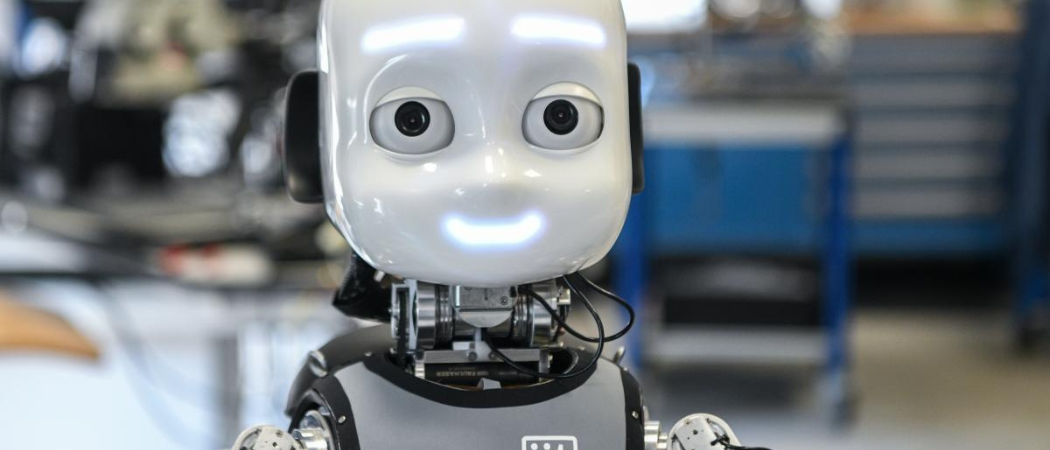
Robotics is one area where Europe can still lead. Photo credits: Piero Cruciatti / European Union
Europe must be willing to accept “ugly trade-offs” and focus on building leverage to avoid being left behind by the AI revolution, rather than betting the house on moonshot projects that might not pay off, according to a group of European AI experts.
“The current trajectory of AI calls for the most ambitious political agenda in the history of post-war Europe,” begins Europe 2031, an 18,000-word warning about the cost of inaction, published on June 11.
Written by a small group of AI researchers, representatives from think tanks and investors, the narrative centres on a fictional character working at the European Commission who struggles to convince her bosses to take AI more seriously. In novelistic prose, it imagines what could happen over the next five years if Europe doesn’t rise to the challenges it’s currently facing.
The goal is to engage people on an emotional level and to “wake up the European continent,” said co-author Daan Juijn, director of research at AI-focused think tank Arq Foundation. The authors wanted to show that “we are very unprepared, and we need a lot of courage and political will to turn the ship around in time,” Juijn told Science|Business.
It comes just a week after the Commission presented its tech sovereignty package, which includes a proposal for a Cloud and AI Development Act aiming to triple the EU’s data centre capacity within the next five to seven years. Data centres provide much of the computing power that’s needed for training and running AI systems.
Juijn welcomed the proposal’s focus on streamlined permitting for data centres, but fears it’s “too little, too late.” The Commission says expanding data centre capacity will require €200 billion, mostly from the private sector, by 2036. Meanwhile, the large-scale US cloud providers, known as hyperscalers, “are spending the same money in one quarter in 2026” on AI data centres, Juijn said.
Trade-offs
Building leverage will require the bloc to mobilise public and private capital “at a scale Europe has not attempted in peacetime,” the authors write, as well as to pick its battles. Funds should be focused on upstream and downstream technologies, including energy, semiconductors, data centres and robotics.
Juijn does believe the EU should continue to support ambitious moonshot projects. For example, world models that are meant to understand the physical environment, pioneered by French researcher Yann LeCun, could play an important role in helping Europe to compete in robotics and industrial AI. But Europe should not bet everything on these ideas, he said.
“I think it is worthwhile to invest in novel paradigms that may have a shot at competing with the companies that are building today's frontier large language models, but at this stage, Europe is so far behind that I think we should be operating under the assumption that, by default, we have lost that competition.”
On the other hand, Europe can become an important player when it comes to infrastructure and downstream applications of AI, he said.
In an example of the trade-offs they are calling for, the Europe 2031 authors say Europe should partner with US hyperscalers to build data centre capacity, in return for access and sovereignty guarantees.
“Ideally, we want all these companies that build data centres to be European owned, and ideally, we’d want all these data centres to run on sustainable power,” Juijn said. “I think, realistically speaking, that is just not feasible anymore.”
Europe should try to build a European cloud sector, “but that will take time, and we need an intermediary solution,” he added.
Related articles
- Commission announces plans for EU tech sovereignty amid fears of competitiveness hit
- AI-driven meteorology becomes a strategic issue for Europe
- AI in science: Europe seeks to balance sovereignty with progress
However, it’s still not clear how non-European providers would be able to guarantee the sovereignty of European data. And that’s before mentioning the growing environmental and public health concerns surrounding the proliferation of data centres, which consume significant amounts of water and electricity.
So-called sovereign cloud offerings from US companies “do not address the core sovereignty issues allowing for the extraterritorial reach of third-country laws and the possible degradation or disruption of the service,” the Commission notes in its Cloud and AI Development Act proposal.
Nevertheless, the proposal leaves the door open for US cloud providers to continue expanding in Europe. It would create four tiers of cloud and AI sovereignty based on the perceived level of risk. The more sensitive the public sector use case, the higher the required level of sovereignty.
Vassal state
The Europe 2031 authors are bullish about the transformative potential of AI, dismissing doubts about the technology’s profitability. “AI's impact will match or exceed that of the industrial revolution, but it will arrive in years rather than decades,” they say.
However, they paint an incredibly bleak picture of Europe’s future. This sees the continent trapped between the US, which will lead in cognitive AI, and China, which will dominate physical AI, with both superpowers using this leverage to exert their influence, including over Europe’s main asset in the AI race: semiconductor equipment company ASML.
In this scenario, the US government rations Europe’s access to compute, while its AI companies buy out European carmakers to convert their plants into factories producing robots. AI creates a labour shock, but Europe is unable to capture the economic value of the technology, which ultimately leads to another eurozone crisis and rising anti-EU sentiment.
The authors acknowledge that AI comes with serious risks, ranging from bioweapons to a loss of control over AI systems, but for the exercise, they chose to focus exclusively on European sovereignty. “We believe Europe must preserve its agency before it can do anything else,” they write in an explainer published with the scenario.
That also goes for the preservation of European values. The EU’s AI Act introduced a code of practice for developers of general-purpose AI models, but without leverage, Europe will struggle to enforce it, Juijn said.
“The AI Act is basically premised on the idea that US providers will not want to lose out on the European market,” he said. “But if compute becomes very scarce, which we estimate it will over the next couple of years, then there is very little incentive for US AI providers to keep serving the European audience.”
One way to build leverage and secure access to frontier AI or safer and more reliable models, the authors suggest, is to form a “middle-power coalition,” with countries including the Netherlands, Germany and France partnering with the likes of the UK, Canada, Japan and South Korea.
They also recommend labour reform based on the Danish “flexicurity” model, which would involve making it easier for companies to let go of staff while offering generous unemployment benefits and retraining programmes.



 Receive the Funding Newswire [full access requires a subscription] each Tuesday, our Policy Bulletin each Thursday, and the fortnightly R&D Express, tracking reforms and investments in central and eastern Europe.
 A unique international forum for public research organisations and companies to connect their external engagement with strategic interests around their R&D system.