At the annual Re:publica conference in Berlin, delegates debated the “authoritarian stack,” migrant founders, copyright reform and civic social media
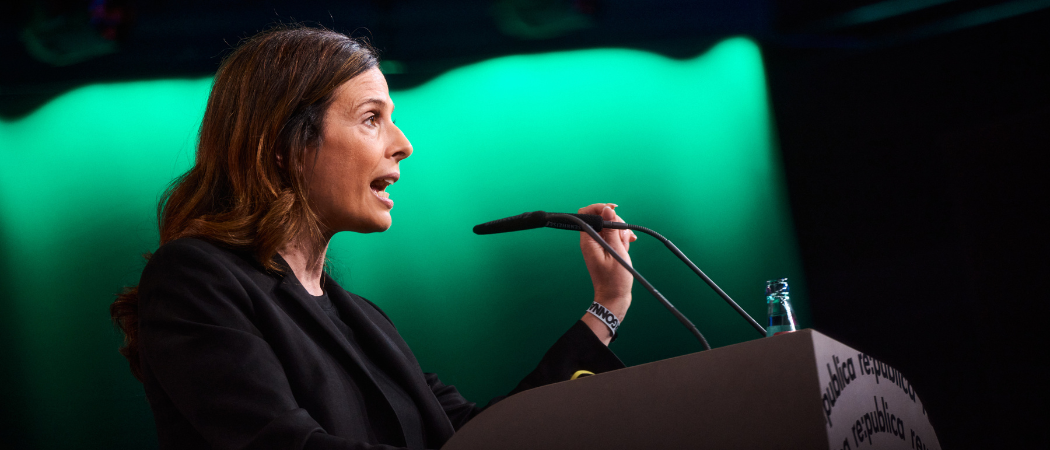
Francesca Bria, a board member of the European Innovation Council, warns of the ‘authoritarian stack’. Photo credits: Stefanie Loos/re:publica
This week, tens of thousands of tech policy people descended on Berlin for three days of discussion and debate at Re:publica, one of the continent’s biggest jamborees for digital ideas. This year, the mood at the left-leaning event was dark, but defiant.
“Four minutes into any small talk, conversations now inherently turn to war, antisemitism, [far right party] Alternative für Deutschland, online hate, Trump, climate change or the uptick in openly stated racism,” the event’s organisers said.
However, the conference aims to offer new visions for an open internet, “digital justice.” and technology for “everyone” rather than the “powerful few.”
One key theme was the need for Europe to free itself from what’s dubbed the “authoritarian stack,” digital tools from cloud services to artificial intelligence controlled by far-right US tech elites who have increasingly co-opted the government in Washington DC.
“They're coming for Europe, the last continent built on democracy and social rights,” Francesca Bria, a board member of the European Innovation Council, told delegates on May 19.
For Europe, “the answer is not regulation alone, it is to decouple from tech oligarchs and to build our independence, an online democratic liberation movement,” she said.
Last year, Bria, a professor of innovation at University College London, helped launch a project that maps the links between US politicians such as JD Vance, financiers including Marc Andreessen, and technology firm leaders such as Palantir chief executive Alex Karp.
Europe is falling into dependence on this elite, Bria said. The UK has awarded Palantir health and defence contracts worth hundreds of millions of pounds, for example. Meanwhile, it was revealed in January that the US company, co-founded by tech mogul and Donald Trump ally Peter Thiel, had hired four former UK defence officials.
Germany had also bought Palantir systems for military intelligence and police forces, Bria said, but German politicians were increasingly speaking out against such deals. “Here in Germany I think the future of Europe will be decided,” she said.
But European unity was cracking, she went on. Norway and Sweden have recently joined Pax Silica, a Washington-led effort to secure the AI supply chain, to which the EU was not invited. Europe is being “picked off one member state at a time,” said Bria.
Her final call for a “Europe independence moment” received a standing ovation from the crowd. But after she left the stage, a big screen flashed up the conference’s sponsors. Among them was Meta.
Newcomer tech
Not all debates were quite so dark. One focused on the vast, but still largely untapped, potential of European start-up founders with a migrant background.
“For decades, we have labelled migration as the problem to be solved,” said Ramona Hinkelmann, the co-founder of Singa Deutschland, the German branch of an organisation that originated in Paris in 2012 and tries to help immigrants become entrepreneurs. “But what if, in fact, they are part of the solution?”
There are all kinds of structural barriers that could be dismantled, she said. It takes Germany an average of 611 days to recognise a foreign degree. Less than 2% of venture capital funding in Germany goes to founders with a migrant background, despite nearly one in five people in the country having moved there.
Singa’s aim is not merely to smooth over bureaucratic hurdles. It’s also to make immigrant founders feel genuinely included as a “legitimate participant in our economy” so they waste less time and energy on what Hinkelmann calls “impression management.”
“When founders don't feel they belong, they spend their best cognitive capacity trying to look German enough,” she said.
Copyright reform
There were also calls for the EU to alter copyright laws to allow citizens more freedom to modify, maintain or improve products, including software, without permission from the manufacturer.
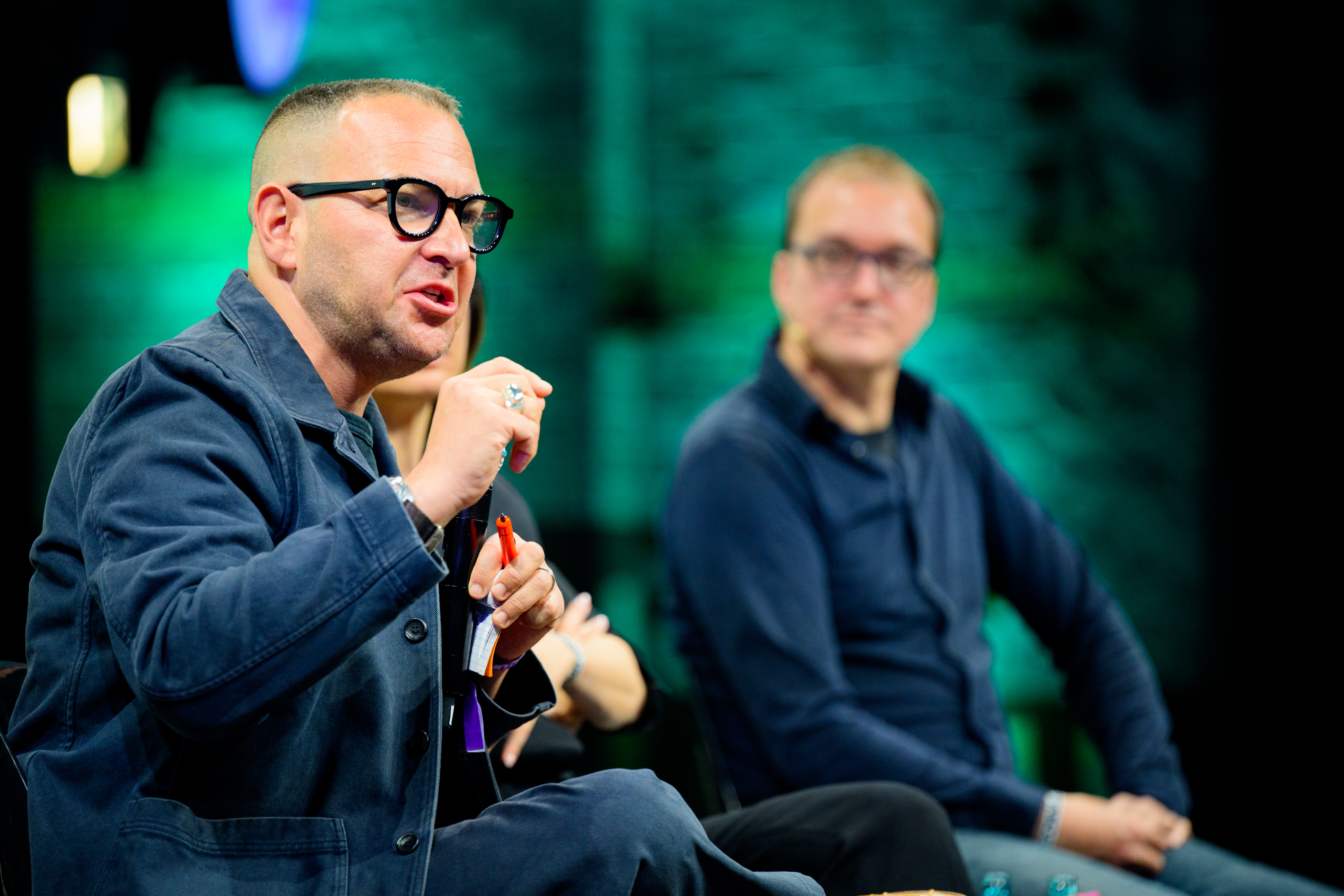
Currently, copyright laws prevent such tinkering, locking consumers into expensive, proprietary app stores, or giving manufacturers a lucrative monopoly when spare parts or repairs are needed, the technology writer Cory Doctorow (left) has argued.
For example, the current “epidemic” of ransomware is caused by the “routine use of opaque, non-auditable, non-transparent, non-maintainable digital goods by our structurally important firms and our government agencies,” Doctorow told the conference.
Doctorow, who coined the term enshitification to describe the process by which digital platforms lock in then exploit their users, said that the EU had an opportunity to reform copyright law in its mooted Digital Fairness Act, expected to be proposed by the European Commission later this year. “We have a directive that's in the station now that we can catch,” he said.
New social media business models
Delegates also heard from an initiative in the Netherlands to help public organisations such as libraries or universities set up their own social networks.
“If you want to reach your audiences online, you almost have to make use of big tech platforms, and public values go out of the window,” said Jantien Borsboom, director of PublicSpaces, an umbrella body of Dutch public organisations. “This is a big problem, and we're trying to solve that.”
One model to emerge from the Netherlands is PubHubs, a network of community chatrooms run, for example, by schools, patient associations or local government. They are free from advertising, don’t profile users, offer identify verification and avoid social media mechanisms that could keep users “trapped in rabbit holes.”
“People with anorexia, people with depression, they want to talk to each other,” said Pepijn Lemmens, a product owner at PublicSpaces. But if this happens over a platform such as Facebook, the risk is these users “get advertising for dietary pills or something like that.”
Related articles
- Trio of reports say the EU is betting too heavily on generative AI
- The EU urgently needs technological autonomy from the US, MEPs say
- The EU’s AI gigafactories need a rethink, says industry
The problem is funding. Without personalised advertising revenue, public social platforms need another way to sustain themselves. Crowdfunding, non-targeted advertising, freemium models and direct funding by public bodies were all discussed as options.
Public broadcasters can also contribute. During a workshop discussion, one participant suggested Europe set up a new wave of public digital bodies, funded by license fees, just as it had set up public radio and television stations after the Second World War.
How useful is AI?
One big question that hung over Re:publica was the question of AI. Will large language models (LLMs) transform jobs and the economy, or are they an overblown example of tech hype?
Bärbel Bas, Germany’s federal minister for labour and social affairs, said that AI would transform the country’s entire job market. “The coming years will be crucial,” she told the audience.
Bas, a social democrat, isn’t uncritical of AI. She defended the EU’s AI Act, and said the technology “must be safe and transparent.” But she likened the technology to the coming of electricity, which required a big, controversial build out of infrastructure.
However, others at the conference are much more sceptical of LLM capabilities and financial sustainability.
“No one knows how anyone's going to make money off of AI,” said Doctorow. “They spent $1.4 trillion so far, they make $50 billion a year, and they turn over the assets every two and a half years. Nothing has ever lost as much money as AI. Dutch tulips are a good investment compared to AI.”


 Receive the Funding Newswire [full access requires a subscription] each Tuesday, our Policy Bulletin each Thursday, and the fortnightly R&D Express, tracking reforms and investments in central and eastern Europe.
 A unique international forum for public research organisations and companies to connect their external engagement with strategic interests around their R&D system.