After a year of Trump, a former US diplomat suggests what the EU can do to bring American science back from the brink
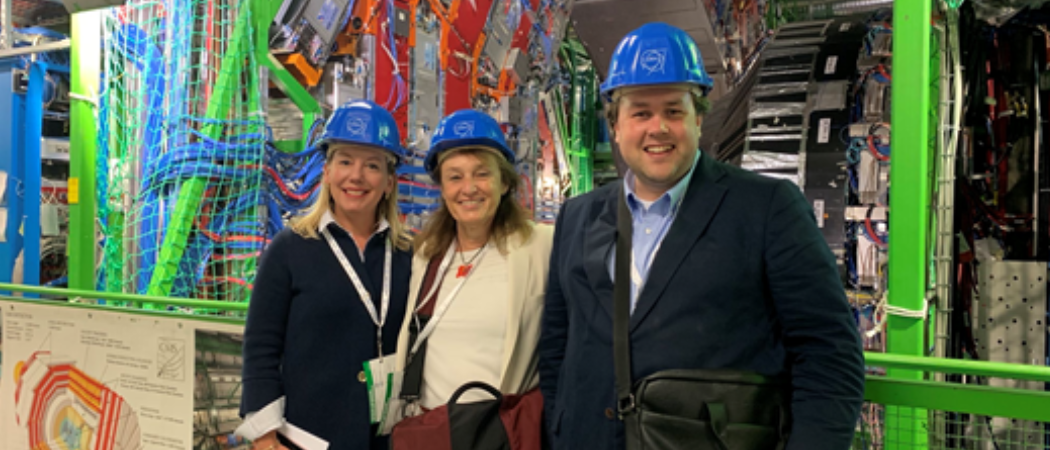
Photo credits: Former US State Department aide Cole Donovan, with colleagues, visiting the CERN laboratory near Geneva in 2019.
About a decade ago, when I was the US Department of State’s primary action officer covering the US-EU science and technology relationship, I briefed my boss on the Global Research Area proposed by then-research Commissioner Carlos Moedas. The briefing suggested that the European Commission was preparing to take a larger and more assertive role in the development of international science policy. Ten years later, that is exactly what is happening, and the US should take heed.
The vision for the Global Research Area was one “where researchers and innovators are able to work together smoothly with colleagues worldwide and where researchers, scientific knowledge and technology circulate as freely as possible.” I noted several factors weighing in Europe’s favour: the increasing concentration of research infrastructures in Europe, its position as home to the world’s leading scientific publishers, and a willingness to use the EU’s regulatory processes to define standards for research conduct, particularly through its data-protection regulation. Few outside our office appreciated the significance of this transformation.
Today, though the language has changed, the basic idea of Europe leading a global research area is real. The multi-step process Moedas described is manifest in the expansion today of formal membership, or association, in the €93.5 billion Horizon Europe programme to Japan, Canada, New Zealand and other high-income countries. The programme also supports collaboration with scores of middle- and low-income countries. Even the UK, despite Brexit, is back in the Horizon club. Of course, there are problems: the initial funding for some new partners is relatively small, bureaucracy continues to be a worry, and technological protectionism is a rising issue in the EU as elsewhere.
But the direction of travel is clear: countries whose representatives once shared US concerns, including my own, about association’s terms have come to appreciate the value proposition of joining what is now the world’s largest transnational research funding mechanism.
The US “wrecking ball”
The US has, on the other hand, “demolish[ed] its scientific leadership with a wrecking ball,” as one senior Commission official recently put it. It is tempting to attribute this primarily to two Trump administrations. Giving in to such temptations is incomplete. While the current administration has made unprecedented cuts to the US science and technology ecosystem that will take decades to repair, previous missteps in US policies toward semiconductors, weapons systems, and clean energy unnecessarily antagonised our closest partners, even when it was more important than ever that we work to rebuild trust. Frequently it was not Russia or China, but the US that failed to deliver on its international obligations to large scientific endeavours. For example, in 2023 the High Energy Physics Advisory Panel, which advises the government in one of the most globally-linked fields of research, blamed the loss of the US’s preferred partner status on decades of “unilateral decisions [. . .] inadequately communicated between US decision makers and international partners.” We have long had difficulty acting on our international scientific aspirations due to political factors and budget apparatuses that incentivise programme cuts over sustained commitment.
Related articles
- US withdraws from multiple global research and technology organisations
- US is ‘demolishing its scientific leadership with a wrecking ball,’ says chief EU research diplomat
By 2021, China was positioned to overtake the US as a destination for scientific talent. Today, its scientific and engineering juggernaut, fuelled by enormous investments and scientific great works, is on track to replace US pre-eminence in new technology development. But pre-eminence does not inherently translate into leadership. Governments and scientists, alike, are familiar with Beijing's authoritarian approach and are reacting accordingly. As a bloc, the now 50 Horizon Europe countries have significantly greater multilateral voting power than the EU or NATO. The EU has already started to bring China to the table, and this leverage is amplified when joined by other members of the bloc.
After 40 years as the world’s primary superpower, the US is used to being able to will preferred outcomes into existence without considering global consequences. But science is inherently a global undertaking. Disharmony is likely to damage both US and EU efforts to improve scientific practice, weaken the global research ecosystem, and undermine our ability to deliver positive outcomes for people. While the current state of the transatlantic government-to-government relationship is poor, there is a significant opportunity to reach out to civil society and start laying the groundwork for a better future.
How Europe can help
Though currently unimaginable, there is a future where the US could be ready to join the next EU research initiative, also called Horizon Europe, as an associated country like Japan or the UK today. Foreign policy think tanks in Washington frequently produce papers dreaming of building global technology alliances in an era of geopolitical competition. I believe, however, that there is no need for the US to recreate what the EU has already built. The attractiveness of such an alliance, paired with a growing willingness to reform, could offer an important carrot to a country and scientific community that wants to maintain international relevance. These aspirations must be reconciled with fundamental governance challenges and the need to rebuild trust.
To do this, EU outreach to US scientific and foreign policy influencers outside government should begin now. The Commission should also reach beyond natural scientific counterparts to engage communities focused on budgets, national security and government capacity, all parts of the US political ecosystem that are essential to such ambitious undertakings. Outreach should articulate the consequences of US unilateralism, legal pedantry and the need to rebuild trust with our closest partners. Even if formal Horizon negotiations fail or don't take place, the discussions will help Americans understand what’s needed to regain the world’s trust. In short, the effort would have been worth it.
In the US, our earlier aspiration was to lead the world not by the example of our power, but rather by the power of our example. Falling short, the US is now in a different position. European science can help. After all, it was science that, after the shock of Hiroshima and Nagasaki, led to one of the world’s most successful collaborations, at the CERN high-energy lab outside Geneva. In a world descending into madness, Horizon Europe’s success offers us a sense of possibility and hope extending from a truly global research area.
Cole Donovan is an associate director at the Federation of American Scientists. He worked previously in the White House Office of Science and Technology Policy, the National Oceanographic and Atmospheric Administration, the National Academies of Sciences, Engineering, and Medicine, and the State Department.


 Receive the Funding Newswire [full access requires a subscription] each Tuesday, our Policy Bulletin each Thursday, and the fortnightly R&D Express, tracking reforms and investments in central and eastern Europe.
 A unique international forum for public research organisations and companies to connect their external engagement with strategic interests around their R&D system.