Gdańsk declaration sets out infrastructure, brain drain and grant office measures. But Ukraine is far short of R&D spending targets
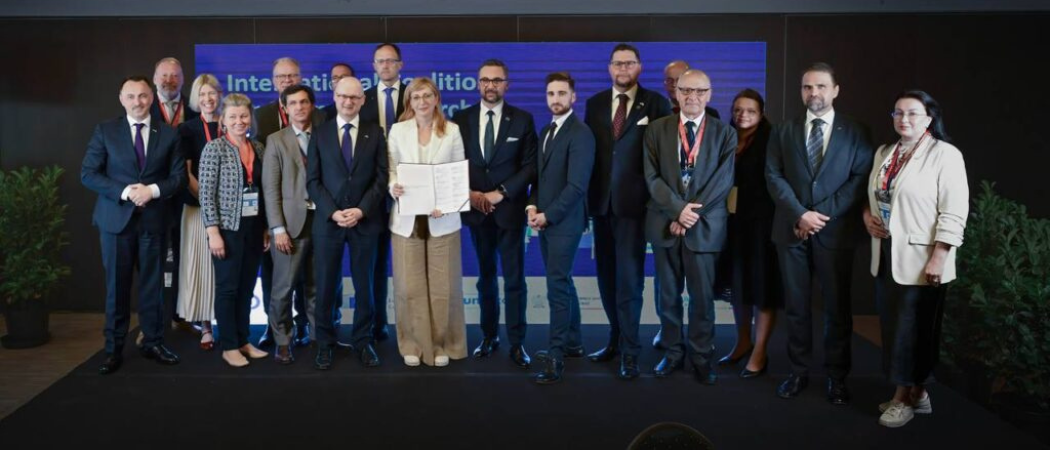
Research Commissioner Ekaterina Zaharieva presents the Gdańsk declaration alongside representatives from European research ministries. Photo credits: National Research Foundation of Ukraine
European countries have hammered out a new agreement setting out how the continent will help Ukraine’s battered science and innovation system to emerge stronger from the country’s war with Russia.
Since Russia’s full-scale invasion of the country in 2022, there have been numerous deals and assistance projects to help Ukrainian science. But this is the first multilateral deal specifically focused on science and innovation, said Olga Polotska, executive director of the National Research Foundation of Ukraine, who was involved in drafting the declaration at the end of June. It was released on July 2.
Polotska hopes it won’t just remain on paper. “Many European governments are involved,” she said.
The war has hammered Ukrainian research, as Russian attacks have destroyed university buildings, funding has been diverted to defence and many academics have left the country.
The budget of the National Academy of Sciences of Ukraine, a countrywide network of institutes, suffered a 48% funding cut between 2021 and 2023, one analysis found. Meanwhile, the number of scholars in the country dropped by 20% in 2022, as some academics fled abroad. More than 1,500 have joined the military and 70 have been killed.
On the other hand, Ukraine is now one of the most innovative countries in the world when it comes to drone and other defence equipment. Through quicker, smarter invention, it’s managed to match the much larger population and industrial base of Russia on the battlefield.
But the rest of the country’s R&D system is starved of support. One of the most tangible targets in the declaration is to “support efforts aimed at enabling” Ukraine to spend 3% of its GDP on R&D, mirroring a longstanding, and long-missed, EU-wide benchmark. The idea is that Ukraine needs to spend more to better fit into the wider European research area.
“This level has never been reached,” Polotska said. “This is an ambitious goal.” Even before 2022, Ukrainian spending had declined from 1.2% in 1997, when data starts, to 0.38%, according to the Organisation for Economic Co-operation and Development. It now sits at 0.37%.
The EU average is 2.1%, although some countries, such as Malta, Bulgaria, Romania and Latvia, also spend less than 1%.
Grant offices
Another priority, according to the declaration, is helping Ukrainian universities manage grants, so that they can win and coordinate EU research consortia as part of the bloc’s Horizon Europe research programme.
European countries will step up efforts “to develop partnerships with Ukrainian research organisations, to strengthen their capacities to participate in international research consortia,” the statement says.
Just a handful of Ukrainian universities have offices that can handle complex EU grants, Polotska said. “This is a huge problem in Ukraine.”
Related articles:
- European leaders cobble together international coalition for Ukrainian science
- Ukraine’s research and innovation community eyes a better future
- How defence start-ups can sell to the Ukrainian military
The declaration also prioritises allowing Ukrainian researchers access to European scientific infrastructure. “That’s a challenge,” said Polotska. While some machines do offer free access, “this is not systematic.”
There’s also the question of how Ukraine’s scientific diaspora can help the country. Female researchers in particular fled the country after 2022 and, initially, Europe focused on short-term grants and positions to give them a form of professional shelter.
However, the discussion has now moved on to how Europe can help these diaspora researchers maintain links with Ukraine. The declaration says that Europe needs to keep supporting these “networks and partnerships.”
“We ask for their expertise,” said Polotska. Ukrainian diaspora scientists have been useful in striking up partnerships between Ukrainian universities and counterparts in the rest of Europe. “That works.”
It’s an open question, however, whether they will return to the country. “We want every Ukrainian to come back, but that would be naïve,” she said.
Many female academics fled with their children at the beginning of the full-scale invasion, and their offspring have often now put down school roots elsewhere, she added.



 Receive the Funding Newswire [full access requires a subscription] each Tuesday, our Policy Bulletin each Thursday, and the fortnightly R&D Express, tracking reforms and investments in central and eastern Europe.
 A unique international forum for public research organisations and companies to connect their external engagement with strategic interests around their R&D system.