The European Commission is playing with words. Its initiatives fall far short of what is needed

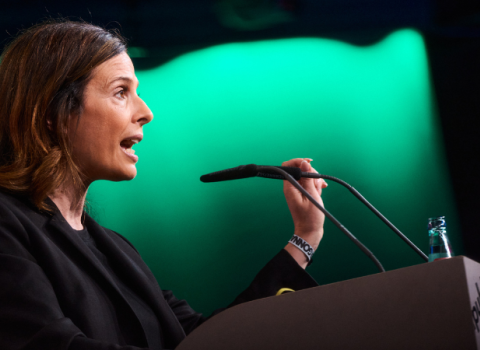
Holger Hoos (left) and Morten Irgens (right) are members of the board of directors of CAIRNE, the Confederation of Laboratories for Artificial Intelligence Research in Europe. Photo: Elbmotion / Humboldt Foundation and Kristiania / Jonatan Quintero
For nearly ten years, thousands of artificial intelligence scientists and technologists across Europe have been calling for a “CERN for AI.” The idea provides a clear way to strengthen Europe’s ability to take control of a key technology of our time and shape its own future. It also recognises that when 12 European nations established CERN, officially the European Organization for Nuclear Research, in 1954, they set it up for success, giving it autonomy, longevity and trust. Trust in science and scientists. The European Commission has agreed Europe needs such a body for AI, and claims to have delivered it in recent announcements. But in reality, it has not established anything resembling a CERN for AI.
When CERN was established, Europe had emerged from World War Two as a ravaged continent. One of the many challenges European nations faced was a devastating drain of talent: their brightest minds were leaving for the US.
A main topic of the time was, of course, the atomic revolution. The giants of that field, outstanding scientists such as Albert Einstein, Niels Bohr and Erwin Schrödinger, to name a few, were largely European and had done their groundbreaking work in Europe. However, the fruits of that work were not harvested in Europe, and scientists, being sensible sorts, naturally gravitated towards where the action and investments were.
Twelve countries recognised that rebuilding Europe required restoring its scientific strength. Europe needed to get a grasp on nuclear physics and atomic technology. This was not only essential for economic recovery but also for securing sovereignty. Europe would never be independent otherwise.
These 12 countries also recognised that no single European nation could achieve this alone. Nor could any single European nation rival the scientific superpowers of the post-war period: the US and the Soviet Union. The solution was simple: pool resources to create what no one country could achieve alone.
Having experienced the horrors of unchecked nationalism, they drafted a convention designed to ensure true multinational collaboration. The convention, a binding multigovernmental treaty, established a framework that has made it possible for CERN to grow from a modest research facility to the world’s leading laboratory for particle physics. It also became, unexpectedly, the birthplace of the World Wide Web.
Seventy years on, CERN remains perhaps the most successful example of international scientific collaboration in history. The confirmation of the existence of the Higgs boson at CERN was a triumph no single nation could have achieved alone. But behind the headlines lies something more valuable: the convention has become a tried-and-tested model for organising large research agendas: big science that actually works.
The AI challenge
Today, Europe faces a remarkably similar challenge. AI is one of the most important technologies in human history. It is largely built on European science and scientists. Europe’s AI scientists are among the best in the world, and you can find European scientists at the heart of practically all US technology companies and research groups that are advancing this scientific frontier and developing today’s remarkable technologies.
However, Europe’s technological capacity and expertise have declined over many years. The AI systems we rely on today, like almost all the technology around us, are developed elsewhere. Europe has become a technological vassal of a few major US technology companies and now faces a critical challenge similar to the one it faced after World War Two. This is a challenge that must be addressed to protect both our economy and strategic sovereignty.
In February 2025, European Commission President Ursula von der Leyen proclaimed at the AI Action Summit in Paris that she had “launched the idea of a CERN of AI.” Since then, the Commission has set out AI initiatives described as “akin to a CERN for AI,” such as the AI Gigafactories, a series of supercomputers across Europe, and AI for Science, largely a bundle of Horizon Europe calls that will be available over the next few years.
Related articles
- Trio of reports say the EU is betting too heavily on generative AI
- The EU’s AI in science plan gets a mixed reception
- Viewpoint: Europe needs a CERN for artificial intelligence
But these bear little resemblance to what CERN was and is, or to what made CERN so significant for Europe. Von der Leyen and the Commission appear to be playing with words. Once again, they are taking a broadly called-for concept and appropriating it, altering its meaning to suit something else. There is no “CERN for AI” or “CERN model” in any of their initiatives.
What made CERN so successful? What was the secret sauce? The Confederation of Laboratories for Artificial Intelligence Research in Europe (Cairne) has identified six key attributes that were key to CERN’s success. They are:
1. CERN is an intergovernmental organisation established by international treaty that provides political legitimacy and financial stability.
2. CERN is independent of direct control from industry, individual nations or individual organisations (such as the Commission), and to protect decisions from private interests, CERN is only publicly funded.
3. CERN's governance structure balances scientific ambition and political realities by having both a scientific and a political delegate appointed from each member country to its governing body.
4. CERN's funding is substantial, stable and long-term, because it is bound by the treaty, which has enabled the projects to extend far beyond typical political horizons, even decades.
5. CERN is physically concentrated and thus brings together talent, funding and infrastructure, creating the critical mass needed to solve the significant technical challenges characteristic of important and ambitious large-scale scientific projects.
6. CERN lifts all member states by bringingtogether scientific talent from all over Europe for shorter or longer periods, after which they return to their home institutions, research groups and companies. This provides very effective knowledge transfer, networking and sharing of experience.
The CERN model is more than historical inspiration: it provides a proven blueprint for ambitious scientific collaboration. These principles remain as relevant today as they were 70 years ago.
The stakes could hardly be higher. Europe's technological standing is experiencing a significant decline. AI is quickly becoming vital infrastructure, supporting nearly every sector and aspect of our lives. Europe cannot afford to remain dependent on AI developed elsewhere.
What is required is a big science initiative for AI: a pan-European research centre that can restore Europe's technological sovereignty. For such an endeavour, no organisational model and funding approach may be better suited than that of CERN. However, we must ensure that the Commission does not continue to appropriate terms, dilute their meaning, and then repackage them as the real deal.
Instead, to effectively address the pressing issue of technological sovereignty in AI, a coalition of EU member states and like-minded countries should commit themselves to creating a CERN for AI worthy of the name.
Morten Irgens is deputy chair of the board of Cairne. Holger Hoos is chair of the board at Cairne.


 Receive the Funding Newswire [full access requires a subscription] each Tuesday, our Policy Bulletin each Thursday, and the fortnightly R&D Express, tracking reforms and investments in central and eastern Europe.
 A unique international forum for public research organisations and companies to connect their external engagement with strategic interests around their R&D system.