The Diana accelerator has announced a record cohort for 2026. Participants are looking forward to connecting with investors and end users
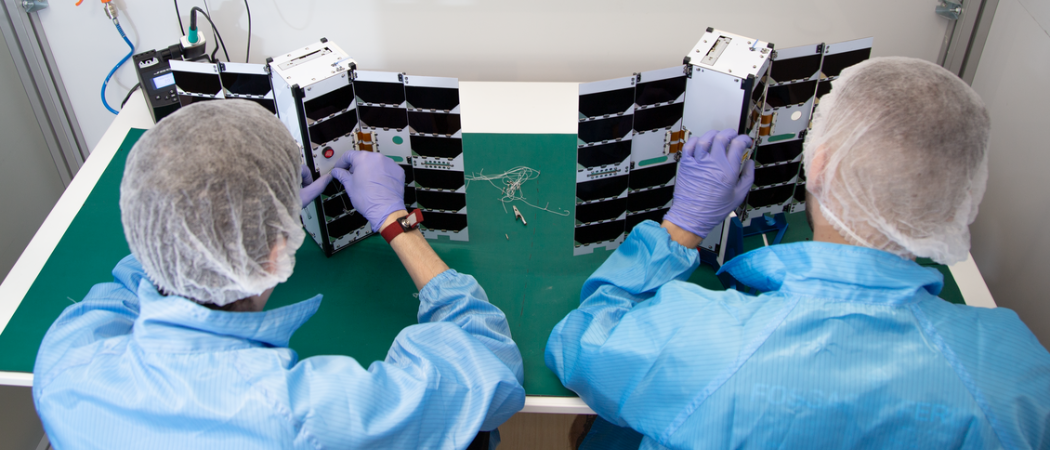
Assembly of a FOSSA Systems satellite. Credit: FOSSA Systems
Nato’s Defence Innovation Accelerator for the North Atlantic (Diana) has selected 150 companies to participate in its 2026 challenge programme, more than double this year’s cohort of 73 companies.
This will be the third group of companies to join the scheme, which helps innovators to develop and test dual-use technologies and connects them with military end-users, mentors and investors.
In the first phase of the programme, which lasts six months, companies will receive a €100,000 grant. They will also be assigned to one of 16 accelerator sites, gain access to more than 200 test centres, and participate in lectures, workshops, networking events and mentoring.
A smaller group of companies will be selected to continue to the second phase, where they will receiving additional funding of up to €300,000 to further develop and demonstrate their solutions and work with investors and end users.
Diana is open to companies headquartered in any of the 32 Nato countries. UK-based companies were the big winners of the most recent call, which focused on ten challenge areas from operations in extreme environments to autonomy and unmanned systems. Out of 150 companies, 27 are based in the UK, followed by the US with 24 and Canada with 22.
Door opener
The successful applicants who spoke to Science|Business shared a similar message: the money is a bonus, but the real appeal of the scheme is the connections it offers.
Testnor, a Norwegian company that enables clients to test technologies and collect data in Arctic conditions, hopes Diana will be a “door opener” and bring it closer to end users.
Today, Testnor works mostly with private companies as well as government authorities and research organisations. In Diana, “We are hoping to get validation from Nato and allied partners, and are also hoping to get strategic partnerships, investments and end user feedback,” said chief executive Heidi Andreassen.
“The validation that we’ve been through a due diligence process where we’ve been vetted by Nato is also a big advantage for us. It makes it easier to be a trusted partner,” Andreassen said.
Earlier this year, Testnor was part of a consortium selected for funding by the European Defence Fund. For the company, this was more like a contract, she said, whereas Diana “is more a programme where we can learn to work with defence customers and learn about their procurement processes.”
Though not the main attraction, the €100,000 grant will be helpful for covering travel costs, particularly between the company’s Arctic base and the accelerator it will join in London, as well as some operational costs.
Similarly, for Slovenian company PeK Automotive, the grant will cover travel and other expenses related to testing its solutions at Nato facilities, said Sašo Letnikoski, head of defence line marketing.
More importantly, “We would like to be exposed to the decision makers and venture capitalists and investors who are involved in the defence and dual use sectors,” Letnikoski said.
PeK Automotive is developing an unmanned ground vehicle for last-mile delivery in defence environments or for civil protection, for example after natural disasters, where it would be dangerous to send a human.
The firm, which started out developing agricultural robots, is hoping to gain access to a wider pool of investors. “When we started our defence line, two of the [Slovenian] banks immediately closed our accounts. It’s quite hard to start something for defence in Slovenia,” Letnikoski said.
Related articles:
- Explained: EU dual-use and defence funding changes
- A sneak peek into NATO DIANA’s start-up bootcamp
- NATO’s DIANA innovation accelerator doubles size of its network
Nato backing
Fossa Systems, a Spanish company designing, manufacturing, launching and operating small satellites to provide connectivity and intelligence services from space, derives around 80% of its revenues from the defence field, said co-founder and chief executive Julian Fernandez.
Fossa already has customers for its internet-of-things connectivity technology, which allows for the monitoring of anything from a shipping container to a cow, or a soldier. The Diana support will help it develop its signal-intelligence technology, which makes it possible to analyse and geolocate sources of interference, jamming and electromagnetic emissions, and which is still in a testing phase.
Like Testnor and PeK Automotive, Fossa was not drawn to Diana because of the funding on offer. “As a start-up, it’s interesting for product development. At the stage that Fossa is at, however, it isn’t very relevant. What’s relevant is getting access to end users and to Nato’s organisational backing,” Fernandez said.
He hopes these contacts with defence ministries will convert into long-term contracts. “It’s sort of opening the door and getting your first step into the room at Nato, but there’s a big process once you’re inside to convert it into more material business for us,” he said.
In June, Nato member states pledged to increase defence spending to 5% of GDP, including 3.5% on core defence requirements and 1.5% on related spending such as cyber-defence, critical infrastructure and defence innovation.
In Europe, Diana is part of a broader effort to increase investment in defence R&D that will also see parts of the civilian research programme Horizon Europe open to dual-use and defence projects.
European countries want to reduce their dependence on military equipment imported from the US, a move that has further soured relations with a US administration that insists they continue buying from US companies.
The US National Security Strategy published earlier this month accused the EU of undermining political liberty and expressed concern about the influence of migration on long-term European attitudes towards the US and Nato.


 Receive the Funding Newswire [full access requires a subscription] each Tuesday, our Policy Bulletin each Thursday, and the fortnightly R&D Express, tracking reforms and investments in central and eastern Europe.
 A unique international forum for public research organisations and companies to connect their external engagement with strategic interests around their R&D system.