The report feeds into conversations about future EU support for countries lagging in research and development

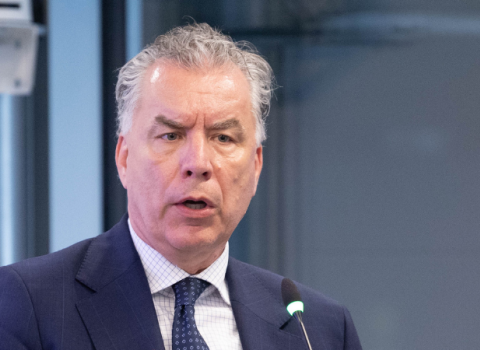
Reinhilde Veugelers speaking at a meeting of the European Parliament’s Science and Technology Options Assessment (STOA) Panel in Strasbourg on 22 January, 2026.
Horizon Europe’s Widening measures should be diversified to target individual countries’ research and innovation needs, a draft study commissioned by the European Parliament’s Science and Technology Options Assessment (STOA) Panel has concluded.
The report is both a review of how effective Widening measures have been to date, and a framework for establishing a new structure, or a Widening 2.0. It is authored by Reinhilde Veugelers, an innovation specialist at Belgian university KU Leuven, who presented an early snapshot at a STOA meeting on January 22. The full study will be published and presented to STOA in the coming months.
Among the conclusions is the point that there is a huge amount of heterogeneity in the 15 Widening countries, with bottlenecks blocking research and innovation potential in different areas. It means that some Widening instruments are not necessarily well suited to all countries’ needs.
“To know how to support specific Widening countries you need to know where they are, what blockages they face to catch up, and also their potential,” Veugelers told Science|Business following the STOA meeting. “There needs to be constant monitoring and evaluation, and really tailoring the instruments to every individual country, depending on what would make more sense for them.”
By way of example, she highlighted two long-established Widening instruments, commonly known as teaming and twinning. Teaming provides co-funding for the establishment or upgrade of research and innovation centres of excellence; twinning is about networking and raising the profile of research institutes in Widening countries by pairing them with leading institutes elsewhere.
“Instruments like twinning and teaming, they are great, but they only work if a country’s research and innovation landscape is sufficiently developed,” Veugelers said. “That’s not necessarily the case for all Widening countries.”
Not really catching up
Widening measures were first introduced as a part of the EU’s Framework Programme for research and innovation in 2014, to help lagging countries catch up with Europe’s stronger research and innovation states. The Widening measures have a separate budget, which started in 2014 at around €1 billion and rose to around €3 billion when Horizon Europe kicked off in 2021.
The new study paints a mixed picture of their success. It found that while some countries have managed to catch up to the EU average for certain indicators, others have barely closed the gap in many areas.
The study assessed the potential of Widening countries to catch up on innovation capacity, a metric referred to as PIC. It looked at several areas, including a country’s access to tools to carry out science and technology, such as high-speed internet, IT specialists, international scientific co-publications, etc; a country’s absorptive capacity, covering population demographics and education level, etc; its creative capacity, and its impact, through indicators such as medium- and high-tech exports, knowledge intensive services exports, high-tech imports from foreign partners, labour productivity, etc.
The one area that stands out for there being little or no progress is a country’s access to finance. This category looked at R&D expenditures in the public sector, venture capital expenditures, and direct government funding and government tax support for business R&D. While some countries, such as Estonia, Portugal, Lithuania, Croatia and Greece, made significant strides in this category, others deteriorated. And even for the countries that improved, it wasn’t necessarily fast enough to catch up with better performing EU countries.
This shows that the problem facing Widening countries is systemic and, according to Veugelers, cannot be solved by improving just one element. Instead the whole research and innovation landscape has to have good conditions in order to improve.
Actively monitoring a country’s PIC and bringing in appropriate measures, whether through the next Framework Programme, FP10, or development funds, or national initiatives, would better address the problem.
“The solution shouldn’t just be ‘let’s throw some money in there’ because there are systematic elements that need to be improved before money can actually be effective,” Veugelers said.
Related articles:
- Research community calls for more detail on 'transition countries' in FP10
- Commission floats Widening reforms in leaked FP10 proposal
- Parliament’s FP10 negotiators push to keep Widening in research talks
The future of the Widening
Veugelers’ study comes at an uncertain time for Widening measures. The European Commission’s FP10 proposal includes plans to divide the 15 current Widening countries into two groups by adding a new category for countries that have been able to show progress in the EU innovation scoreboard, an annual analysis of R&D performance across all member states.
The new category would be called “transition countries” and would include EU member states with an innovation scoreboard index above 75% that have been able to increase their participation in Horizon Europe. According to the proposal, the Commission is planning to measure participation growth against “a positive relative financial return per gross national income” in the research and innovation programme.
This is a step in the right direction for Veugelers in the sense that it offers some level of differentiation. However, she questioned the idea of using metrics such as the innovation scoreboard performance or the financial return from the Framework Programme, saying that the PIC, coupled with regular monitoring and assessment, would give a much fuller picture. She also questioned the idea of creating just two categories of countries.
“It’s a step in the right direction, but why just two groups? Given that policymaking is a very difficult path-dependent process, maybe if we take this one step now we might get stuck there,” she said.
“It should be a more dynamic process, with constant monitoring to see what is working. Otherwise, we’ll always have the Widening countries, they’ll remain Widening countries, and there is no progress.”



 Receive the Funding Newswire [full access requires a subscription] each Tuesday, our Policy Bulletin each Thursday, and the fortnightly R&D Express, tracking reforms and investments in central and eastern Europe.
 A unique international forum for public research organisations and companies to connect their external engagement with strategic interests around their R&D system.