Sayasat Nurbek tells Science|Business why he thinks the EU is missing a trick in its collaboration with Kazakhstan
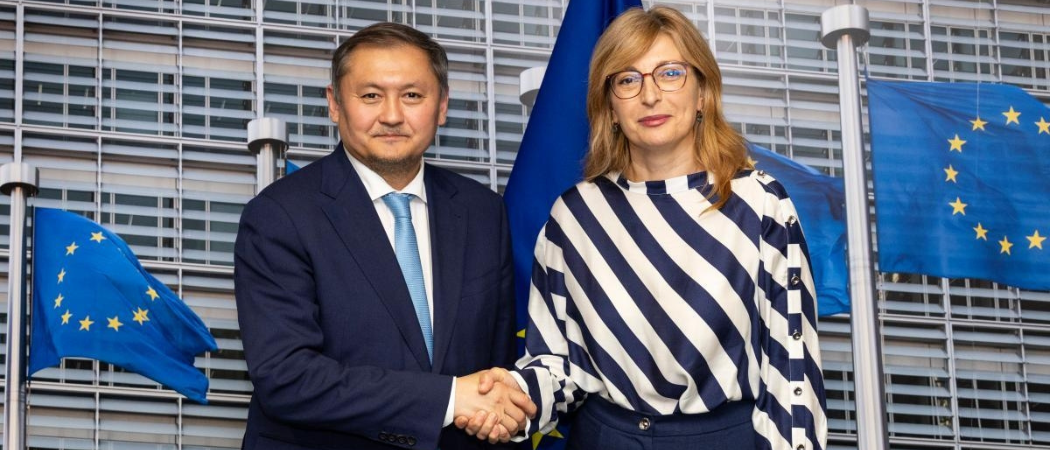
Kazakhstan’s minister of science and higher education Sayasat Nurbek (left) with EU research Commissioner Ekaterina Zaharieva (right) in Brussels on June 2. Photo credits: Lukasz Kobus / European Union
The message from Kazakhstan’s minister of science and higher education was clear on his visit to Brussels this month: his country’s association to Horizon Europe would help create the mutually beneficial partnership needed if the EU wants to continue benefiting from Kazakhstan’s rich stock of resources.
This is the pitch that Sayasat Nurbek took to EU research Commissioner Ekaterina Zaharieva, as well as MEP Borys Budka, chair of the European Parliament’s research committee, and EU special representative for Central Asia Eduards Stiprais on a multi-day visit to Belgium.
“I look at what the EU is trying to do in Kazakhstan and Central Asia, and it's missing the whole point,” Nurbek told Science|Business in an interview on June 3. “There's no pillar of science diplomacy, academic diplomacy, research diplomacy, academic mobility, networking. It's all very weak at the moment.”
In 2025, the EU announced a €12 billion investment package for Central Asia through its Global Gateway strategy. It supports the region’s development in the fields of transport, critical raw materials, digital networks and the environment. For Kazakhstan, this follows the signing of a 2022 strategic partnership on raw materials, batteries and renewable hydrogen.
But this approach favours the EU too much, Nurbek said, adding that it should not expect simply to take resources from Kazakhstan, manufacture goods from them and then sell them back.
He pointed to Kazakhstan’s location, surrounded by superpowers such as Russia and China, as well as its budding relationship with the likes of Japan, South Korea and the US, as reasons for the EU should offer the Horizon Europe olive branch.
“The EU’s Global Gateway investment package is €12 billion. But there's China, and it can at least double that amount. . . and its much closer. So, [the EU] really needs to add that extra layer of soft power to build trust,” he said.
It’s a bullish stance, but it comes from a playbook of well-constructed arguments that Nurbek brought with him from Astana. Over the course of a 40-minute interview, the minister dropped in a host of political and historical references, as well as facts and figures to back up his points.
It is the first time that a science minister from Kazakhstan has come to Brussels to discuss research collaboration and is intended to lay the groundwork ahead of a planned future visit from Kazakhstan’s president, Kassym-Jomart Tokayev.
Why Horizon Europe association?
Kazakhstan can and does already participate in Horizon Europe, with 18 grants so far under the programme. These are mainly through the Marie Skłodowska-Curie Actions, which support early-career researcher training, but there are also two Pillar 2 grants under the topics of health and culture.
But it is not a “steady or predictable” involvement, Nurbek said, with Kazakh universities, research teams and companies only able to join consortia started by European partners. “It’s not sustainable,” he said.
Most non-European countries associated to Horizon Europe have limited involvement. For example, Japan, Canada, New Zealand and South Korea are only associated to Pillar 2 of the programme, which funds big consortia of scientists and companies to tackle relatively applied problems.
When asked how much of the programme Nurbek envisages Kazakhstan associating to, he is reticent. “Ideally, we would ask for a full association, but we understand it takes time. We need to build trust, we need to build real-time cases. So, we'll take it one step at a time,” he said.
Democratic concerns
But association may not be straight forward. On the day Nurbek met with Zaharieva, news broke that Horizon Europe negotiations between Brussels and Singapore had collapsed. The south-east Asian city state and the EU officially opened exploratory talks on Horizon Europe association in 2024, but the move raised human rights concerns in the European Parliament and among NGOs.
Christian Ehler, an MEP for the European People's Party and rapporteur for Horizon Europe, demanded that the Commission show how Singapore complies with the programme’s rules. These stipulate that associated countries outside the European region must have “respect of human rights, backed by democratic institutions.”
Similar questions may be asked about Kazakhstan. The country was led by President Nursultan Nazarbayev from before the fall of the Soviet Union up until 2019, when he passed power to Tokayev, a career diplomat who from 2011 to 2013 was director general of the United Nations Office at Geneva.
Most international democracy monitors judge Kazakhstan to be more akin to an “electoral autocracy” than a democracy. US organisation Freedom House is particularly scathing.
“In Kazakhstan, parliamentary and presidential elections are neither free nor fair. The dominant media outlets are either in state hands or owned by government-friendly businessmen. Freedoms of speech and assembly remain restricted and punished, and corruption is endemic,” the organisation states.
An especially contentious moment in the country’s recent history came in 2022 when a series of mass protests broke out, sparked by an increase in gas prices. The government responded strongly, resulting in 227 deaths and nearly 10,000 arrests. Since then, there are ongoing accusations about a lack of accountability by authorities, and the need for an independent evaluation of the events.
Despite this, the European perspective on Kazakhstan as a democratic country is improving. The Council of Europe, an international organisation based in Strasbourg, wrote in 2025 that under President Tokayev’s leadership “the country has undertaken a broad spectrum of reforms aimed at recalibrating the political system, strengthening the rule of law, improving the protection of human rights, and creating space for a more pluralistic society.”
Even so, this transformation remains “a work in progress,” it adds.
Kazakhstan’s domestic policies are not the only issue. As Nurbek was jetting off to Brussels, Russian President Vladimir Putin was touching down in Astana to sign an agreement on the construction of a nuclear power plant. The two countries have, since the end of the Soviet Union, remained very close and interlinked. And Russia is not the only superpower on Kazakhstan’s doorstep, with China sharing a long border to the east. Tokayev is also seeking close relations with Xi Jinping.
“We live in a tough neighbourhood,” Nurbek said when asked how the EU could agree to closer relations while Kazakhstan maintains ties with countries such as China and Russia. “We have been very careful to build trust with everyone.”
What’s in it for the EU?
Horizon Europe association for Kazakhstan would also be a win for the EU, Nurbek said. On one hand, it would provide more stable and reliable access to Kazakhstan’s rich resources, including significant reserves of critical raw materials such as titanium, silicon, copper, lithium, nickel, cobalt, rare earths and uranium.
“Kazakhstan can really become that steadfast and solid partner, providing the EU with a stable supply of critical minerals, raw materials, oil and gas, and agricultural needs such as fertiliser and grain,” Nurbek said.
But he stresses the need for this exchange to be mutually beneficial. He wants the EU to co-develop technologies alongside Kazakhstan, not just extract its resources.
Related articles
- Franco-Polish plan could see Horizon Europe fund labs, not just projects
- Singapore Horizon Europe talks have broken down
- ‘Academic Huxit.’ Hungarian researchers speak out on impact of EU ban
Then, there is the advancing scientific and digital infrastructure. Kazakhstan has its own supercomputers and is well advanced in terms of e-governance and digital services. The country is pouring a lot of resources into AI, and it has the space and resources to be a hub for data centres. Horizon Europe association would make partnerships in all these areas easier and stronger, Nurbek said.
Kazakhstan is also making policy efforts to improve its research sector. It has increased R&D spending as a proportion of its GDP to 0.25%, and wants to boost this to 1% over the next three years. Meanwhile, the country has introduced tax incentives for companies investing in R&D, and adopted a new constitution that priorities education, research, human capital and innovation.
University development
But research and innovation are only one part of Nurbek’s effort to increase global cooperation. For the past four years, the minister has been on a mission to accelerate Kazakhstan’s higher education sector by opening partnerships with a host of leading universities from around the world.
In some cases, such as Cardiff University or Coventry University, branch campuses have opened in Kazakhstan. In others, such as Edinburgh’s Heriot Watt University or France’s Université de Lorraine, there are teams within departments of local universities.
One goal is to make money on transnational education. A second is to transform local universities. For example, Heriot Watt University is helping the K. Zhubanov Aktobe Regional University develop from a teaching institution into a research-intensive university.
Finally, there is a desire to see more technology transfer. For example, a researcher from the University of Arizona, Jeffrey Pyun, has been working with researchers in Kazakhstan to find applications for sulphur extracted from the country’s oil. “Over the past two years we’ve got 11 patents and built a joint research group,” Nurbek said.
Nurbek is confident in his mission to strengthen Kazakhstan’s collaboration with the EU. “You don't have to reintroduce Europe to our part of the world. We’re already there. I mean, we live by European standards, we admire European culture,” he said. “But you need to add that real layer of soft power, and that comes from academia and research.”
The European Commission did not respond to questions on their position on Kazakhstan associating to Horizon Europe by time of publishing.

 Receive the Funding Newswire [full access requires a subscription] each Tuesday, our Policy Bulletin each Thursday, and the fortnightly R&D Express, tracking reforms and investments in central and eastern Europe.
 A unique international forum for public research organisations and companies to connect their external engagement with strategic interests around their R&D system.