EOSC Node | European Digital Twin Ocean: the next chapter for collaborative marine science
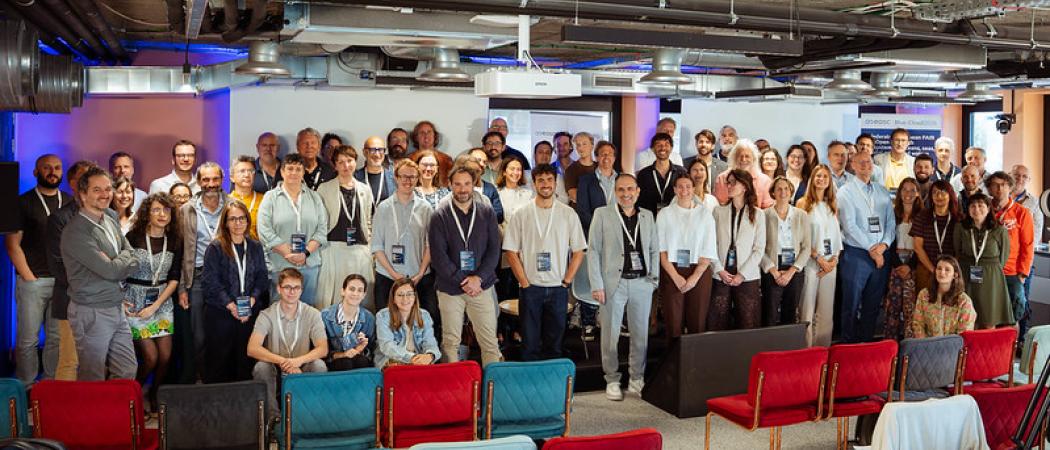
Photo credits: Anastasija Grinuk @Trust-IT Services
Just like the ocean, the knowledge related to Europe's marine environment is vast. Only a few years ago, the wealth of ocean-related data was largely siloed, making collaborative research difficult.
Launched in 2019 under EU Horizon 2020 and continued under Horizon Europe as Blue-Cloud 2026, the Blue-Cloud project has developed a single web-based platform to enable researchers to produce, share and reuse research outputs across disciplines and countries. Now, as the project reaches its conclusion, it is aiming to hand over something considerably more durable than a research prototype.
“Research projects aim to demonstrate certain possibilities and tools, but the long-term sustainability of the outputs, once the project ends, is far from a given and depends on many different aspects,” says Pasquale Pagano, scientific coordinator of Blue-Cloud 2026 and researcher at the Italian National Research Council. “However, the Blue-Cloud project results were transferred into a stable environment and are designed to remain available for a long period of time.”
That stable environment is the EOSC Node | European Digital Twin Ocean, a federated open science platform that consolidates harmonised marine data, analytical services, and computational tools within a single access point for the research community.
A bridge between major infrastructures
Formally launched in November 2025 during the EOSC Symposium, the Node has assumed a strategically significant position in Europe's research landscape. As Pagano explains, it “forms a bridge between two large infrastructures that were not previously linked: EOSC and EDITO”.
The EOSC Node | European DTO is part of the European Open Science Cloud (EOSC) Federation, a growing network of thematic, national and infrastructure research nodes. The EOSC Node is the marine thematic component of the EOSC Federation, providing the computational infrastructure, data, and analytical tools required for quality marine science. The EOSC Node is also being integrated within EDITO, the core technical platform of the EU Digital Twin Ocean programme, which is implementing a digital replica of the ocean designed to simulate complex marine environments.
“By linking to EDITO, we drive the research outputs to cover broader needs, including industrial, civil society and policy needs,” explains Sara Pittonet, project coordinator of Blue-Cloud 2026 at Trust-IT Services.
The EOSC Node European DTO is part of the EU's wider ocean strategy. In June 2026, the European Commission announced OceanEye, a new initiative to position the EU as the world's leading provider of ocean intelligence. “One of the pillars of OceanEye is the operationalisation of digital infrastructures and we are an important component in this regard,” notes Pittonet.
A platform for collaborative open science
Beyond its institutional role, the Node functions as what Pittonet calls “a blueprint for collaborative science” - a shared environment where research teams can access data, computational tools, and services without having to build or maintain the underlying infrastructure themselves. “We provide a platform for researchers to test, improve and develop products that will be of benefit to the whole scientific community,” she says. “It is the place where teams do collaborative research, a place where researchers can access all necessary resources and develop or use tools.”
The practical effect, Pagano adds, is a significant reduction in time and cost: “By using our integrated platform, researchers can achieve results faster and more easily.”
This matters at a moment when the challenges facing ocean science, such as restoration, sustainable resource management and climate adaptation, increasingly exceed what any single institution or country can address alone. “These challenges require international and cross-disciplinary collaboration,” observes Pagano. “We provide a trusted environment where researchers can discover, combine and build on each other’s work. They can focus more on producing knowledge, rather than on overcoming technical problems.”
Rich data lakes spanning decades
The EOSC Node European DTO is already equipped with a range of operational services. The main test beds for users are the virtual labs, where scientists can discover data, run analyses, and collaborate on marine-related science from genomics to wildlife, as well as environmental data, without ever leaving their browser. One of the nine labs is the Global Fisheries Atlas, offering catch statistics of tuna and tuna-like species around the world to support decision-making and resource management worldwide.
The Node also encompasses three workbenches covering essential ocean variables, for assessing the state of the marine environment: physical variables (temperature and salinity), eutrophication variables (chlorophyll, nutrients, and oxygen), and biological data relating to plankton dynamics and distribution. The workbenches are digital environments with ready-to-use datasets, for physics covering the Mediterranean Sea from 1950 to 2025 and for eutrophication offering more than seven decades of continuous and harmonised observations in the global ocean.
These services are designed to empower experts to monitor ecosystems along coastlines, support prediction of extreme weather events, and provide maps to help manage incidents, such as oil spills.
A long-term trusted and sovereign research ecosystem
“From the beginning, we tried to have a long-term vision, and we carried it across several projects,” says Pagano. “This can only be achieved thanks to excellent consortia — all key stakeholders that deliver marine services were onboarded in this initiative.”
Sustainability will be supported by EOSC-Marine, a new project due to kick off in September 2026, which will provide continued backing for the Node's operations and development.
Looking further ahead, Pittonet points to the momentum building around the EOSC Federation model, as well as the EOSC’s call for a dedicated partnership under the next EU research funding framework. “We have all the necessary resources to transform Europe’s research data ecosystem towards a trusted, secure and sovereign common space of high-quality, FAIR research data and services” she says. “EOSC is working to connect them all in one federation, as a strategic priority for the Union to build a resilient, productive and sovereign knowledge economy.”
 Receive the Funding Newswire [full access requires a subscription] each Tuesday, our Policy Bulletin each Thursday, and the fortnightly R&D Express, tracking reforms and investments in central and eastern Europe.
 A unique international forum for public research organisations and companies to connect their external engagement with strategic interests around their R&D system.