Cohesion and innovation policy should not be seen as separate, but interconnected components of a single innovation strategy

Bernadett Petri, Ministerial Commissioner and managing director at the Hungarian Development Promotion Office. Photo credits: Bernadett Petri
Europe’s innovation paradox has become one of the defining challenges of EU policymaking. Despite being home to world-class universities, research institutes and technology clusters, the continent still struggles to convert its collective talent into balanced, sustainable growth and shared success.
At the heart of this paradox lies a structural imbalance: innovation capacity in Europe remains geographically concentrated. While a handful of regions perform at a global level, large parts of the union remain on the margins of its innovation economy. The EU’s next seven-year budget, due to start in 2028, offers a unique opportunity to address this imbalance, not through new institutions, but through better coordination between Europe’s two main policy engines: cohesion and innovation policy.
Europe’s innovation map continues to reflect deep territorial disparities. Data shows that out of nearly €39 billion distributed by Horizon Europe so far, the top 20 regions received more than half of the total funding. The remaining 230 regions share the other half.
Moreover, none of the top regions are located in member states that joined the EU after 2004. The younger member states, which together represent almost a quarter of the EU’s population, capture less than 9% of Horizon Europe funding.
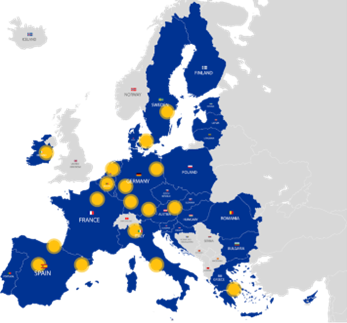
EU regions receiving Horizon Europe funds. Source: János Matuz based on data from Eurostat and R&D Country Profile, RTD Cordia BI Reporting, 18 September 2025.
Although Horizon Europe operates on the principle of excellence, without national quotas, the results demonstrate that geography continues to determine access. The regions with well-established innovation infrastructures, which is to say research-performing universities, project management capacity and existing networks, remain systematically advantaged.
The regional development trap
The imbalance has both historical and structural roots. When countries in central and eastern Europe joined the EU in 2004, their GDP per capita stood at roughly half the EU average. By 2021, that figure had risen to around 80%. Yet, region-level data tells a more nuanced story.
Less developed regions have ceased converging since the late 2000s, and in some cases, are diverging again. This phenomenon shows how regions that only rely on cohesion funding, but are not advanced enough to participate in competitive EU programmes, get stuck in the middle-development trap.
From 2014 and onwards, the expansion of directly managed instruments, particularly Horizon 2020 and other direct programmes, has unintentionally reinforced this pattern. Regions with strong participation capacity continue to attract competitive funding, while those still developing such capacity fall further behind. Over time, funding concentration has translated into innovation concentration, creating a self-reinforcing cycle of uneven development. Therefore, it is clear that the innovation divide and the funding divide are not parallel trends, but interconnected layers of the same structure.
Local strength, European impact
The Regional Innovation Scoreboard underscores this asymmetry. Innovation leaders are primarily located in northwestern Europe: Scandinavia, the Netherlands, and parts of Germany, France and Belgium. The explanation lies in ecosystem maturity. Where regional networks link universities, SMEs, municipalities and civic actors, innovation outcomes are stronger. Conversely, where such networks are fragmented or overly centralised, innovation potential remains untapped.
This confirms what every major regional innovation policy assessment has consistently shown: innovation is local. Yet current funding models remain predominantly centralised. The result is a system that rewards maturity rather than momentum.
The territorial dimension of innovation is visible across multiple domains. In patenting, the OECD RegPat database shows that the top ten patent-producing regions account for over 60% of all EU patent applications, while the bottom hundred regions combined barely reach 10%.
Similarly, Europe’s green transition displays a stark territorial imbalance. Around 63% of hydrogen refuelling stations are located in Germany, 25% in France and the Netherlands, and none in eastern Europe. At the same time, 60% of coal-related jobs are concentrated in just seven regions across Poland, Romania, Bulgaria, Czechia, Germany and Greece.
This reflects a wider pattern: Europe is building the future in some regions while managing the past in others. The risk is that the green transition, which is intended as an equaliser, becomes a new dividing line between regions that can access transition funding and those that cannot.
Demographic trends further compound the challenge. Eurostat projects that urban regions such as Stockholm, Dublin, Amsterdam and Warsaw will continue to attract population, while peripheral regions face depopulation. As talent migrates towards innovation centres, local ecosystems weaken, leading to a vicious circle of outmigration and declining competitiveness.
Related articles:
- North vs south: Horizon success rates defy familiar east-west divide
- Data corner: top 20 universities for Horizon Europe innovation projects
Cohesion versus directly managed funds
The EU’s two main financing systems, cohesion policy and directly managed programmes, operate in parallel. Cohesion funds such as the European Regional Development Fund, the European Social Fund Plus and the Cohesion Fund, build infrastructure, skills and local capacity. Directly managed programmes such as Horizon Europe, Digital Europe, and Life, drive research, technology, networks and the go-to-market stage.
These instruments were designed to be complementary, not competitive: directly managed programmes depend on the groundwork laid by cohesion funds. Therefore, cohesion must prepare regions to participate, and direct funds must reward not only maturity but momentum. Coordinating cohesion and direct funds would make the entire EU budget more efficient, because the money would finally work together, not in silos. With the next Multiannual Financial Framework (MFF) in preparation, the opportunity to make this coordination happen is arising.
A more balanced innovation model
Several practical measures could help synchronise the EU’s innovation and cohesion frameworks. One option would be to establish a dashboard for directly managed EU funds, a transparent online platform that displays the territorial distribution of funding. This would allow comparative analysis with cohesion allocations, making structural imbalances visible and actionable.
Another proposal is to create regional innovation corridors, structured partnerships linking advanced and emerging regions. EU project consortia operating within a recognised corridor could receive additional evaluation points, thereby incentivising cross-regional cooperation and capacity transfer.
A demographic incentive bonus in directly managed programmes could also be introduced, offering 5–10% extra support intensity for projects implemented in less developed regions facing population decline, rewarding efforts to retain and attract talent in demographically challenged areas.
Finally, a Regional Capacity Facility could provide dedicated support to strengthen project preparation, application writing and partnership-building in less developed regions, potentially co-financed by member states.
Each of these measures aligns with existing EU objectives of improving transparency, fostering convergence and reinforcing the link between regional policy and innovation.
Innovation cohesion
Conceptually, innovation cohesion should be seen not as redistribution but as strategic investment. A geographically balanced innovation system enhances the EU’s overall resilience and competitiveness.
If current patterns persist, directly managed programmes will continue to amplify existing disparities. But if redesigned to reward transformation and participation, they could become Europe’s most effective equaliser.
The upcoming MFF negotiations provide an opportunity to operationalise this principle. Integrating cohesion intelligence into the design of directly managed EU programmes would ensure that funding supports both excellence and inclusiveness, sustaining the EU’s competitiveness in the long term.
Reconnecting Europe’s policy engines
Europe’s innovation divide is not inevitable. It is the outcome of policy design, and therefore within the EU’s capacity to correct.
Cohesion and innovation policy should not be treated as separate domains, but as two interconnected components of a single innovation strategy. Cohesion provides the foundation; directly managed programmes build on it. Together, they can make innovation both excellent and inclusive.
Innovation cohesion is, ultimately, Europe’s competitiveness policy by other means. It ensures that no region remains a spectator to Europe’s innovation success, and that every region has the capacity to contribute to it.
Bernadett Petri is Ministerial Commissioner and managing director at the Hungarian Development Promotion Office.




 Receive the Funding Newswire [full access requires a subscription] each Tuesday, our Policy Bulletin each Thursday, and the fortnightly R&D Express, tracking reforms and investments in central and eastern Europe.
 A unique international forum for public research organisations and companies to connect their external engagement with strategic interests around their R&D system.