Overcoming regulatory fragmentation is more urgent than the quirky details of R&I programmes, said MEP Christian Ehler and EU research chief Marc Lemaître
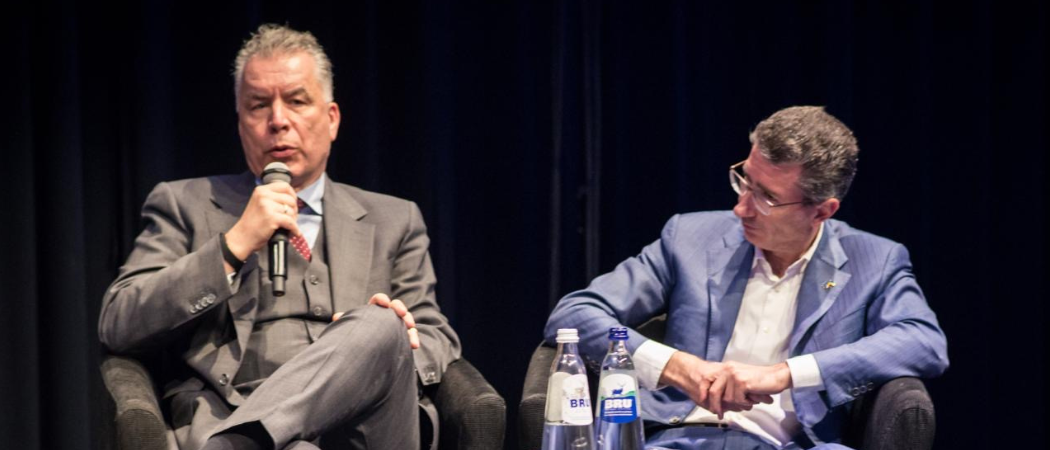
MEP Christian Ehler of the European People’s Party (left) and Marc Lemaître, director general for research and innovation at the European Commission (right). Photo credits: Jeroen Vanhecke
The future success of European research and innovation rests not on the structure of the next Horizon Europe or the new Competitiveness Fund (ECF), but on the continent’s capability to scale cutting edge technologies across borders, MEP Christian Ehler told the Science|Business annual conference on February 5.
“The number one problem in Europe for innovation is not the need for a competitiveness programme, it is simply the fragmentation of the single market,” said Ehler, who is the European Parliament’s lead rapporteur on the next Horizon Europe and co-rapporteur on the ECF.
Marc Lemaître, director general for research and innovation at the European Commission, agreed that “it is not first and foremost about money, but about overcoming regulation fragmentation in Europe.” He said he hoped for “bold political decisions” to be taken in areas such as the Capital Markets Union.
An EU capital markets union is not a new idea but gained fresh support in 2024 following reports on European research and competitiveness by former Italian prime ministers Mario Draghi and Enrico Letta. The aim would be to make it easier for investments and savings to flow across the bloc, instead of on a national level.
Lemaitre also argued that EU funding for research and innovation needs to focus more on late-stage development and deployment. “We need to do better in the eventual impact, economic and societal, of that collective research that we pursue in Europe,” he said.
The largest pot of EU funding goes towards collaborative research, which mostly start at around technology readiness level (TRL) 3 and end around TRL 6, which is still some way off market deployment, Lemaitre pointed out. “I am absolutely with those who say we don’t have the right balance [of TRLs],” Lemaitre said.
The EU research chief also suggested rethinking how collaborative research projects are managed. Today, there are too many calls “with just two or three projects” at the end and too little money, he said. Instead, the next research Framework Programme could publish fewer calls and fund more projects per call.
The average size of an EU-funded collaborative research project is €4 million over four years, with 11 participants in the consortium, he said. “You break that down, and how much is there on average per participant in the consortium? Something like €100,000 per year.”
Asked whether there were too many calls, Lemaître suggested that if the EU were to set priorities, it could focus on areas where the continent lags or key technologies where it needs to step up its capacities moving forward.
Linking Horizon to the ECF
The European Commission last year put forward its plans for a standalone Horizon Europe successor worth €175 billion that would be tightly connected to a wider €409 billion ECF.
Significant question marks remain around the links between the two instruments. “I would say also the 13th floor [of the Berlaymont building, where the Commission president’s office is located] doesn’t know what it will look like,” Ehler said. “I’m fairly sure the Council also doesn’t know what it will look like.”
Related articles
- Commissioner suggests ‘fast-track access’ to the ECF for selected Horizon Europe projects
- EU Competitiveness Fund will not finance research activities
- European Competitiveness Fund to be jointly run by Commission research and industry directorates
Lemaître said the Commission has not laid out all the details around governance because, “we want to be in listening mode.” Research stakeholders, industry, investors, the European Parliament and member states will all have a say in how Europe sets priorities and pursues them through Horizon and the ECF, he suggested.
Future of the EIT
The future of the European Institute of Innovation and Technology (EIT) is another lingering question. Here, Ehler was frank, suggesting the EU should “shutter” the EIT’s central agency in Budapest and think about alternative ways of managing its thematic knowledge and innovation communities (KICs).
The individual KICs are “a fast-moving and really interesting instrument” but “wrongly placed institutionally,” he said. The German MEP also suggested that there were “two or three” KICs that should be immediately shut down, saying for example that it was “not the best idea to have a climate KIC.”
However, the Climate KIC is no longer part of the EIT as it became financially independent in January 2025.
Lemaître said that the Commission would examine the situation of the EIT and remaining KICs by the end of the year.
Caroline Viarouge, chief executive officer of the EIT Manufacturing KIC, was on the panel with Ehler end Lemaître. Ehler suggested that this KIC would be worth keeping.
Editor’s note: This article was updated 18 February 2026 to note that Climate KIC has gain financial independence from EIT in January 2025.



 Receive the Funding Newswire [full access requires a subscription] each Tuesday, our Policy Bulletin each Thursday, and the fortnightly R&D Express, tracking reforms and investments in central and eastern Europe.
 A unique international forum for public research organisations and companies to connect their external engagement with strategic interests around their R&D system.