But restrictions will still be needed, making science “as open as possible, as closed as necessary,” Ehler says
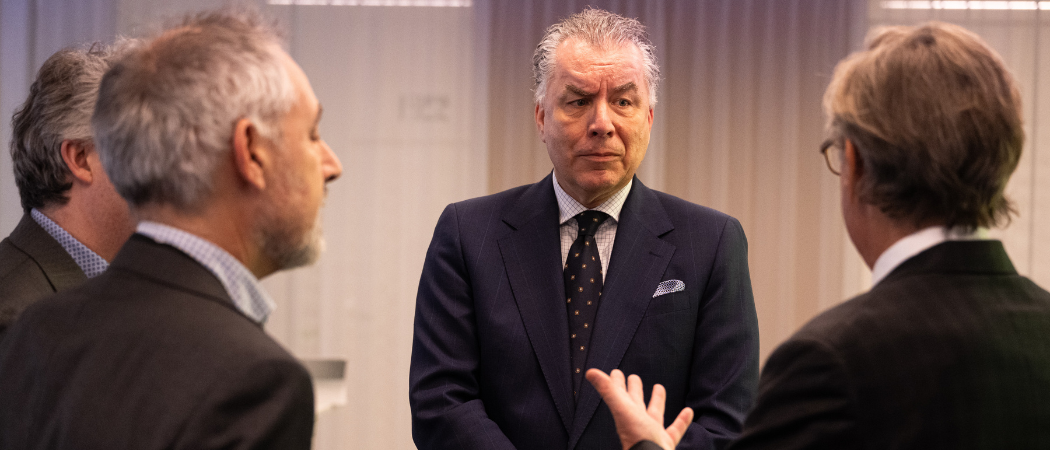
MEP Christian Ehler. Photo credits: European Union
As the US retreats from international science, the EU “will have an important role to play maintaining global cooperation,” according to MEP Christian Ehler. Speaking in the European Parliament on January 14, he characterised the Trump administration’s recent actions as “step by step breaking down the world order that allows science to thrive.”
Ehler, from the European People’s Party group, is a prominent voice on research policy within the Parliament, and lead rapporteur on legislation to establish the next Horizon Europe research and innovation programme. He is also co-rapporteur for the new European Competitiveness Fund (ECF).
The same geopolitical context that has pushed Europe to the forefront of global scientific cooperation means that it must reconsider its own openness, Ehler went on. While cooperation between scientists remains essential for innovation, he said, this principle must now be viewed “in the context of the world created by Trump.”
As a result, openness can no longer be unconditional. Science, he said, must be “as open as possible and as closed as necessary,” a logic that applies equally to innovation policy. In a world shaped by US protectionism, Chinese state subsidies and unfair competition, keeping European research and markets fully open could end up harming the EU rather than benefiting it, he said.
This shift is already influencing the EU’s research architecture. While Horizon Europe would remain open in principle to global participation, allowing researchers from third countries to take part, access under the ECF would be more limited.
International association, he said, should no longer be seen as a purely technical instrument, but as an “instrument of international relations” that must now be managed with greater caution. As global conditions change, so too do the parameters for participation in Europe’s flagship research programmes.
Associated states voice concerns
Ehler was speaking at a meeting with representatives from states associated to Horizon Europe, including the UK, Switzerland, Japan and Norway. They shared some of his concerns, but were not ready to turn their backs on the US.
Asked by Science|Businsess how a US retreat from international research cooperation could affect Horizon Europe and Europe more broadly, Caroline Read, deputy ambassador at the UK Mission to the EU, said the EU would need to make a compelling case for openness.
“We need to demonstrate that open, collaborative research is beneficial to all,” she said. Europe should also show US researchers who may disagree with current domestic policies that they would still find “welcoming arms” for their work in Europe, she added.
While acknowledging the US withdrawal from some multilateral research frameworks, Rahel Byland Skvarc, science counsellor at the Swiss Mission to the EU, said that cooperation with US researchers can and should continue through bilateral channels. They remain committed to international collaboration, despite political constraints, she said.
For countries such as Japan and Norway, cooperation with the US remains a practical priority. Erik Yssen, counsellor for science and research at Norway’s Mission to the EU, said the US continues to be among Norway’s key bilateral partners.
From Japan’s perspective, Toshiyasu Ichioka, director of the Riken Europe Office, also noted that ties with US partners remain strong. While the broader political context is evolving rapidly, day-to-day scientific collaboration, he said, has not yet been significantly affected.
Clear and equal rules for association
But the associated states also said that international cooperation can only function if it is based on clear and equal rules. And that includes the next edition of Horizon Europe, also known as Framework Programme 10 (FP10).
“We are very keen that any legal text, particularly on FP10, would have equal terms for researchers coming from the EU and associated countries,” said Read. “If it doesn’t, we risk undermining genuine collaboration that is happening now.”
She recalled that when the UK first associated to Horizon Europe, its researchers were excluded from certain calls, including in areas such as strategic technologies and quantum research.
Byland Skvarc also stated the importance of guaranteeing access to research results for all partners. “All the project parties, whether they are from [EU] member states or from associated countries, [must] have guaranteed access to project results, and ‘dual use’ [must] not lead to any access restrictions,” she said.
The representatives also highlighted the need to ensure that research funding continues to be allocated on the basis of excellence rather than political direction, and that association procedures for third countries under Horizon Europe should be fast and seamless. “Being able to associate from the very beginning of the next programme means there won’t be gaps and [that] we can collaborate without interruption,” Read said.


 Receive the Funding Newswire [full access requires a subscription] each Tuesday, our Policy Bulletin each Thursday, and the fortnightly R&D Express, tracking reforms and investments in central and eastern Europe.
 A unique international forum for public research organisations and companies to connect their external engagement with strategic interests around their R&D system.