Paris-Saclay Call appeals for European scale and for better alignment between national and European strategies
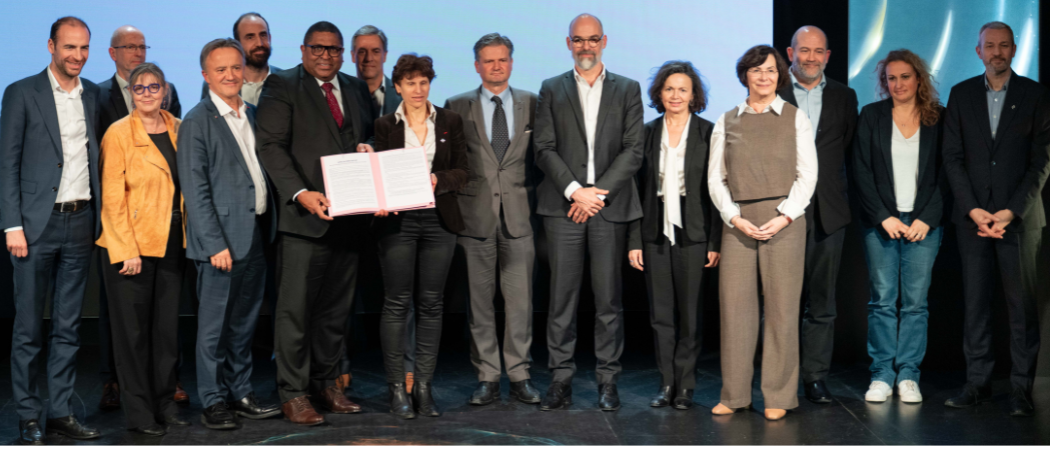
The research community launched the Paris-Saclay Call during the Paris-Saclay Summit on February 19. Photo credits: Communauté d'agglomération Paris-Saclay
Prominent voices in France’s research community have urged European policymakers to stop thinking about fair national returns on EU investments, and to focus instead on building the critical mass needed to compete with the US and China in strategic fields.
The Paris-Saclay Call “for a sovereign, free and competitive Europe through research and innovation” was launched at the Paris-Saclay Summit on February 19, and urges decision-makers to “make research a fully-fledged European political project.”
The call has been signed by universities and alliances in France and across Europe, including France Universités, Denmark’s Aarhus University, and Wageningen University and Research in the Netherlands. It also has the support of companies and a long list of research organisations such as France’s CNRS, Inria, Institut Pasteur, and the European Institute for Energy Research in Germany.
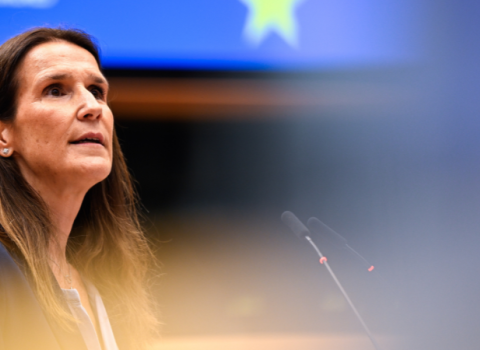
“Major scientific and technological advances are first of all the result of cooperation, of the circulation of talent, on shared infrastructures, and in this regard the right level is the European level,” said Sylvie Retailleau, former French research minister, as she presented the text at the summit.
Research and innovation “can no longer be thought of simply as a sum of national efforts,” Retailleau said. “It must be conceived of as a collective investment based on the sharing of risks, expertise and infrastructures, and on a strong link between public financing and private investment at European level.”
The initiators of the appeal, addressed to national decision-makers and EU institutions, hope to contribute to ongoing discussions on the next iteration of Horizon Europe, which will run from 2028. The EU’s flagship research fund plays a “central role” in national and European research systems, Retailleau said.
Five priorities
The text is structured around five priorities. The first is to focus on European scale, which it says is “the precondition for effective research and innovation.” The second recommendation is to preserve and promote academic freedom.
The third priority is to strengthen the continuum from fundamental research to innovation and industrialisation, including through public-private partnerships and greater alignment between the different pillars in Horizon Europe.
The fourth area is related to mastering critical technologies in energy, health, agriculture and food, digital technologies, AI, biotechnologies, quantum, advanced materials, space and defence. The signatories call for shared research and computing infrastructures, multi-annual technology roadmaps and better links between research, regulation and industrialisation.
The final priority is to algin national and European strategies, including by better supporting university alliances and cooperation between national research organisations.
The idea is to publish a follow-up text at a later stage with more practical propositions on each of the key themes, Retailleau said.
France’s current research minister, Philippe Baptiste, welcomed the initiative. European sovereignty relies on key technologies such as energy, AI and quantum, but no European country is able to master all of them on its own, he said in a recorded message to the summit. “European scale is essential to reach critical mass and to be at the level of the two other great powers.”
EU countries must go further by strengthening European collaboration, and by “deepening the European research and training area,” Baptiste added.
The call has been signed companies including EDF, Danone, Sanofi and STMicroelectronics, which say they recognise the value of European funding.
By pooling resources at European level, it’s possible to take risks on very innovative technologies, said Yves Desbazeille, international director at EDF. With the proposed €409 billion for the new European Competitiveness Fund and €175 billion for the next iteration of Horizon Europe, “we can work, try new technologies, get things wrong,” he said. “The funding is sufficiently large to do that. At the level of a country like France, we wouldn’t be able to.”
Paris-Berlin corridor
The third edition of the Paris-Saclay Summit had a distinctly European focus. In addition to the declaration, it saw the Paris-Saclay Urban Community and the Berlin city government sign a partnership to work together to support breakthrough technologies.
The joint declaration foresees the launch of collaborative projects in health, energy, quantum, digital technologies and climate innovation; increased mobility for students, researchers and entrepreneurs; and annual events at the Paris Saclay Summit in February and Berlin Science Week and Falling Walls in November.
“Franco-German cooperation is and remains the engine of Europe, and Franco-German cooperation is not simply a partnership between national governments, it’s first of all very local, concrete projects that work together,” said Grégoire de Lasteyrie, president of the Paris-Saclay Urban Community, representing the cluster of businesses and research institutions to the south of Paris.
In the future, he hopes Paris-Saclay and Berlin will be capable of “applying together to international competitions” and “speaking with a coordinated voice, if not one voice, on the international stage, around the big questions linked to research and innovation.”
Related articles
- France leads push for widespread adoption of European AI
- Germany launches €18 billion High-Tech Agenda
At national level, France and Germany have worked closely in recent years to advance on topics including cutting-edge technologies. As recently as November 2025, the two countries co-organised a summit on European digital sovereignty in Berlin. However, they are also increasingly divided on topics including free trade agreements, and German Chancellor Friedrich Merz has stepped up bilateral cooperation on European policy with Italy’s Giorgia Meloni.
“I think ecosystems move faster than nations,” said Ina Czyborra, senator for science and health in the Berlin Senate, who presented the agreement on behalf of Berlin. “Innovation is part of diplomacy at a territorial level, so we have to strengthen this.” The Paris-Berlin partnership is “a strong signal for a coordinated, integrated Europe” in favour of deep-tech, she added.
For Paris-Saclay, the partnership with Berlin is part of a broader strategy aiming to build links across Europe. With two universities, Paris-Saclay University and CentraleSupélec, and innovative companies such as Alice & Bob and Pasqal, the area represents 21% of French public and private R&D and expects to reach 25% by the end of the decade, de Lasteyrie said.
“I think we can go even further,” he said. “We can do it notably by connecting our region with other European innovation regions.”
This emerging Europe-wide vision is also a response to the geopolitical shifts of recent months and years. “Those we believed to be our historic allies are turning out not to be, beginning of course with the US, and international competition today puts us face to face with powers which have significant means and aims on certain technologies which could be hegemonic,” de Lasteyrie said.
“The response must be European. Below the European level, we will not be able to resist these fundamental shifts,” he concluded.
For Valérie Pécresse, president of the Île-de-France region, which includes Paris-Saclay, this is a unique opportunity. “Donald Trump is our best ambassador,” she said. “We have lots of researchers who are American or work in the US who want to leave, either because their research budget was cut, or there is another scenario, those who don’t want their research to benefit the United States of Donald Trump.”
 Receive the Funding Newswire [full access requires a subscription] each Tuesday, our Policy Bulletin each Thursday, and the fortnightly R&D Express, tracking reforms and investments in central and eastern Europe.
 A unique international forum for public research organisations and companies to connect their external engagement with strategic interests around their R&D system.