How Malta’s Semiconductor Competence Centre is progressing Europe’s chip ambitions
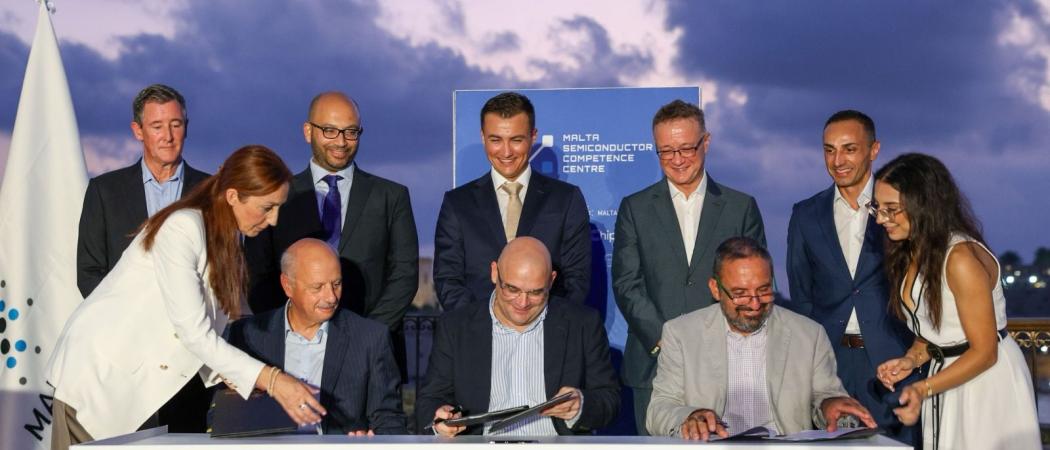
The official launch of the Malta Semiconductor Competence Centre in the presence of Hon Silvio Schembri, Minister for Economy, Enterprise and Strategic Projects.
Photo Credits: Chips Joint Undertaking
Malta’s semiconductor industry has been decades in the making. Long before semiconductors became central to European industrial policy, Malta had established itself as a base for advanced electronics, back-end packaging and high-reliability manufacturing. The Malta Semiconductor Competence Centre (MSCC) builds on this foundation, adding structure, scale and European connectivity to an ecosystem already delivering industrial value.
At its core, the MSCC brings together academia, research, industry and government to strengthen skills, accelerate innovation and, crucially, drive commercialisation. By embedding entrepreneurship, start-up support and industry-led pathways alongside training and research, the Centre positions Malta as a significant contributor to Europe’s semiconductor strategy and as a launchpad for new semiconductor ventures.
Skills and applied research at the heart of the MSCC
For Malta College of Arts, Science and Technology (MCAST), semiconductors are “a key part of our institution”, according to Stephen Sammut, director of MCAST’s Institute of Engineering and Transport. MCAST trains technicians, operators and engineers with semiconductor skills embedded across programmes.
Through its link with the MSCC, MCAST is scaling training for industry and students alike. Sammut points to initiatives that have already upskilled hundreds of staff from high-tech companies, alongside technician-level education that attracts international students. MCAST is also active in applied research relevant to the semiconductor value chain, including lasers, advanced packaging, plasma cleaning, spectroscopy, digital twinning and automation systems for semiconductor and electronics manufacturing.
The ambition for the MSCC, Sammut says, is to be “seen holistically in a Europe-wide structure”. In a strategic, dual-use industry, global supply chains remain essential and competence centres help Europe build coherence and resilience. With the US and China exerting tighter control over their industries, European coordination on skills, R&D and talent is increasingly critical.
A small country with strategic reach
Malta regards its size as an advantage rather than a limitation. Sammut highlights how close links between academia, industry and government enable fast decision-making and favourable investment conditions. Malta’s geographic position also matters. Links to North Africa, the UK, India, China and Singapore provide access to talent and markets at a time when Europe faces demographic pressure. “These links are the lifeblood of the industry,” Sammut says.
The case for European semiconductor capability is, in his view, self-evident. Covid-19 and geopolitical tensions exposed the fragility of global supply chains. Strengthening Europe’s semiconductor base, while remaining globally connected, would encourage manufacturers in sectors, such as automotive and electronics, to locate more production in Europe, with positive implications for quality, security and defence.
Start-ups, design and packaging – building the next phase
If skills form one pillar of the MSCC, start-ups form another. Sean Redmond, president of Silicon Catalyst Europe and an MSCC partner, describes Malta’s ambition as building “a new semiconductor base” that complements its established strengths. With four decades of experience, Malta has some of the most advanced back-end packaging capabilities in the EU, particularly for automotive applications. What is changing, Redmond explains, is the convergence of chip design and packaging as a driver of innovation.
This is reflected in the ChipStart EU programme, delivered in Malta through the MSCC in partnership with Silicon Catalyst Europe. Since mid-2024, the programme has attracted about 50 applications from 17 EU countries, with 12 start-ups selected for incubation. They receive access to foundries, senior industry mentors, strategic partners and curated investment networks, alongside regular in-person workshops in Malta.
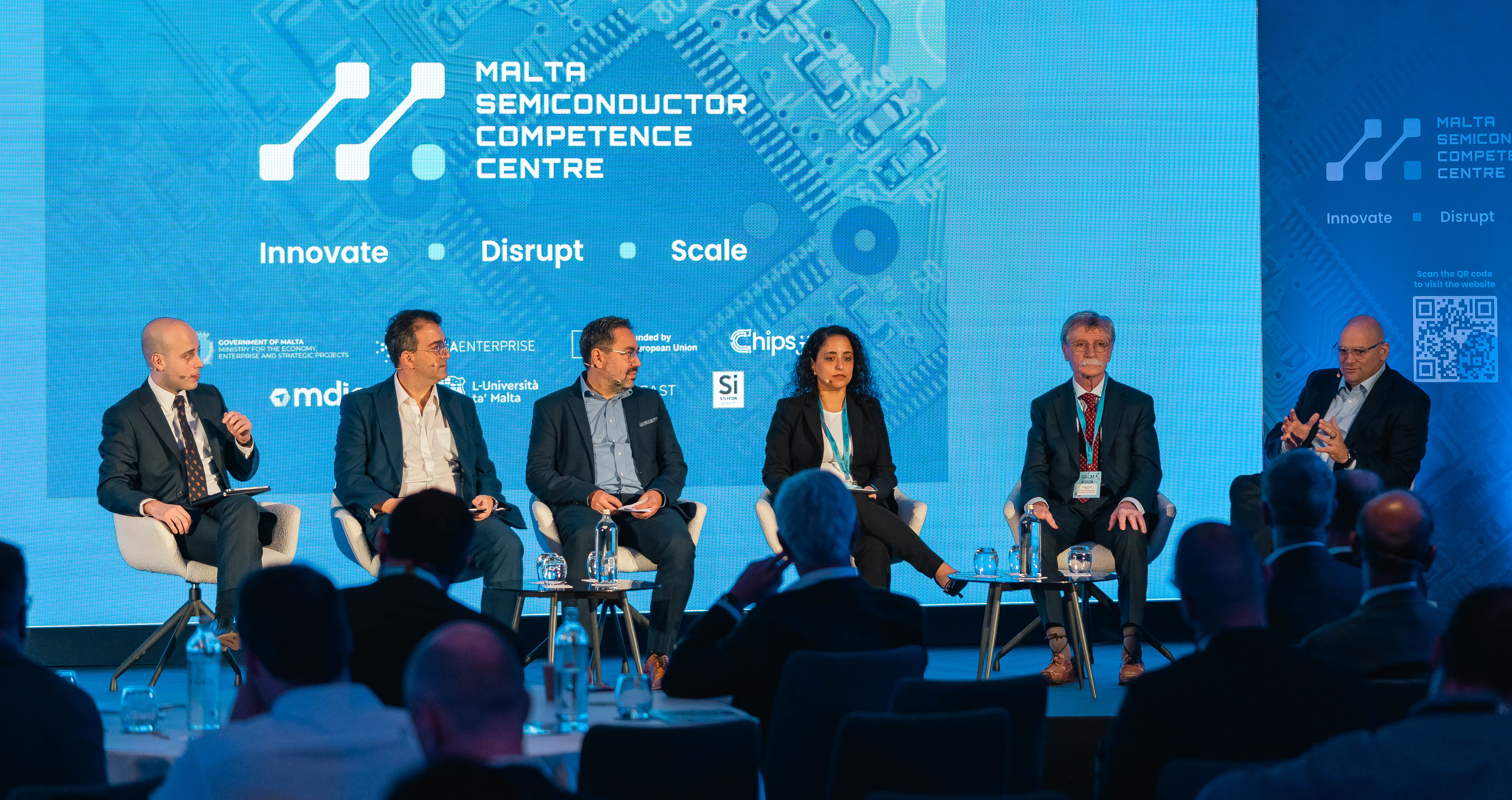
chaired by Matthew Xuereb, Policy Officer at DG CNECT.
Photo Credits: Chips Joint Undertaking
Over the past four decades, Europe has produced only a handful of semiconductor companies valued above US$10 billion, compared with more than a hundred in the US. “We need to do something different,” Redmond argues, and ChipStart EU is designed to help build globally competitive companies from the EEA.
Initiatives, such as EFECS 2025 and the launch of EuroChip design platforms, are central to this effort, providing visibility, trust and direct engagement with pilot lines and partners. Face-to-face interaction matters, Redmond notes and Malta’s close-knit ecosystem makes this possible.
From universities to spin-outs
The University of Malta is another key MSCC partner, particularly in microelectronics and design. Through a single access node for EuroChip, the university is training graduates in design and simulation, connecting them to European infrastructure, such as the R&D hub imec (Interuniversity Microelectronics Centre) and international foundries. The objective is to extend this work into packaging, building on Malta’s industrial strengths and encouraging graduates to remain in Malta through EU-funded projects supported by Malta Enterprise.
One example of this pipeline is ICECAP, a University of Malta spin-out and member of the ChipStart EU cohort. The company, winner of the 2025 Pitch Black competition at Startup Festival Malta, is developing thermoelectric cooling solutions that improve power efficiency for integrated circuits and sensors. Now at pre-seed stage, ICECAP is working with the MSCC ecosystem to secure pilot customers and prepare for market entry.
A coordinated contribution to Europe
In the view of Malta Enterprise CEO George Gregory, the MSCC strengthens an ecosystem that already exists, aligning education, industry and public support with European priorities, such as the Chips Act, Chips Joint Undertaking and IPCEI (Important Project of Common European Interest) projects. By reducing risk through targeted funding and coordination, the aim is to ensure semiconductor investment delivers long-term value in skills, high-quality jobs, innovation and export capacity.
Taken together, these activities show how the MSCC is reinforcing an established industry while integrating it into Europe’s semiconductor strategy – suggesting that in the global chip race, strategic impact and innovation do not depend on size, but on coordination, capability and commitment.
This article was written by Keir Bonine, Brussels-based media consultant and business writer.

 Receive the Funding Newswire [full access requires a subscription] each Tuesday, our Policy Bulletin each Thursday, and the fortnightly R&D Express, tracking reforms and investments in central and eastern Europe.
 A unique international forum for public research organisations and companies to connect their external engagement with strategic interests around their R&D system.