From July, Ireland’s EU Council presidency hopes to advance single market reform, but most eyes will be on budget negotiations
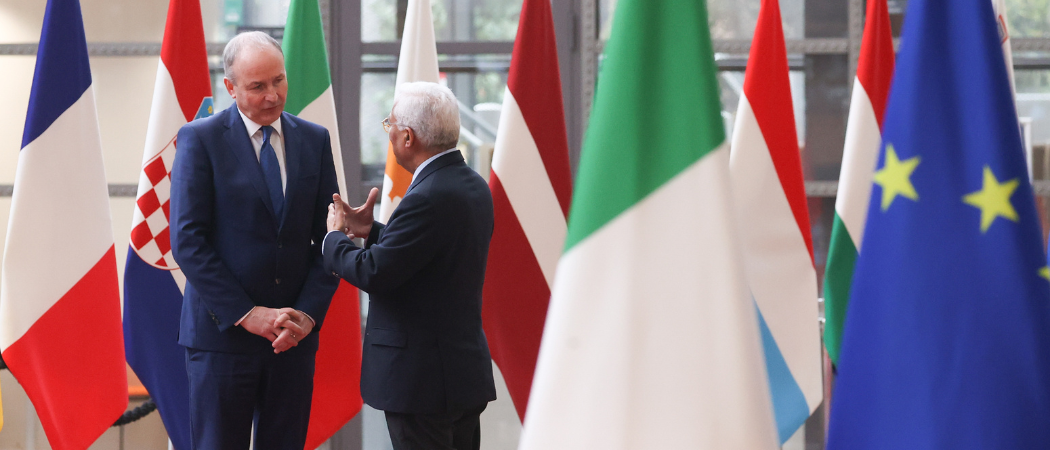
Irish Taoiseach Micheál Martin (left) with European Council President António Costa (right) in 2025. Photo credits: European Union
Ireland plans to use its six-month presidency of the EU Council, starting July 1, to advance work on deepening the single market. However, it will ultimately be judged on whether it reaches an agreement on the next long-term EU budget.
Delivering on the targets set out in the One Europe, One Market roadmap agreed in April between the Council, the European Commission and the European Parliament will be a key priority, Ireland says in its presidency programme, published on June 10.
The roadmap sets ambitious targets to conclude negotiations on several important files by the end of 2026, including a new EU-wide corporate regime, known as EU Inc; the market integration and supervision package, part of broader efforts to create a single market for financing in the EU; and the Industrial Accelerator Act.
“Progressing the savings and investments union and finalising a Council position on the market integration and supervision package will be my primary focus over the coming months,” said finance minister Simon Harris during a press conference to present the programme. “If not now, when, in terms of Europe taking that decision to deepen its capital markets.”
Meetings with his fellow EU finance ministers will have a strong focus on competitiveness, Harris went on. “Priority will be given to advancing current and new competitiveness initiatives, including the simplification agenda.”
The programme also promises to work towards “a more innovation-friendly regulatory and policy environment,” and to “promote investment and reinforcement of resilience in strategic and emerging sectors, including AI, semiconductors, biotechnology and new technologies.”
The Industrial Accelerator Act will therefore be a priority file for the Irish presidency, which also plans to make progress on the Chips Act 2.0 proposal presented last week by the Commission.
Crunch talks
The Irish presidency will also have the significant responsibility of trying to guide EU governments towards a joint position on the EU budget for 2028-34. The target is to conclude negotiations before the end of the year to avoid talks being derailed by elections in several countries, notably France, in 2027.
The presidency also comes at a key time in negotiations over the next Horizon Europe research and innovation programme. EU governments are still hoping to reach an agreement on the Council’s position by the end of the current Cypriot presidency, but there is a chance this could roll over into the second half of the year.
Related articles
- EU governments make final push for FP10 deal this month
- Horizon Europe negotiations shape up for October start
- Fragmented single market is ‘number one problem’ for EU research
Meanwhile, EU governments expect to adopt an agreement on the main elements of the European Competitiveness Fund (ECF) during the General Affairs Council on June 16.
However, it remains to be seen whether negotiations with the Parliament will be able to kick off during the Irish presidency, as MEPs have suggested they could wait until there is a deal on the size of the EU budget before opening talks with member states on files such as Horizon Europe and the ECF.
Ireland’s programme does not set concrete targets for negotiations, but says that “maximising the contribution of research and innovation to Europe’s competitiveness, security, and prosperity will be a key priority.”
Ireland also says it will initiate discussions on the European Research Area Act proposal, due in the autumn, and will look to progress talks on the European Innovation Act, which is currently delayed in the Commission.
Another focus will be strengthening EU relations with the UK, the US and Canada.



 Receive the Funding Newswire [full access requires a subscription] each Tuesday, our Policy Bulletin each Thursday, and the fortnightly R&D Express, tracking reforms and investments in central and eastern Europe.
 A unique international forum for public research organisations and companies to connect their external engagement with strategic interests around their R&D system.