Revised Chips Act should include a dedicated scale-up strategy and a greater focus on deploying innovation
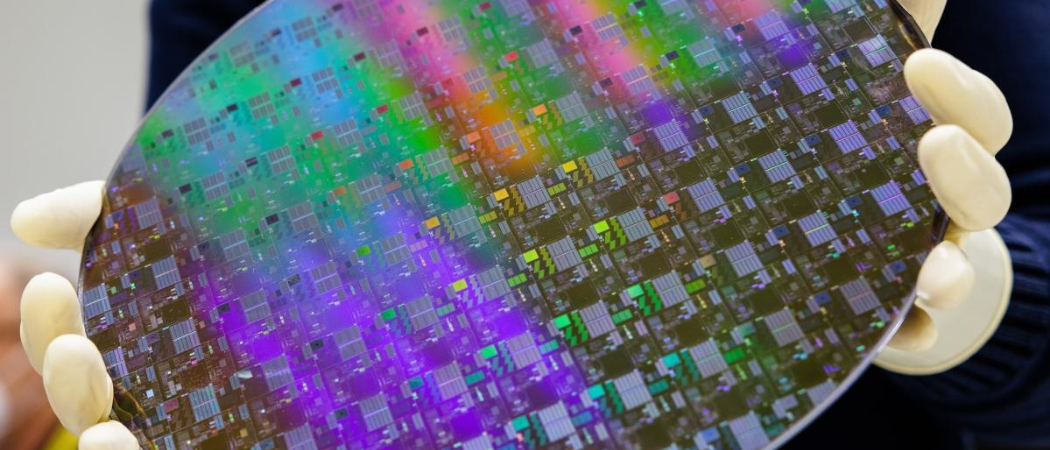
Test structures of microchips on a silicon wafer. Photo credits: European Union
Europe’s semiconductor industry is pushing for a more central role in R&D funding under the revised EU Chips Act, to ensure the relevance and uptake of research results.
R&D support should cover the entire semiconductor value chain as part of a “deployment-oriented framework” that links research with industrial scale-up, according to an industry report that will inform the European Commission’s proposal for a Chips Act 2.0, due in the coming weeks.
The report also calls for funding streams to be brought together under a dedicated EU semiconductor budget, armed with €30-60 billion in EU funding and €50-60 billion from national governments over seven years, alongside a dedicated fund of €20-30 billion for start-ups and scale-ups.
The industry advisory group presented its report to Henna Virkkunen, the commissioner responsible for technology sovereignty, during a meeting on the Chips Act on March 26.
The call to better link R&D and deployment also has backing from the research sector. “A stronger connection between research, industry and end users is essential to truly bring innovations to the market,” said Silvia Lenaerts, rector of Eindhoven University of Technology.
Her university is contributing to one of five pilot lines funded by the Chips Act. These were established precisely to bridge the gap between research and the market, she said, but “we see that the link with industrialisation could be further strengthened.”
Lenaerts told Science|Business that Europe should continue funding the full value chain. “We must preserve room for long-term, exploratory research, even when it is not yet market-ready.” This will require clear choices, focusing on technologies and value chains “where we can truly be strong and make a difference,” she said.
Simplification should also be a priority when revising the Chips Act, Lenaerts added. “Less bureaucracy and better alignment will make collaboration easier and help us achieve results more quickly.”
Lack of industry involvement
The first EU Chips Act, adopted in 2023, was organised around three pillars: technological capacity building and innovation, known as the Chips for Europe initiative; security of supply and resilience; and monitoring and crisis response.
But companies say the R&D pillar, and the Chips Joint Undertaking (JU) responsible for delivering it, are “characterised by a lack of industry involvement and industrialisation focus when setting R&D funding priorities.” In the governance of the Chips Act, there is a lack of alignment between the EU’s strategic objectives and those of the main industrial actors, according to the report.
“A long-term (10 years +) but agile strategy concentrating resources on technology areas where Europe has a chance to take global leadership positions is missing,” it says.
The report names power semiconductors, microcontrollers, analog/mixed signal and sensor technologies, and semiconductor equipment technologies as areas where Europe excels.
The Chips Act 2.0 can capitalise on these strengths by focusing on physical AI and its applications in strategic sectors such as healthcare, manufacturing, aerospace and defence, it continues. This will require targeted R&D investments combined with strengthening existing industrial capabilities.
At the same time, Europe must increase its sovereignty in chip design, industry says. It calls for a targeted EU fund to support R&D in advanced chip design, focusing on leading-edge technologies and fostering partnerships with universities and research institutes.
The revised Chips Act should also stimulate demand by promoting links with end-user industries, including by incentivising them to jointly develop products with European chip makers, the industry blueprint suggests.
Meanwhile, it calls for a sector-specific start-up scaling strategy, including measures to support procurement, close the funding gap and de-risk private investment.
Chips JU
Industry is already represented in the Chips JU, a tripartite partnership between the Commission, participating countries and the private sector. “All our activities” are based on a Strategic Research and Innovation Agenda developed by the European industry, executive director Jari Kinaret told Science|Business.
The Chips JU’s activities are divided into two areas. As part of the Chips for Europe initiative, it supports the development of the pilot lines, a cloud-based design platform, national competence centres and quantum chip technologies. In a second part, it provides broader support for research and innovation in the field of electronic components and systems.
Related articles
- European science ‘hugely dependent’ on US chips
- US creates tech alliance to secure AI supply chain, without the EU
- EU governments set out priorities for Chips Act 2.0
Industry involvement in activities related to the Chips for Europe Initiative is more limited than in the second part, said Kinaret. “Due to the nature of the capacity-building activities, they have a larger representation of research and technology organisations than industrial end-users, who are expected to access the new facilities when they become available.”
The capacity building can be seen as supply, while the electronic components and systems projects are more closely linked to demand, Kinaret said. “I fully agree that the Chips Act 2.0 should place more emphasis on the demand side, which is currently not a part of the Chips for Europe initiative.”
Broaden scope
The industry report also recommends reforming the security of supply pillar of the Chips Act, which supports first-of-a-kind facilities. This instrument focuses too narrowly on semiconductor manufacturing, it says, and should be extended to include design and product development throughout the supply chain, including equipment suppliers.
It also calls for a fast-track process for technologies developed within Important Projects of Common European Interest to get support from the Chips Act.
With the 2023 Chips Act, the EU set out to double its share of the global semiconductor market to 20% by 2030. However, earlier this year, a report from the European Court of Auditors found that the bloc is “far off the pace” needed to meet its ambitions.
In September 2025, EU governments outlined their priorities for the revised Chips Act, which include boosting R&D support from lower technology readiness levels up to first industrial deployment.



 Receive the Funding Newswire [full access requires a subscription] each Tuesday, our Policy Bulletin each Thursday, and the fortnightly R&D Express, tracking reforms and investments in central and eastern Europe.
 A unique international forum for public research organisations and companies to connect their external engagement with strategic interests around their R&D system.