In an interview with Science|Business, the Parliament’s rapporteur shares his vision for FP10 and the ECF
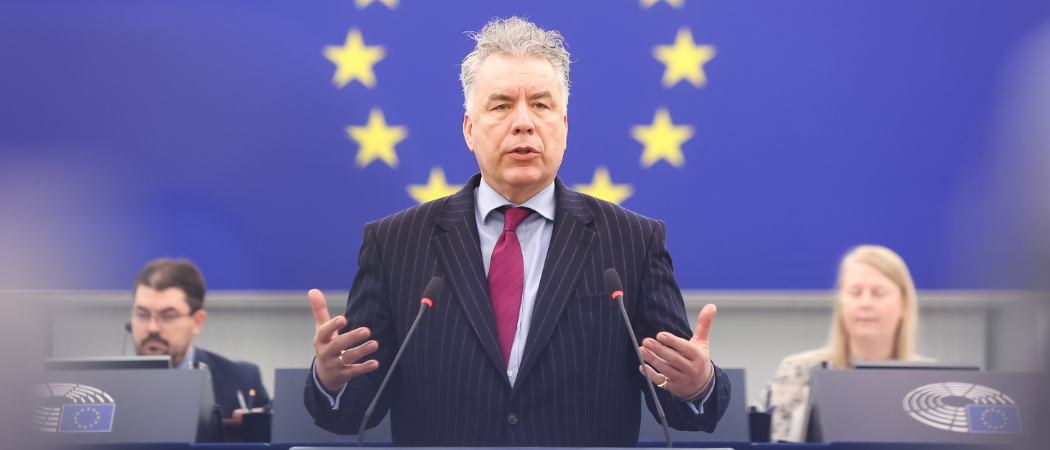
German MEP Christian Ehler. Photo credits: Fred Marvaux / European Union
Innovation is Europe’s main competitive advantage, but industrial policy must not dictate research priorities, said Christian Ehler following his confirmation as lead rapporteur for the tenth EU research Framework Programme (FP10) and co-rapporteur for the new European Competitiveness Fund (ECF).
Ehler, a German member of the European People’s Party who sits on the Parliament’s research committee, told Science|Business that while research and industry should work closely together, especially given the strong link the European Commission envisions between FP10 and the ECF, science must remain independent. The research programme, he warned, should not become a reserve fund for other political goals.
“Industrial policy can’t drive research because that limits its potential,” he said. “There should be an interaction, but not a top-down Commission-driven approach that dictates the research agenda. We want to strengthen stakeholder participation, [. . .] looking more toward an ARPA-like model.”
This refers to the approach employed by the US Defense Advanced Research Projects Agency (DARPA), which gives programme managers huge budgets and the freedom to make risky bets on radically new technologies.
According to Ehler, innovation can make a substantial contribution to Europe’s competitive edge, but he warned against a simplistic, stimulus–response approach in which merely injecting funds into industrial innovation is expected to deliver results. “We have to differentiate to what extent innovation can serve competitiveness,” he said.
This approach aligns with recommendations in the Heitor report, which advocates deeper expert involvement in shaping EU research programmes.
On the budget
First elected to the European Parliament in 2004, Ehler is a veteran of EU research policy, serving as rapporteur for both Horizon 2020 (2014–20) and Horizon Europe (2021–27).
He noted that negotiations over FP10 will be “substantially different” from previous Frameworks, which followed a more predictable, incremental pattern. “Two weeks before the Commission actually announced the MFF [Multiannual Financial Framework] proposals, [the] Horizon [programme] was no longer existing,” he recalled, referring to the uncertainty that surrounded the programme’s future earlier this year.
Before the Commission formally presented its plans for the next MFF in July, rumours had circulated in Brussels that it was considering folding the research Framework Programme into the ECF, merging several existing initiatives under one umbrella.
The final proposal, however, suggests almost doubling Horizon Europe’s budget to €175 billion and keeping FP10 a standalone component separate from the ECF. This outcome reflects months of intense debate between the Parliament and the Commission.
“This is the biggest jump we’ve ever had in the history of Framework Programmes in terms of the budget,” Ehler said, adding that robust funding is essential to counter Europe’s sluggish capital markets, particularly when it comes to investing in deep-tech innovation.
Related articles:
- Ehler appointed rapporteur for FP10 and Competitiveness Fund
- Dual use undermines promised Horizon budget increase, says MEP Repasi
Dual-use research and security concerns
In July, research Commissioner Ekaterina Zaharieva confirmed that FP10 will include funding for dual-use projects, those with both civilian and military applications. According to Ehler, this will be one of the more delicate topics in the coming negotiations.
“I'm relatively sceptical,” he said about merging civil and military research, arguing that defence-related work should primarily be funded under the European Defence Fund. At the same time, he recognised that some basic and advanced research may naturally have dual-use potential and should not be excluded outright.
The key, he said, is to clearly define what qualifies as dual use and to ensure that the Horizon programme itself is not “militarised.” In particular, cooperation should be limited to countries that share the EU’s democratic values.
On the Widening programme, which is designed to help countries that joined the EU after 2004 to improve their performance when bidding for EU research funds, Ehler argued it must remain part of the Horizon negotiations rather than being shifted to the broader MFF talks.
“My first intention is to get the Widening out of the brackets,” he said, referring to annotation in the Council’s version of the MFF proposal indicating that diplomats dealing primarily with budget issues will play an important part in its negotiation.
Negotiations ahead
As lead negotiator for FP10 and co-rapporteur for the ECF, Ehler will have to steer discussions among MEPs, member states, research stakeholders and the Commission in the upcoming months.
This will be complex, he said, with the different institutions pursuing divergent goals. Research ministers, he said, tend to prioritise excellence-driven science, while economics ministers view the Horizon Europe programme more as a tool for industrial competitiveness, and finance ministers see it as a potential reserve for national budgets. The Commission, meanwhile, seeks flexibility to respond to emerging challenges.
From the Parliament’s perspective, the plan is to strengthen independence, bottom-up research and stakeholder participation. “We want to run a modern programme, we have to stay away from this idea that politics are steering research and innovation,” he said. However, “It's plausible that we align behind bigger missions. I expect that, for example, on quantum,” he added.
Despite the complexity, Ehler remains optimistic. “There’s a general appreciation across institutions of the role of innovation for the future of Europe,” he told Science|Business.
Finally, addressing recent threats from the Parliament’s leaders to reject the Commission’s overall budget proposal, Ehler said the dispute mainly concerns agricultural and structural funds, and that FP10 and the ECF should remain unaffected. “The Parliament might be the strongest supporter of the research community,” he concluded.


 Receive the Funding Newswire [full access requires a subscription] each Tuesday, our Policy Bulletin each Thursday, and the fortnightly R&D Express, tracking reforms and investments in central and eastern Europe.
 A unique international forum for public research organisations and companies to connect their external engagement with strategic interests around their R&D system.