Controversy erupts over how rapporteurs for FP10 and the European Competitiveness Fund were chosen
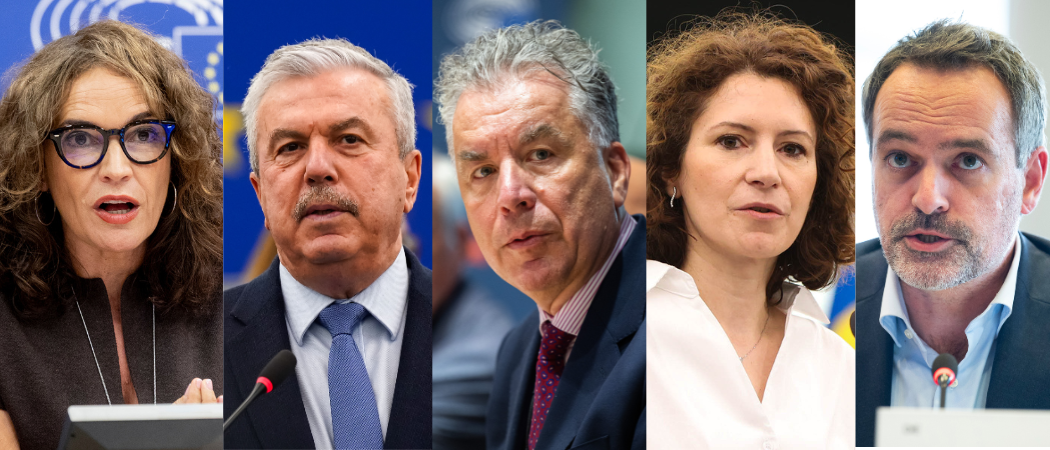
From left to right: Lina Gálvez (S&D), Dan Nica (S&D), Christian Ehler (EPP), Eszter Lakos (EPP) and René Repasi (S&D). Photo credits: European Union
MEPs from left and right-wing groups are protesting the way legislative files on research and innovation have been shared out in the European Parliament’s research and industry committee. Normal procedures were ignored, they say, and the various coordinating roles shared out “behind closed doors.”
Rapporteurs and co-rapporteurs lead the drafting of legislative files within the Parliament, and lead negotiations with the EU Council and European Commission. Political groups not included in these positions can appoint shadow rapporteurs who follow the process, propose amendments and ensure their priorities are represented in the final text.
As previously reported by Science|Business, the most significant of these roles has gone to German MEP Christian Ehler from the European People’s Party (EPP). He was confirmed on November 5 as lead rapporteur for the next EU research Framework Programme (FP10) and co-rapporteur for the European Competitiveness Fund (ECF), alongside Dan Nica of the Progressive Alliance of Socialists and Democrats (S&D).
The two were co-rapporteurs when legislation for the present Horizon Europe programme went through Parliament.
Lina Gálvez will serve as S&D shadow rapporteur for FP10. Shadows from other groups will be announced in due course.
Meanwhile, René Repasi (S&D) will act rapporteur for the FP10 specific programme, a separate piece of legislation covering implementation measures. Eszter Lakos will be the EPP shadow rapporteur.
A contested procedure
The allocation of these files has been criticised by several MEPs, who think normal procedures have been ignored.
Speaking during an extraordinary meeting of the research committee on November 5, Paolo Borchia of the Patriots for Europe group said the usual system, a points-based “auction” where each political group bids for reports in proportion to its size, was bypassed. This mechanism is intended to ensure transparent and balanced distribution of files among political groups.
According to Borchia, the allocations were made “behind closed doors [. . .] through a private agreement between the EPP, the S&D, and Renew Europe,” without debate or bidding. “After nine years working in this committee, I’ve never seen such an important and sensitive allocation handled in this way,” he told Science|Business.
Daniel Obajtek from the European Conservatives and Reformists (ECR) group denounced the move, calling it “a kind of cartel.”
“This is an undemocratic and unfair approach, unworthy of EU institutions,” he told Science|Business. “It doesn’t make sense to attend coordinators’ meetings if three gentlemen can make decisions over a beer,” he said during the committee meeting, most likely referring to Ehler as EPP coordinator, Nica as S&D coordinator and Christophe Grudler, the Renew coordinator.
“In an unofficial meeting, the coordinators of the three majority groups divided up the reports of the most important legislative package of this term, the next multiannual budget,” said Dario Tamburrano representing the Left grouping.
When files were allocated for the present Horizon Europe programme, Ehler and Nica won their drafting roles after an auction.
Related articles:
- Ehler appointed rapporteur for FP10 and Competitiveness Fund
- Commission puts forward €175B budget for FP10
- ‘Self-standing’ FP10 will be ‘tightly connected’ to European Competitiveness Fund, Von der Leyen says
Ehler responds
Ehler defended the process, saying that the allocation of the files was based on established committee working methods. “A large majority in the committee has confirmed this deal today,” he told Science|Business, adding that discussions should now focus on the content, rather than on procedural questions. “It is surprising to me that the Greens have voted together with the far-right, thereby risking that these files fall into the hand of anti-European forces,” he added.
In practice, the EPP, S&D and Renew, being the majority, would have had the numbers to achieve the same result. What annoys protesting MEPs is that the democratic spirit of the procedure was disregarded.
“The coordinators meeting is one of the few places where all groups can compete on equal terms,” Borchia said. “And undermining that principle sets a dangerous precedent that damages trust and democratic balance.”
The ECR group formally contested the allocations decided on October 23, but the coordinators’ decision was ultimately approved on November 5, with 50 votes in favour and 37 against.
Borys Budka, the EPP MEP who chairs the research committee, did not respond to requests for comment on the coordinators’ decision and their approach by the time of publication.
Welcome back
Brussels-based research and innovation stakeholders are unconcerned by the Parliamentary row, and are preparing to work closely with the newly appointed rapporteurs and shadow rapporteurs.
“Ehler is the most experienced MEP on the Framework Programme and has been very outspoken on the ECF over the past months,” said Kurt Deketelaere, secretary-general of the League of European Research Universities. He also acknowledged Dan Nica’s experience.
“Gálvez and Lakos are upcoming stars in the Framework Programme file, so this will be a good experience for both,” he told Science|Business.
This view was shared by Vinciane Gaillard, director of research and innovation at the European University Association, and Jan Palmowski, secretary-general of the Guild of European Research-Intensive Universities.
Palmowski highlighted the added value of the shadow rapporteurs, “with Lakos developing a focus on how to bring together inclusiveness and excellence.” Meanwhile, Gálvez had impressed with her contributions to discussions about how research and innovation can contribute to competitiveness, he added.

 Receive the Funding Newswire [full access requires a subscription] each Tuesday, our Policy Bulletin each Thursday, and the fortnightly R&D Express, tracking reforms and investments in central and eastern Europe.
 A unique international forum for public research organisations and companies to connect their external engagement with strategic interests around their R&D system.