Trump’s squeeze on science should be met with enhanced, more diverse international partnerships, conference hears
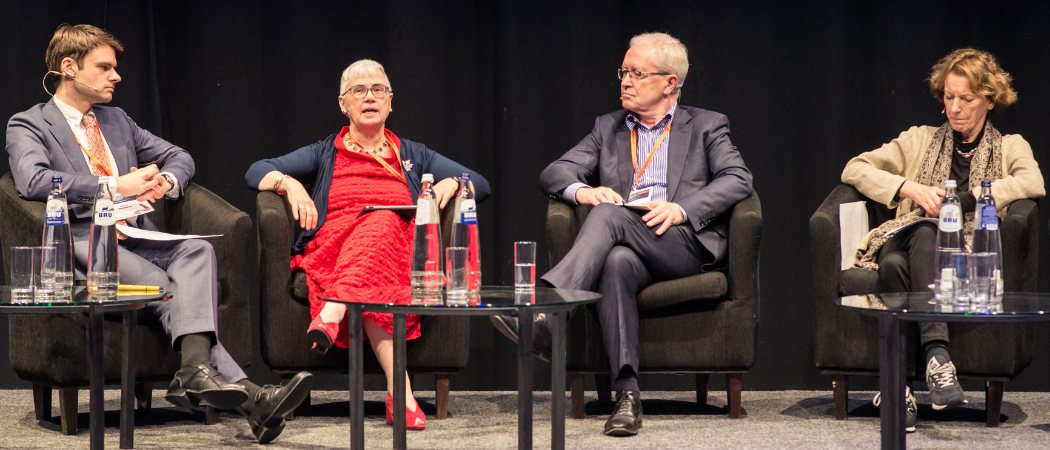
From left to right: David Matthews, international editor at Science|Business, Leslie Weir, president of the International Federation of Library Associations and Institutions and Canada's Librarian, Hugh Brady, president of Imperial College London, and Maria Leptin, president of the European Research Council. Photo credits: Jeroen Vanhecke
Science leaders in Europe and Canada say international cooperation must go on amid geopolitical turmoil. At the same time, Europe and like-minded countries should continue to enhance and diversify international partnerships, a Science|Business conference hears.
Hugh Brady, president of Imperial College London, told delegates that Europe’s response to the current geopolitical climate should be to “diversify in terms of research partnerships and build resilience and scale into our own system.”
A first priority should be for the EU to sort out the scope of the upcoming European Competitiveness Fund and ensure that, together with the next iteration of Horizon Europe, it can drive the development and scale up of new technologies.
The EU and the countries associated to the Horizon Europe programme represent “the world's most successful research innovation ecosystem,” Brady said. In order to mitigate the negative effects of shifting geopolitics, the EU together with the UK, Switzerland, Canada, South Korea and others should talk about “building resilience” and address their own “regional needs,” he added.
Responding to Trump
Under Donald Trump’s leadership, the US government has slashed science budgets and shut down international research programmes. Nearly 8,000 grants at the National Institutes of Health and the National Science Foundation have been frozen or terminated. Courts have overturned most of these cancellations, but the disruption caused remains significant.
While Europe may persuade a few thousand disgruntled scientists to move across the ocean to work on topics that have been de-funded in the US, it’s unclear what should happen next with transatlantic scientific cooperation more broadly.
“Now is the time for us to show [US researchers] our support as much as we can,” Brady said.
The European Research Council (ERC), the EU’s basic science funder, has seen a surge in applicants from the US. According its latest data, US-based researchers submitted 347 proposals to the last three big funding rounds, up from 158 in the previous set of calls.
The European Commission has also launched a €22.5 million pilot call in 2025 for the Marie Skłodowska Curie Actions, the EU’s researcher training scheme. It plans to extend this support with a €51.25 million call in 2027 as part of the Choose Europe initiative, which is intended to make the continent a more attractive place to pursue a career in research.
Related articles
- Data corner: US researchers are choosing Europe
- EU-India deal highlights growing alignment on technology policy
Meanwhile, in the private non-profit sector, the Volkswagen Foundation is experimenting with a new type of grant that would allow US researchers to split their time between the US and Germany.
While these schemes are useful, Europe should not bet on an exodus of scientists from the US. “The idea that we might all see them flocking over to Europe is naïve and counterproductive,” said Maria Leptin, president of the ERC, also speaking at the Science|Business conference on February 5.
“We need research in the US to be as healthy as possible. I really admire those who are staying there with a will to fight and an optimism that the world will turn into a better place again,” Leptin said.
Preserving data
Despite political disruption, academics have found ways to continue cooperating and sharing research data.
Leslie Weir, president of the International Federation of Library Associations and Institutions and Canada’s national librarian, said the US cuts have raised concerns about research data security, after ideologically sensitive databases were limited or deleted by the Trump administration. But international organisations teamed up to ensure that the data is not lost.
“It's interesting to see that researchers and libraries across North America are collaborating to make sure that data at risk is duplicated elsewhere outside [the US],” Weir said.


 Receive the Funding Newswire [full access requires a subscription] each Tuesday, our Policy Bulletin each Thursday, and the fortnightly R&D Express, tracking reforms and investments in central and eastern Europe.
 A unique international forum for public research organisations and companies to connect their external engagement with strategic interests around their R&D system.