There are concerns that the strategies are overlooked in the European Commission’s proposed future cohesion plans
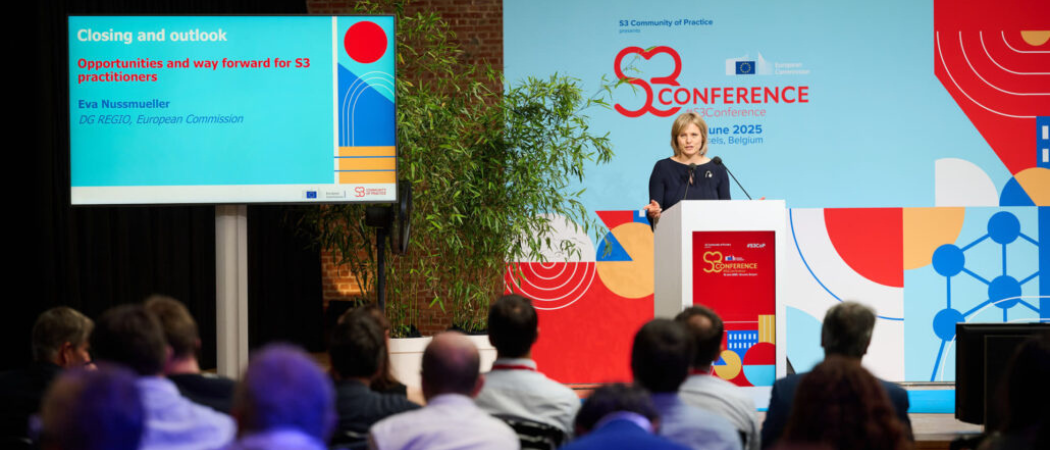
Eva Nussmueller, acting head of unit for smart and sustainable growth at DG REGIO, speaking at the Smart Specialisation Strategies Conference in June 2025. Photo credits: European Union
A group of 12 European associations has called on the EU to ensure that Smart Specialisation Strategies (S3), which help regions coordinate R&D priorities, are maintained and reinforced during the next long-term budget period from 2028 to 2034.
The group, led by the European Association of Development Agencies (Eurada) and the European Regions Research and Innovation Network (Errin), published an open letter on March 16 addressed to the European Commission, the European Parliament and the European Council.
Their issue stems from the draft for the next EU Multiannual Financial Framework (MFF), proposed by the Commission in July last year. The group writes that “under the current MFF proposal, S3 faces strategic ambiguity and risks being reduced to an optional territorial reference.”
The goal of S3 is to help regions focus their innovation spending on areas in which they already have a strong footing or advantage. It was first announced in 2010 and has been in place since 2014. The strategies are legally required in order for countries and regions to access research and innovation funding under the European Regional Development Fund.
In total, around €70 billion in research and innovation funding is guided by the S3 tool over two EU budgetary periods, from 2014 to 2020 and 2021 to 2027. In most cases, the regions take the lead on developing and implementing the strategies.
But under the new MFF proposal, S3 is “hardly mentioned,” and it remains unclear to what extent it will be a required tool to access regional innovation funding, according to Francesco Molica, director of Eurada.
“The lack of a legal framework makes us worry about S3 strategies being discontinued in countries or regions, or, where they are still in place, being structured differently and causing fragmentation,” Molica told Science|Business.
He added that he isn’t necessarily worried about S3 not being an enabling condition to access funds, but that it should be more codified and given a solid legal backing.
Pirita Lindholm, director of Errin, also questioned the proposal and how it could impact regional innovation spending, saying that “it raises the big question of how the research and innovation dimension could be secured in the proposed national and regional partnership plans if not through smart specialisation.”
"We still see smart specialisation as a backbone to make sure that both the research and innovation dimension as well as regions and their priorities are properly considered at a national level,” she added.
S3 is more than just a tool for local authorities to direct funding or for weaker regions to increase their innovation potential, said Ewa Chomicz, policy and engagement manager at Errin. It also increases cross-border regional cooperation, helping countries with similar thematic goals to come together.
“We see S3 as something broader than just a tool for cohesion policy. It is also a tool that could be used to strengthen Europe’s research and innovation efforts,” she said.
It also supports Europe’s need to increase technological competitiveness, Molica said. “Even a strongly innovative sector in a more developed region might still need to rely on activities for its value chain that are located in a less developed region,” he said, pointing out that S3 is “instrumental” in creating these links.
The open letter reflects the wider concerns of regional authorities. The European Committee of the Regions, the EU’s grouping of local and regional representatives, has backed S3 on several occasions in recent weeks. In its opinion on the proposed European Competitiveness Fund, it states that the strategies “are a key place-based tool to strengthen synergies between the national and regional partnership plans and the European Competitiveness Fund.”
S3 popular but still unproven on EU level
The broad consensus in the EU is that smart specialisation is a valuable tool.
A survey by the European Court of Auditors, published in a 2025 report, found that 80% of the 104 regional and national authorities that responded would still prepare a Smart Specialisation Strategy even if it was not a requirement for receiving EU money. “Most of our respondent regions indicated that they find smart specialisation concept useful,” the auditors state.
Meanwhile, EU Council conclusions on cohesion policy published in March 2025 note “the importance of smart specialisation strategies [. . .] to help regions develop competitive capacities, strengthen regional value chains and integrate into global value chains.”
“I think now most of the regional authorities have fully absorbed and understood S3 and are trying to apply it to the most effective way,” Molica said.
What is missing, though, is an EU-wide evaluation of the effectiveness of the S3 tool, with only a few smaller analyses carried out at a national or regional level.
Related articles
- Auditors urge greater links between regional and EU innovation strategies
- EU urged to exempt research spending from deficit rules
The Commission put out a call in 2024 for an external study, but so far no results have been published. The auditor’s report points out the need for such an evaluation to take place in order to understand how best to implement S3 going forwards.
For Molica, not continuing with S3, or marginalising it during the next seven-year budget period, would be a step in the wrong direction.
“We now have smart specialisation experts in all, or in most of the regional administrations. They know what the S3 concept is and how it can be used,” he said. “I would expect now to be honest that the S3 concept is strengthened, instead of being phased out.”
He is hopeful that the topic will be reviewed during upcoming debates between EU member states, and the Commission and Parliament on the MFF and cohesion policy.



 Receive the Funding Newswire [full access requires a subscription] each Tuesday, our Policy Bulletin each Thursday, and the fortnightly R&D Express, tracking reforms and investments in central and eastern Europe.
 A unique international forum for public research organisations and companies to connect their external engagement with strategic interests around their R&D system.