Influential adviser and ex-Portuguese science minister Manuel Heitor calls out the broken system of short-term contracts

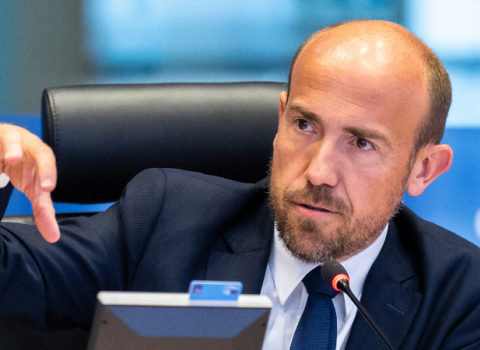
Manuel Heitor, former Portuguese research minister, addresses the Science|Business conference on Fostering Innovative Careers held in Zagreb on March 26, 2026. Photo credits: Science|Business
Europe must end the “bad practice” of project-dependent salaries for researchers, Manuel Heitor, Portugal’s former science minister, said at a Science|Business conference in Zagreb on March 26.
“Funding schemes tend to be around three years, and most European institutions, if not all, have adopted the bad practice of contracting young adults for the duration of these projects,” he said in a video message to the conference Fostering Innovative Careers. “We need to recognise it as a bad practice that needs to be broken.”
Heitor is the author of the 2024 Align, Act, Accelerate report that laid out 12 recommendations to improve Europe’s research and innovation funding landscape. One suggestion was to launch a “choose Europe” initiative to attract and retain research talent.
The European Commission picked up on this idea and last year, at an event at Sorbonne University in Paris, Commission President Ursula von der Leyen announced a €22.5 million Choose Europe for Science pilot scheme to be run through the Marie Skłodowska-Curie Actions. The initiative, largely in line with Heitor’s recommendation, offers young researchers co-funding from their host institution and the MSCA for a period of five years. The host institute is encouraged to offer longer term employment opportunities during this period.
Von der Leyen also announced a new “super grant” that has become the European Research Council’s ERC Plus grants, which offer longer, seven-year projects with a maximum grant size of €7 million, as part of Europe’s efforts to retain and attract scientific talent.
Heitor welcomed the new MSCA pilot scheme, but said it was only a starting point. “The current budget is very, very low and unacceptable. It can only be understood as a very initial and preliminary pilot phase,” he told Science|Business in a discussion following the Zagreb conference.
He is calling for the MSCA budget to be increased threefold under the next Horizon Europe programme, bringing it up from around €9 billion to over €30 billion for the period 2028 to 2034. This increased budget would support a larger Choose Europe initiative, he said.
Lost institutional memory
Mostafa Moonir Shawrav, executive director of the Marie Curie Alumni Association, also said that precarious short-term academic work contracts were a challenge.
“If you have project-based funding, you don’t have institutional memory and subject-specific memory, and that means there is a lack of understanding, a lack of depth of knowledge in that field,” he said, speaking in Zagreb on a panel addressing research careers after Heitor’s video message.
Universities must have greater access to structural funding in order to offer more stable careers, he said, but he did not completely dismiss the idea of project-based funding. “You still need to have the competition factor there. You need to have mobility,” he said, saying a better system would be some combination of project-based and structural funding.
“I think it should be balanced, but I don’t see that happening by the next Framework Programme,” he said.
For Miroslav Rajter, associate professor in the law faculty at the University of Zagreb, the culture of project-based funding comes from what he calls “survivor bias.” “When you have some people who have managed to stay in academia through various project-based funding jobs, they say, well this is just something everyone should do because I did it,” he said.
If this problem isn’t addressed, he went on, the flow of people leaving academia will continue and possibly increase. “They will seek security and stability,” he said. “It should not be that someone in their 20s or 30s is punished for wanting to have the security they need to start a family.”
Related articles
- Venture PhD scheme pitches ‘radical reimagining’ of doctoral training
- EU considers model contracts for academic researchers
The precarity of research careers in Europe is a long-standing issue. A 2016 report by Science Europe that looked into the careers of postdocs found that the time a researcher spends in postdoc positions, which are almost always temporary and can often last just a few years, is increasing considerably.
“Often, researchers began their doctoral training more than 15 years earlier, and have held a doctorate degree for more than ten years, before they access a secure or quasi-secure position, or are awarded their first important independent grant,” the report states.
The proportion of researchers employed on a temporary basis varies by institution in Europe, but various studies indicate that anywhere between 10% and 80% of scientific personnel can be employed on fixed-term contracts. A 2024 report by university alliance Cesaer put the figure at 11% to 47%, while a 2025 report by the Rathenau Institute looking only at the Dutch system noted that 55% of universities’ scientific personnel were on a temporary contract.


 Receive the Funding Newswire [full access requires a subscription] each Tuesday, our Policy Bulletin each Thursday, and the fortnightly R&D Express, tracking reforms and investments in central and eastern Europe.
 A unique international forum for public research organisations and companies to connect their external engagement with strategic interests around their R&D system.