Research and scale-up funding could yield massive alternative protein food market
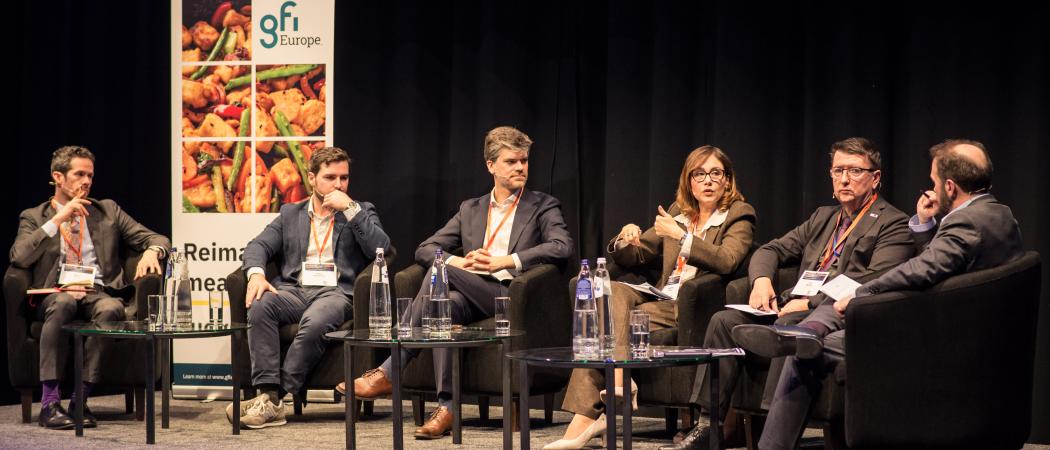
Left to right: Rupert Simons, Bosco Emparanza, Alex Holst, Rosalinda Scalia, Ivan Stefanic and moderator Simon Pickard at the Science|Business annual conference on 5 February.
Animal-free dairy and meat might sound like oxymorons, but there’s a growing industry in Europe set to change that: alternative proteins.
These foods—cultivated meat, fermentation-made products and plant-based foods—are designed to taste similar—or even identical—to conventional meat and dairy products. The difference is they don’t involve slaughtering or farming animals.
They’re made using methods, such as giving yeast or other organisms the instructions needed to produce animal fats, growing fungi that have a meaty texture using side streams from the brewing industry, or even growing real meat from stem cells.
While foods made using these innovative methods have yet to reach the European market, ingredients made with these techniques can enhance the taste and flavour of plant-based products that people across Europe are already familiar with.
New research by Systemiq suggests that if the EU invests €690 million per year in R&D and €720 million in scaling-up businesses, the alternative protein industry could add €111 billion to the bloc’s annual gross domestic product—comparable to Europe’s world-renowned wine industry.
The domestic market could be worth €79 billion—roughly equivalent to the GDP of Lithuania in 2024—and the export market could be €60 billion, which is about the value of the EU’s current exports to South Korea. “If it was a country, you’d want to do a trade deal with it,” Systemiq’s Rupert Simons said during a panel session at the Science|Business annual conference on 5 February.
The research also finds that by reducing reliance on imported animal feed, alternative proteins can also help make Europe more resilient in the face of increasingly volatile global supply chains.
The EU is currently negotiating two funding programmes that could help get the job done: the next iteration of the Horizon Europe research funding programme, with a proposed seven-year budget of €175 billion, and the new European Competitiveness Fund, to which the European Commission wants to allocate €409 billion.
Funding target is ‘realistic’
Annual public R&I of €690 million and public support for scale up of €720 million in the sector is “realistic,” said Alex Holst, deputy head of policy at nonprofit thinktank the Good Food Institute Europe (GFI Europe), which commissioned the Systemiq research. However, “we’re not there yet,” cautioned Holst. “We need to leverage things like the European Competitiveness Fund and the instruments that the European Investment Bank has available in order to get to those investment numbers.”
But it’s not just about money. The EU has strict authorisation procedures for companies that want to market “novel foods,” which means basically any food that Europeans weren’t typically eating before 1997. “We should keep our high food safety standards, but what the sector and the innovators need is predictability,” said Holst. “What we need is better implementation of the existing regulation, not wholesale revision.”
Yet Bosco Emparanza, CEO and founder of Spain-Based fermentation startup MOA Foodtech, described the Novel Food Regulation as a “stopper” for the industry. Nevertheless, Emparanza said MOA Foodtech is staying in Europe because of strong demand. “Europe is the first one in the world, probably, demanding these alternative ingredients for the food industry and for the pet food industry.” He also lauded the European Commission for “doing great in building the optimal ecosystem for startups to grow.”
‘Mixed signals’ in draft biotech rules
In December, the Commission proposed the European Biotech Act, which will introduce new rules for biotech products. The proposal contains “some really good developments,” Holst said, such as allowing regulators to give advice to novel food producers before they submit a request for market authorisation. “That’s exactly what the sector needs.”
But he also noted that the draft law gives “mixed signals” on regulatory sandboxes, which allow testing of biotech products before they receive market authorisation. The Commission’s proposal for the Biotech Act excludes novel foods from those sandboxes, which GFI has called a “missed opportunity.”
The battle for hearts and minds—and wallets
Another hurdle is public opinion: while some people are curious and even enthusiastic about the animal welfare implications of alternative proteins – or support this food’s ability to create new market opportunities for farmers – others are wary. “This is something that we need to face,” said Rosalinda Scalia, deputy head of bioeconomy and food systems at the Commission’s research policy department. “We need to go deep into the reasons why certain citizens are more open to it, while others feel sensitivities there.”
Scalia noted that under the current Horizon Europe programme, there’s a €2 million project to gauge public acceptance of alternative proteins. “We are really looking forward to seeing the results,” she said.
Initial studies have suggested that some consumers may already be open to these foods. Research by GFI Europe with Accenture found that around half of consumers in France, Germany, Spain and the UK were willing to try dairy and egg products made using precision fermentation – a process that has already been used for decades to make rennet for the cheese industry.
But public acceptance is also linked to price, argued Systemiq’s Rupert Simons. Today, the market for alternative proteins “is largely a premium market—it’s targeting a vegan or ‘flexitarian’ demographic. It has not yet got to the point where it is able to compete with and win market share on price,” he added. “Price is essential to mass market adoption, and until we reach price parity, that mass market adoption will lag behind.”
With the right support, that could happen anywhere between 2028 and 2040, conjectured Simons. “It's not happening yet, but it will happen within the careers of some of our political leaders today.”



 Receive the Funding Newswire [full access requires a subscription] each Tuesday, our Policy Bulletin each Thursday, and the fortnightly R&D Express, tracking reforms and investments in central and eastern Europe.
 A unique international forum for public research organisations and companies to connect their external engagement with strategic interests around their R&D system.