Now in its third year, the Pioneering Research programme wants “science fiction” ideas that are too radical for other funders
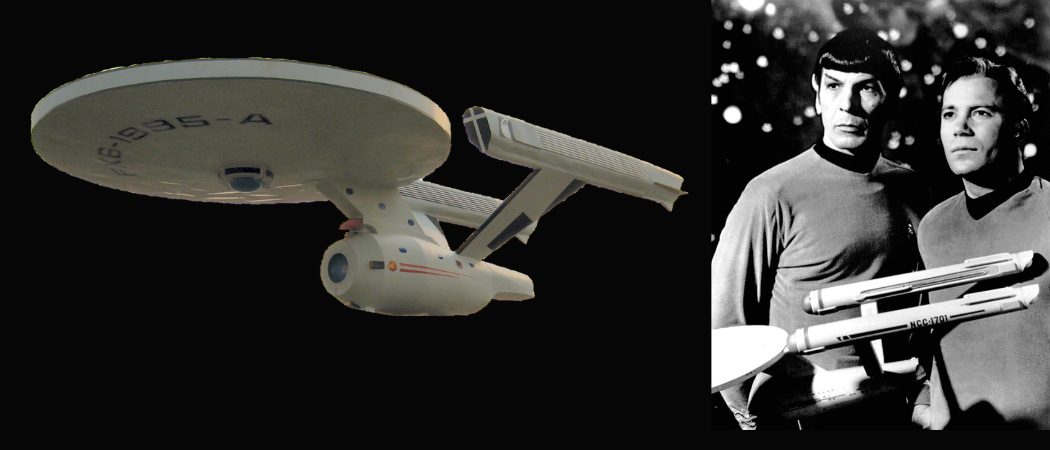
Photo credits: NBC Television / Wikimedia Commons
Germany’s biggest private, not-for-profit research funder is now in the third year of funding “science fiction” research proposals that other funders won’t touch.
The Pioneering Research – Exploring the Unknown Unknown programme offers up to €1.3 million over three to five years for ideas that could create whole new scientific fields, but have a high chance of failure.
So far, the Volkswagen Foundation, which is independent of the car manufacturer, has used the programme to back research into whether depression can be cured using blood transfusion, and whether life can exist on other planets without sunlight.
The foundation is after project ideas that are “science fiction” but not “fantasy,” explained Pavel Dutow, a programme director at the foundation. “Fantasy is actually not possible, but science fiction is possible, maybe in 100 years, maybe in 300 years,” he said.
“If you think of certain TV shows like Star Trek [. . .] they are based on science. And this is, I think, what we want,” he said.
The grants are for projects few other funders would back. “This kind of research [support], where we just offer money for something risky, is not really existent in Germany,” said Dutow.
Right now, if scientists want to win grant funding, they often already need to have a pre-tested proof of concept, said Dutow. Instead, “we want to give the scientists the chance for a very risky hypothesis, which has never been tried or approved or even thought of.”
One funded project will investigate whether mammals, including humans, transmit chemical signals that prime each other’s immune systems against diseases, strengthening immunity without having first to be infected.
It’s known that plants do this, but it’s never been explored whether mammals have a similar mechanism. If they do, this could open up radically new options for fighting epidemics.
“I have dreamt about this project since I was a postdoc,” said Lena Pernas, an assistant professor at the University of California, Los Angeles, who is leading the project.
“But [I] never thought I would actually be able to address it because a) I have zero preliminary data; and b) the concept is, as a dear colleague and friend said, ‘fascinating and deliciously plausible while being so off the wall’,” she said.
Most grants in Germany and the US require preliminary results, she added, making this kind of more speculative research very hard to do.
Eligibility
While the vast majority of projects funded so far are based in Germany, this doesn’t have to be the case, as Pernas’s project shows. So long as projects have a partner based in Germany who is “substantially involved,” grant money can flow outside the country, Dutow explained.
The grants are focused on basic research, and open to all fields. Successful projects so far range from soft robotics and mind-altering plants, to the history of postcolonial Namibia. Applicants need a doctorate to apply.
Ideas don’t necessarily have to be completely new. The foundation would back a new approach to an old unsolved scientific problem, for example.
But “incremental” research won’t be funded. A protein researcher, say, who simply wants to apply their knowledge to a new protein, is “not what we are looking for,” said Dutow.
Proposals also need “scientific relevance,” he said. If successful, they might lead to a “paradigm shift” in their field, or have relevance in other fields too.
Applications are mostly rejected because they develop an already established research branch, Dutow explained. If a proposal has a chance of funding with a more conventional funder, “that's a kind of ‘no go’ for us,” he said.
The programme should be open again in the autumn for a new round of applications.
Related stories
Ballooning applications
The foundation launched funding for “unknown unknowns” in 2022, but without much fanfare. It simply uploaded a single sentence to its website telling scientists to get in touch if they had a risky proposal. There was no deadline, rules or template included.
But despite such limited promotion, it received nearly 70 applications. “We kind of realised that there is a need for such research,” Dutow said.
In the following two years, the foundation formalised the scheme, adding a deadline and more of a structured application format. Interest boomed, and for the last call in September 2024, the foundation received around 500 applications. “Of course, it’s challenging,” he said of this glut of applications.
The application is split into two stages. The first is a pre-proposal, which includes résumés and requires around four pages of information, outlining why an idea is pioneering, why it has never been done before, and a “very very brief” budget plan, he explained. “It should not mean a lot of effort.”
These get read by foundation funding officers, who typically have scientific backgrounds. In a frantic three months, they drastically whittle down pre-proposals.
In the current round, of the 500 pre-proposals, just 31 were invited to submit full applications.
This involves writing a more fleshed out proposal of 15 pages, plus extra information like résumés and data management plans.
The foundation plans to fund around half of these more detailed proposals. In other words, the success rate of getting through the first round is very low, but once that hurdle is cleared, chances are pretty good.
All in all, it takes around 10 months from the first pre-proposals to winners receiving money, said Dutow.
Radioactive life
“I found the application process and the assessment length almost perfect,” said Walter Geibert, a researcher at the Helmholtz Centre for Polar and Marine Research in Bremerhaven. Other grant applications “take up an enormous amount of effort” for a “very slim chance of funding,” he said.
Geibert won funding to investigate whether manganese nodules, mineral lumps that cover the sea floor, could be considered forms of life which use radioactive decay as a form of energy. If they are, this could upend our assumption that life needs sunlight to exist.
“If proven correct, radioactivity could support life basically on any planet or moon, even far away from a sun,” he said.
One year into the project, the funding has allowed Geibert to develop insights “that would have taken me years in other funding routes, if possible at all,” he said.
Now in its third year, the foundation is grappling with how to measure whether the scheme is working. Because the aim is to create really disruptive new ideas and fields, Dutow is sceptical that metrics such as patents or publications will be meaningful. “I don't think you [. . .] can express it in numbers,” he said.
The foundation will ask the teams themselves whether their hypothesis proved true. But that is also fraught with difficulties. “Would you say, no, it failed to your funder?” he asked.
Editor's note: this article has been updated to correct the number of applications received in 2022, and the length of full proposals.


 Receive the Funding Newswire [full access requires a subscription] each Tuesday, our Policy Bulletin each Thursday, and the fortnightly R&D Express, tracking reforms and investments in central and eastern Europe.
 A unique international forum for public research organisations and companies to connect their external engagement with strategic interests around their R&D system.