New conditions on US federal research funding will make transatlantic projects less attractive, universities fear
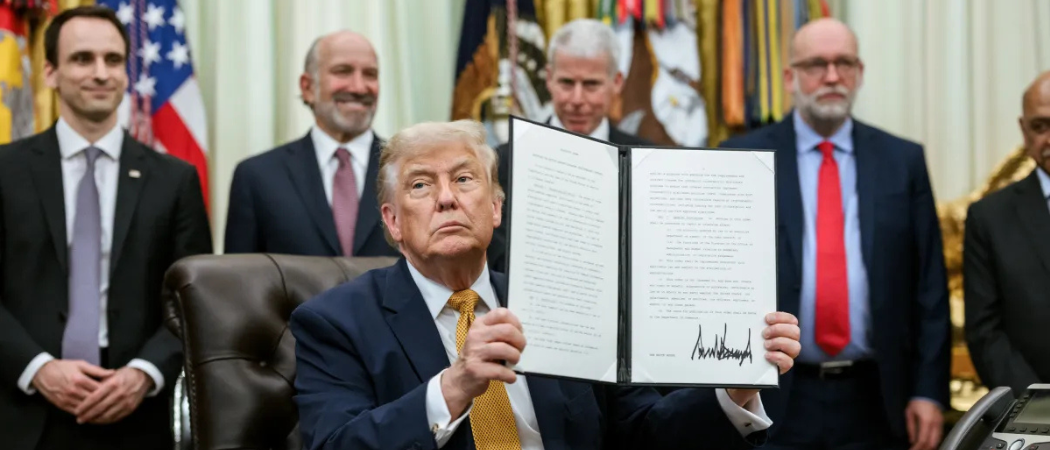
US President Donald Trump with OMB director Russell Vought (far right). Photo credits: the White House
Controversial changes that give US political appointees more power over research funding will also hit transatlantic science cooperation, European universities and researchers have warned.
Sweeping changes to administrative rules, proposed by the Office of Management and Budget (OMB), include proposals that political appointees at US research funders should screen research grants to make sure they “advance the president's policy priorities”.
Even by the standards of the second Donald Trump presidency, the proposals have caused unprecedented uproar among US scientists. Some fear they amount to the political takeover of a system that has been governed by merit-based peer review since the Second World War.
The US Congress may yet cancel the changes, as it has done to many of Trump's science budget cuts. This becomes more likely if Democrats take control of the House of Representatives as expected in November, a month after the new OMB rules are expected to take effect. The courts may also intervene.
Still, the proposals have academics even beyond the US worried. In addition to their effect on US science funding, the rules also include provisions that could isolate US academics from the rest of the world, and make life much harder for European scientists who want to work with US colleagues.
“Short term, you're looking at a broad-based decoupling of the US from the rest of the world in science, until [US researchers] hear otherwise,” said Cole Donovan, director of science policy at the campaigning group Stand Up for Science.
The OMB rules, which run to more than 100 pages and overhaul all federal funding, not just research, have already generated an enormous backlash in the US. Since being released at the end of May, the proposals have generated nearly half a million responses, the vast majority negative, according to an analysis by researchers at the University of North Carolina at Chapel Hill.
But the responses are no more than advisory, and the OMB has said it will implement the changes by October 1. It’s unclear if the office will significantly alter the proposals following the backlash.
Now, European science organisations are also sounding the alarm that the changes will make the US a much less attractive research partner.
The League of European Research Universities has said that the changes “may discourage leading researchers and institutions from participating in US-funded programmes.”
Allea, an umbrella body for European academies, has said that the OMB proposals could result in a “chilling effect on, or even the cessation of, international partnerships.”
And Britain’s Royal Society says it is “deeply concerned” by the proposals, warning that “scientific conclusions must continue to be guided by evidence rather than political or ideological preference.”
What are the concerns?
For European universities and researchers, there are four key parts of the new rules that could hit collaborations.
The first is a stipulation that, when designing and evaluating research grants, US funding agencies “apply a domestic-first framework” and that “international elements” are only included if the agency deems them “justified.”
The US National Institutes for Health has already tightened rules to make it harder to delegate parts of research projects to non-US research institutions.
But these latest rules would widen this net to all US funding agencies, making it much harder for US researchers to include colleagues from outside the US in their federally funded projects, said Donovan, who is a former government science official.
“That is very new,” he said. Although precise details remain unclear, it could even curb US universities’ ability to hire foreign nationals without gaining prior permission, he said.
Domestic-first
This “domestic-first” proposal probably won’t directly affect the majority of transatlantic science links, as most collaborations don’t involve Europeans receiving money from US federal grants.
Europeans often bring their own domestic funding, or simply maintain relationships with US counterparts, exchanging data and ideas, without any money changing hands. In theory, these more informal links should be unaffected.
However, the new rules could still trigger a broader “chilling effect” on US research partnerships, said Rob Johnson, managing director the UK-based firm Research Consulting, who has written about the risk that the rules leave the US isolated.
“The signal that it sends to US researchers is that essentially international collaboration is increasingly disfavoured,” he said.
Baseline ban
Secondly, the rules contain a “baseline” ban on US researchers using federal money to “support bilateral or multilateral collaborations, agreements, programs, or activities” with “covered foreign countries,” most notably China and Russia.
The changes effectively attempt a near-blanket shutdown of federally supported scientific cooperation between the US and China, two of the world’s research leaders. The rules will “hamper research on any topic with anybody who is a Chinese citizen,” said Tobin Smith, senior vice president for government relations and public policy at the Association of American Universities.
In theory, US researchers without federal funding could still work with Chinese counterparts. However, proving that federal funding played no role in a research project is likely to be tricky. US universities are likely to “overcorrect” and stop their academics doing any joint work at all with China, said Donovan.
US out of global collaborations?
For European scientists, the covered countries rule may mean that US colleagues are unable to join global research projects that also involve Chinese researchers.
For example, the rules could hit US participation in global science projects such as the International Thermonuclear Experimental Reactor (ITER), an experimental fusion reactor under construction in the south of France, of which Russia and China are still core members.
“It's likely that a project [in support of ITER] that might be funded by the Department of Energy or the National Science Foundation or whomever might not be able to move forward because of the presence of China [in ITER],” said Donovan.
Further targeting?
What’s more, the “covered country” rules could easily be expanded beyond countries such as China, Russia or Iran, allowing Washington to suddenly pull the plug on international research projects where federal funding is involved.
“Covered foreign countries” can include states deemed a “foreign adversary,” a “country of particular concern,” or a country subject to “sanctions or restrictions relating to national security, defence, or intelligence activities.” They can be designated by a Trump executive order, the rules say.
The risk is that any country, even in Europe, could be designated a “covered country” on a whim due to a geopolitical spat, and US funding underpinning a research partnership immediately yanked.
The Trump administration has already acted erratically on tariffs, said Smith. “Doing that in research where you need long-term stability would be devastating.”
Conferences and publication
A third worry is that the OMB rules could limit US researchers’ ability to publish their work and attend scientific conferences. Conference costs have to be “expressly approved” by funding agencies, they say.
Publication costs, which academics typically have to pay to get their work included in open access journals, are “unallowable” unless approved by grant agencies on a “case-by-case basis.”
The risk is that US attendance at conferences thins out, and Europeans may have to pick up the full bill for article processing fees if they partner with the US.
Of course, conference and publishing costs could be covered from other sources, such as university budgets. But still, the new rules would add “additional points of friction” that make US collaborators “less attractive than they were historically,” said Johnson.
Political control
The final worry for European scientists concerns the most explosive parts of the OMB rules: sweeping new powers for politically appointed agency heads to veto or cancel grants mid-project.
Under the proposals, US researchers can have their funding pulled if they deviate from the “national interest,” as judged by funding agencies. Among other bans, there’s also a prohibition on using federal funds to explore “disparate-impact studies,” the idea that a disease, pollution or policy, say, impacts one group more than another.
The risk is that European researchers engaged in a transatlantic health study that discovered, for example, a certain type of cancer had a greater impact on women than on men, could suddenly find their US counterparts having their funding pulled under the disparate-impact rule.
Related articles
- European research projects hit by halt to NIH sub-awards
- Trump halts new NIH grants to international health-research partners
“This is not something that could happen. It has already happened under executive orders,” said Smith. The overall impact is to cast doubt on whether US collaborators have reliable funding free from political whims.
Overseas observers may be left wondering why the US would erect so many obstacles to working with foreign scientists.
At root, the rules stem from a failure to appreciate that the US gained, rather than lost, from scientific collaboration with the outside world, Smith said. “It’s like thinking we're ahead in a marathon and building a wall behind us, when our competitor is actually already on the other side of the wall.”
The US Office for Science and Technology Policy has been asked for comment.
 Receive the Funding Newswire [full access requires a subscription] each Tuesday, our Policy Bulletin each Thursday, and the fortnightly R&D Express, tracking reforms and investments in central and eastern Europe.
 A unique international forum for public research organisations and companies to connect their external engagement with strategic interests around their R&D system.