Leaked Commission memo reveals details of biodiversity mega-call and bridging actions to the post-2027 EU research programme

Photo credits: inimalGraphic / BigStock
Horizon Europe is due for an update in September, with the European Commission preparing to add two big “horizontal” calls to the work programme for 2026-27, according to a leaked internal meeting memo seen by Science|Business.
The new calls will have their own work programmes, investing hundreds of millions of euros in the two topics. These big, policy-driven horizontal calls are the Commission’s newest creation, with the first two introduced this year covering AI in science and decarbonising energy-intensive industries.
The two draft horizontal calls have already created controversy. According to another batch of internal memos, reported by Science|Business last month, at least part of the horizontal calls will be financed using the money paid into the EU budget by countries associated to Horizon Europe, reportedly at the expense of popular areas of the programme that support bottom-up research.
Bridging Horizons
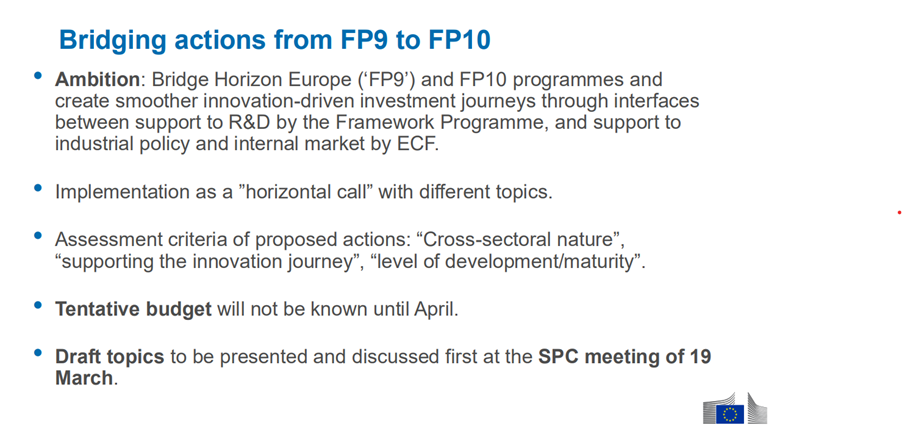
A further draft horizontal call will cover bridging actions from the current Horizon Europe programme to the next, due to start in 2028.
The next Horizon Europe is set to be significantly different, driven more by innovation and EU policy, integrating the research framework into a bigger European Competitiveness Fund (ECF). The foreseen bridging actions will aim to create “smoother innovation-driven investment journeys through interfaces between support to R&D by the Framework Programme, and support to industrial policy and internal market by ECF,” according to leaked slides from a Horizon Europe programme committee meeting involving the Commission and EU member state representatives.
No concrete topics or budgets have been communicated to the member states yet, but the slides show that the assessment criteria for the proposed actions will likely include their cross-sectoral nature, support for the innovation journey and level of development.
Meeting biodiversity targets
The horizontal call on biodiversity meanwhile is at a later planning stage, and its proposed topics and budgets were revealed at the meeting. Science|Business published a draft of the work programme listing the planned topics last month, but the newly leaked memo now includes details on the budget.
According to the memo, the Commission is planning a €230 million call, split into 10 topics across the final two years of the current Horizon Europe.
The goal of this call will be to help the EU meet its target of dedicating 10% of its overall 2026-27 budget to biodiversity.
Related articles
- Exclusive: Commission mulls over Horizon Europe budget reshuffle
- Research community rejects use of MSCA money to fill policy gaps
The call on the first four topics, worth €95 million, is set to open on 6 October 2026. These are the foreseen topics:
- Assessing direct and indirect drivers of biodiversity decline of invertebrates; research and innovation action (RIA), €15 million, three projects
- Better understanding, anticipating and addressing the biodiversity benefits and impacts of the green and digital transitions; RIA, €18 million, three projects
- Systemic approaches to accelerate transformative change for biodiversity; RIA, €12 million, three projects
- stronger global ocean observing system to enhance Europe’s strategic autonomy, climate resilience and biodiversity assessments; innovation action (IA), €50 million, one project
The second call will open on 8 April 2027 with a total budget of €124 million, covering the topics:
- Understanding the nature and the extent of the effects of per- and polyfluoroalkyl substances (PFAS) on biodiversity and ecosystem services; RIA, €10 million, two projects
- Living labs for co-creating solutions for the restoration of ecosystems addressing implementation bottlenecks and improving resilience to risks; RIA, €60 million, six projects
- Networking to scale up living labs for nature restoration solutions and to address bottlenecks to implementation; coordination and support action, €4 million, one project
- Innovative solutions to fight wildlife trafficking and to reduce introduction of invasive alien species; IA, €15 million, one project
- Cost-effective biodiversity monitoring for EU policies; RIA, €15 million, three projects
- Advancing interdisciplinary, data-driven research at the biodiversity-health interface under a one-health approach; RIA, €20 million, one project
The memo suggests that formal consultation with member states on the work programme amendment will start in mid-July, ahead of a formal adoption at the end of September.


 Receive the Funding Newswire [full access requires a subscription] each Tuesday, our Policy Bulletin each Thursday, and the fortnightly R&D Express, tracking reforms and investments in central and eastern Europe.
 A unique international forum for public research organisations and companies to connect their external engagement with strategic interests around their R&D system.