Private sector agrees R&D should be at heart of European space policy, as ESA looks to innovation to catch up with competitors
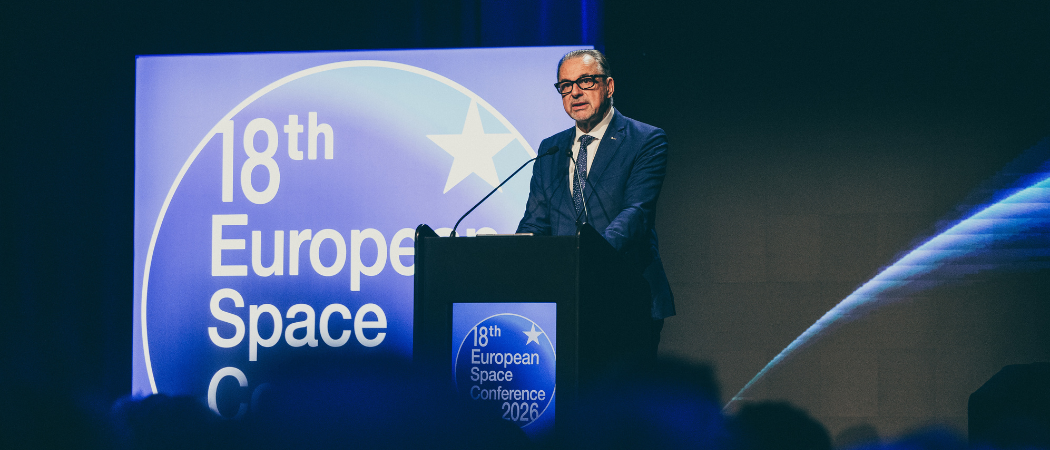
Josef Aschbacher, director general od the European Space Agency. Photo credits: Ph. Servent / European Space Agency
The European space sector requires a “quantum leap in innovation and technology” if it is to keep pace with global competitors, Josef Aschbacher, director general of the European Space Agency (ESA), said on January 27.
“We are moving in the right direction, but others are moving just as fast, if not faster,” Aschbacher told the European Space Conference in Brussels.
In 2024, the US invested six times more in public space funding than all European actors combined, while China spent 50% more than Europe. “Europe’s global share declined by 50% in relative terms between 2019 and 2024. This should ring alarm bells,” he said.
Part of the solution, according to the ESA chief, is to get better at turning Europe’s excellence in Earth observation, navigation and space science into commercial success.
“We need to translate our intellectual excellence into industrial scale, as Europe has done in automotives, aeroplanes and pharmaceuticals,” Aschbacher said. “To regain lost control, we must accelerate disruptive, game-changing innovation, from integrated space AI and quantum technologies to in-space data centres, new propulsion systems and advanced materials.”
Industry must lead this transformation, with ESA’s support, he said. The agency has already taken steps towards a competition-based model intended to support new players, including launching competitions to provide launch services and a cargo delivery vehicle. “We must go further and faster,” Aschbacher said.
This message was echoed by the private sector. “R&D must find its place back at the top of the European space policy agenda now,” Marco Fuchs, president of industry association ASD-Eurospace, told the conference.
“If we want non-dependence, we need technological leadership, and if we want technological leadership, we need strong and consistent institutional support for R&D,” he said. “Industry is ready to co-invest, , and ready to take this risk, but this only works if R&D is treated as a strategic priority at European level.”
Fuchs called on Europe to use the current political and budgetary momentum behind space to strengthen its own industrial base and create interdependencies with international partners. “If more European public money is put on the table, it’s not to outsource critical technologies, critical systems or critical supply chains,” he said.
AI and quantum
At its ministerial council in November, ESA received “huge support for the entire R&D programme” from member states, said Dietmar Pilz, its director of technology, engineering and quality.
AI is one of the technologies the agency wants to focus on developing, as it has “a huge influence on the autonomy of our spacecraft, on connectivity, but also on downstream data processing,” Pilz said.
Quantum is another priority, as it’s an area where the conditions in space can help to advance research and where Europe is “very well-established,” he said.
R&D efforts will also focus on security, defence and dual use, including defence technologies that could have civil applications, and on sustainability.
“We have launched an initiative to look into all of these technology areas that are needed to have controlled re-entry, to have affordable re-entry, even for smaller satellites, for satellites that you use in mass production,” Pilz said.
European preference
For industry, it’s essential to know that there will be demand for their technologies. France is leading the push for a European preference in public procurement, in space as in other strategic sectors. During the event, Philippe Baptiste, French minister for higher education, research and space, stressed the need for launchers and telecommunications satellites that are “100% European.”
“We need a European constellation, with European hardware, with full sovereignty on all the components,” he said.
Related articles
- Romanian researchers decry plan to pare back country’s participation in European space projects
- ESA members agree €22 billion three-year budget
- Europe seeks leading role in burgeoning space economy
European autonomy in space is more relevant than ever as the Trump administration continues to escalate its confrontational rhetoric directed at Europe, while cutting its own research funding. Congress recently rescued NASA from proposed budget cuts of almost 25%.
“Our very strong ally, or what used to be our very strong ally, is now very unpredictable,” Baptiste said. What is needed, he went on, is for Europe to have greater control of its own space and defence strategy.
“It does not mean that, within the next ten years, we will invest similar amounts of money as the US or as China on all topics of space,” he said. The priority will be defence and security. “At least on this segment, we have to catch up.”
When it comes to space exploration, science, or earth observation for climate, “of course we need to carry on international cooperation,” Baptiste said. “But on other topics, on which our security depends, then, yes, we need to be more European, and we need 100% European preference.”
Paris will host an international space conference in July, where France hopes to bring together all major space actors, including the US and China, to discuss issues such as international scientific programmes, regulation including on traffic control in space, and defence and security.
More investments needed
In addition to supporting innovation, catching up with global competitors will require a simplified and more unified approach, as well as significant, long-term funding, Aschbacher said. In November, ESA member states agreed to a record €22.1 billion budget for the next three years.
The European Commission, on its side, has proposed dedicating €131 billion to security, defence and space under the future European Competitiveness Fund, which would be a five-fold increase on the current budget. ESA “fully supports” the proposal, but “I would argue that both defence and space should receive even more funding,” Aschbacher said.
“Our goal should be to reach roughly one-third of the US space budget by 2030,” he said. This would likely require a significant increase in European funding.



 Receive the Funding Newswire [full access requires a subscription] each Tuesday, our Policy Bulletin each Thursday, and the fortnightly R&D Express, tracking reforms and investments in central and eastern Europe.
 A unique international forum for public research organisations and companies to connect their external engagement with strategic interests around their R&D system.