ESA’s director of science and head of future preparation reflect on Europe’s space strategy in response to US uncertainty
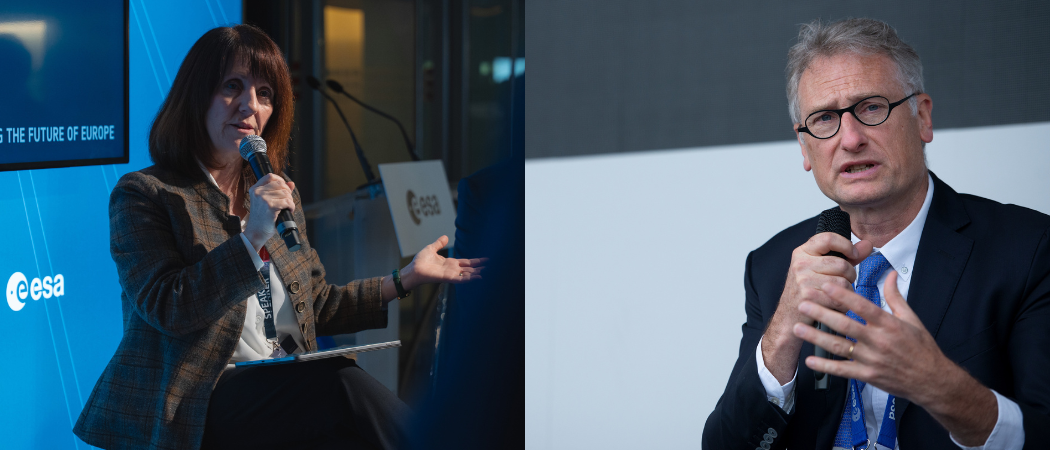
Carole Mundell, ESA’s director of science (left), and Didier Schmitt, head of future preparation (right). Photo credits: ESA - D. Dos Santos / P. Sebirot
Everybody at NASA breathed a sigh of relief in January, when Congress rejected President Donald Trump’s proposal to reduce the agency’s funding by a quarter and to cut its science funding by 47% in 2026.
Also relieved was the European Space Agency (ESA), which works closely with its US counterpart on its scientific missions and on space exploration.
“My and all our member states’ priority is to continue the partnership with NASA,” Carole Mundell, ESA’s director of science, told Science|Business in an interview at the European Space Conference in Brussels on January 28.
She said it had been a “difficult year” for her colleagues at NASA, even if the negotiations were a normal part of the annual budget process. But the uncertainty forced Europe to confront the possibility that NASA would pull out of key international collaborations, and to think seriously about what it was and wasn’t capable of achieving on its own.
Of 19 ESA missions that were potentially affected by the proposed cuts, “we very quickly worked out that, with efficiency measures, we could probably absorb the impact on 16 of those missions,” said Mundell.
The three missions for which “recovery actions” would have been needed were Envision, ESA’s mission to Venus; Lisa, a planned mission to study gravitational waves and ripples in space-time; and NewAthena, which will be the world’s largest X-ray observatory.
While maintaining these missions would have required additional funds from ESA member states, the agency’s analysis suggested Europe’s industry had the required technical capabilities to go it alone. If industry doesn’t know how to deliver the frontier technologies, that’s “a much harder problem” than if only the money is lacking, Mundell said. “We didn’t have the technological gap problem, we just had the money problem.”
Diversifying partnerships
The direction of travel for ESA is clear: more autonomy, and closer cooperation with a more diverse range of partners, including India, Japan and South Korea. Later this year, ESA and the Chinese Academy of Sciences will launch the Smile joint mission to study how earth responds to the solar wind from the sun.
“The ESA science programme, in particular, has always been international,” Mundell said. “NASA, of course, is a major partner, and I don't yet see that changing.”
As a multinational agency, ESA is used to managing the risks that come with uncertainty, she added. “I think we go into these collaborations eyes wide open, knowing that any nation that we collaborate with can, at any time, decide that a national priority has changed.”
But diversification is increasingly central to the strategy. At the ESA ministerial council in November, Canada agreed to increase its contribution to ESA programmes by a factor of five. Also last year, ESA opened a new office in Tokyo, dedicated to strengthening links with the Japan Aerospace Exploration Agency at both policy and industrial level.
In a strategy document adopted last year, looking ahead to 2040, ESA set out plans to expand global partnerships. Amid US budget uncertainty and the administration’s broader attacks on science, Europe has a chance to diversify its collaborations as a trusted partner, said Didier Schmitt, head of future preparation at ESA.
“There is an opportunity to be a better anchor, an organisation that is trusted, that is stable, because we have a three-year budget, not a yearly budget,” he told Science|Business. “And whatever you can say, we're on a relatively safe political course compared to others.”
At the same time, caution is needed. “We cannot fall into the other trap and have more dependencies with others,” Schmitt said.
European autonomy
Schmitt said that Europe has relied too much on its collaborations with the US in the past. In developing the 2040 strategy with member states, it was clear that more self-determination was “the number one recommendation,” he said.
However, he believes Europe is lacking a simple political narrative to rally support. “For the US, China, and now India, it’s very easy, it’s one sentence: space dominance. And dominance is mostly exploration, because this is what is really visible.”
According to Schmitt, Europe is “quite competitive” in the space domain. When it comes to space exploration, though, “we have the capacity to do as well as the others, but at the end of the day, we are hampered by the lack of political will and the lack of cohesion in Europe to go ahead,” he said.
Related articles
- Europe needs ‘quantum leap’ in space innovation, says ESA chief
- ESA members agree €22 billion three-year budget
- Europe and India to cooperate on human space exploration
ESA secured a historic budget increase in November, including €3.8 billion over three years for its scientific programme. However, the €3 billion committed to exploration was lower than requested, which Schmitt puts down to uncertainty surrounding activities that depend on the US.
In its proposal for the next iteration of Horizon Europe, from 2028, the European Commission included “making the moon accessible to Europeans” as one possible “moonshot” project that could mobilise funds from Horizon Europe and the European Competitiveness Fund. During the conference in Brussels, space Commissioner Andrius Kubilius, said that, “one day Europe should be capable of putting European boots on the Moon.”
These are positive signals but would require “a real step increase in budget,” as well as broad political backing, Schmitt said. “Of course, there is a limit in the budget, but within this budget, there is an arbitration issue, and the arbitration is not today in favour of exploration.”
Instead, attention is increasingly turning towards how the space and defence sectors can reinforce one another. Despite this prioritisation, Schmitt does not believe there is an excessive focus on defence, as it’s also an area where Europe has a lot of catching up to do.
Technology development
Funding for innovation represents around 22% of ESA’s new €22 billion, three-year budget, across the different programmes.
When it comes to exploration, ESA has challenged industry to develop a cargo delivery service to and from space stations in low-earth orbit. At the same time, it’s looking to de-risk the technology needed for a future crew vehicle in case there is the political will in the coming years, Schmitt said.
Work is also being done to lay the technological groundwork for future lunar landers, and for the next Mars lander after the ExoMars mission, which is set to launch in 2028. The next lander will probably be 100 times more accurate, Schmitt said. “We are now developing the critical technologies for braking engines, for communication and navigation to have precision landing.”
As for the scientific programme, the priorities always come down to “propulsion, power and sensing,” Mundell said. “They’re my three biggest challenges: how do I get to where I want to get to? How do I have enough energy? And how do I sense the universe?”



 Receive the Funding Newswire [full access requires a subscription] each Tuesday, our Policy Bulletin each Thursday, and the fortnightly R&D Express, tracking reforms and investments in central and eastern Europe.
 A unique international forum for public research organisations and companies to connect their external engagement with strategic interests around their R&D system.