Carol Robinson, a chemist who broke professorial glass ceilings at Oxford and Cambridge, puts the case for supporting young scientists
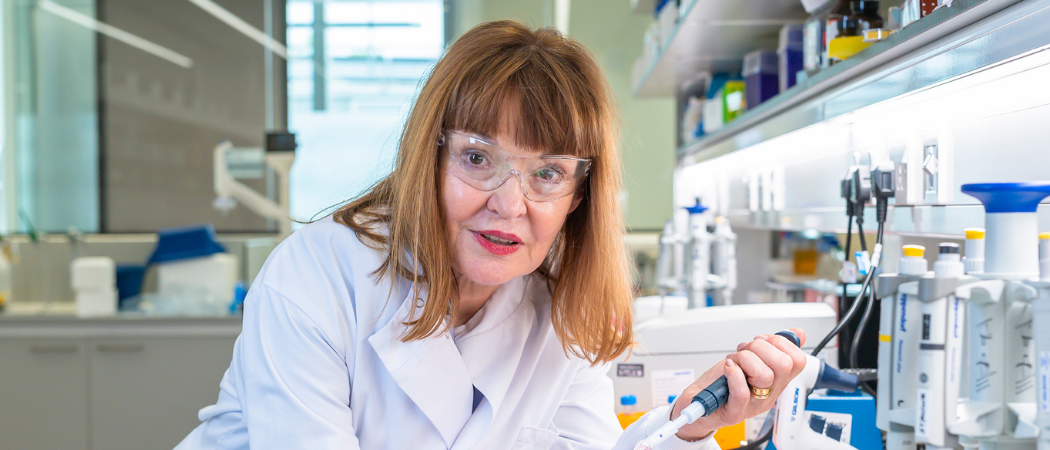
British chemist Carol Robinson. Photo credits: European Patent Office
Starting a career in science is exciting, but also demanding, with researchers often faced with intense competition, long working hours and high levels of stress. A pioneer in the field of mass spectrometry, Carol Robinson has been there. She speaks with Science|Business on the importance of creating a supportive environment, particularly for women.
Robinson did not wake up one day thinking that she would become a scientist. It was only late in school that she developed an interest in chemistry. “The more you work at something, the more you think, actually, this is fascinating. So, I went much further and deeper than I ever needed to pass the exam. And then I loved it,” she says. “I thought, I’m going to give it my all. I’m going to enjoy it while I’m here. But I didn’t think this would be my career for 50 odd years.”
She left school at 16 to become a lab technician with the drug company Pfizer, which is where she first worked with mass spectrometry. Fascinated, she was encouraged to take a part-time degree and then a PhD. She went on to do pioneering work in native mass spectrometry, a technique that is used to study protein structures in their natural state, paving the way for breakthroughs in drug discovery. She also broke new ground by becoming the first female professor of chemistry at the University of Cambridge, and then the first female professor of chemistry at the University of Oxford, her current home.
She now wants to show young researchers that a career in science is worth it. “Sometimes, I believe the culture isn’t very encouraging, and that’s something I have worked on,” Robinson says.
In 2021, she launched the Kavli Institute for Nanoscience Discovery at Oxford, whose acronym gives a sense of what she hopes it will achieve. “Maybe it is corny,” she says. “It’s just a reminder that I would like it if we could all be kind to each other and supportive, especially for early-career researchers of either gender, because there’s quite a big attrition rate in science, and maybe it just doesn’t feel like a very friendly place to work.”
And yet, a career in science comes with a lot of flexibility. “There are few careers where you have that amount of freedom, to go to conferences, to the library. Just because you didn’t see me didn’t mean I wasn’t working,” she says. “And I’m excited to come in every day. So, I don’t want people to think it’s a terrible place.”
Gender equality is also important when it comes to the quality of science as a career. “The more women we have, the better it becomes,” Robinson adds.
Imposter syndrome
According to EU data, women outnumber men in university education but account for just about a third of graduates in science, technology, engineering and mathematics (Stem). And while the number of women working as scientists and engineers in the 27-member bloc is on the rise, their representation remains below that of men, at 41%. This discrepancy is even more pronounced in top-tier functions across these fields, where women fill just 20% of positions.
Having supervised many young scientists, Robinson sees that women continue to have a greater propensity than men to doubt their abilities, a feeling she once shared. “When I was doing my PhD at the University at Cambridge, I really felt like an imposter,” she says. “I don’t think I ever felt I deserved to be there or owned it and was proud. I just thought I was lucky.” Later on, she adds, “I was always that person who said, I can’t apply yet because my CV is not strong enough.”
She has now made it her job to encourage women to break with this imposter syndrome. For example, rather than calling for volunteers to give a lecture in the groups that she mentors or teaches, which nearly always results in men stepping forward, she goes straight to the women, “because I know they won’t push themselves forward.”
But the gender gap in science is not just down to imposter syndrome. The “obvious” reason, Robinson says, and the reason that is on everybody’s mind when discussing workplace gender equality, is the balance between work and raising a family. Her own path was to choose between the two, taking an eight-year break after completing a postdoctoral training fellowship to bring up three children.
And she continues to advise women not to work part-time while they raise a family. “You’ll just get half the pay and continue to work full-time because you are not able to fit everything in,” she says. “You should be able to have a family and come back to have the career that you want.”
The solution is for men to also take career breaks. “That kind of evens it up, so that it’s not such a big thing for women,” Robinson says. “I always encourage men in my groups to do that. I think it’s important to take your share of the duties.”
Support produces results
According to the Women in Stem Network, a UK advocacy group, countries with strong childcare systems and equal pay policies retain more women in technical careers. In Europe, these are primarily found in the Nordic region and parts of central Europe.
At the EU level, the European Commission asks all Horizon Europe applicant organisations to have a gender action plan in place. Since this criterion was introduced in 2021, the share of women leading consortia has increased to 31%, against 23% in Horizon 2020. Their overall participation, however, has risen just 1%, to 38%.
After trying to weaken the requirement for gender action plans in 2025, the Commission now intends to adopt a plan for supporting women in research and innovation.
Related articles
- Commission scraps plan to water down gender requirements in Horizon
- How gender balance can swing who wins Horizon Europe funding
Robinson herself has benefited from three Advanced Grants from the European Research Council. “I was extremely honoured and privileged to get those, because they really allowed me to fuel my passion,” she says. “Without that, it would have been a much harder slog.”
Beyond applying gender rules, she says that more work is needed on translational enterprise, where women are, once again, largely underrepresented. The European Patent Office found that only 13.8% of applications were filed by women in 2022. “We have so many more women doing amazing science; why do they feel it’s not a thing to have a company?” she asks.
She founded her own spin-out company, OMass Technologies, in 2016, and remains chair of its scientific advisory board now that it trades as OMass Therapeutics.
As for research, Robinson is now studying how changes in the brain may be linked to depression, using post-mortem tissue. “We’re hoping to publish soon,” she says. “We had to consult with a lot of people who knew a lot more about the brain than we did. So, we’ve learnt a lot, and that’s always a lot of fun to learn a new thing. That’s what keeps you going.”

 Receive the Funding Newswire [full access requires a subscription] each Tuesday, our Policy Bulletin each Thursday, and the fortnightly R&D Express, tracking reforms and investments in central and eastern Europe.
 A unique international forum for public research organisations and companies to connect their external engagement with strategic interests around their R&D system.