Launch of first 14 EOSC nodes will allow seamless sharing of research data across disciplines and borders
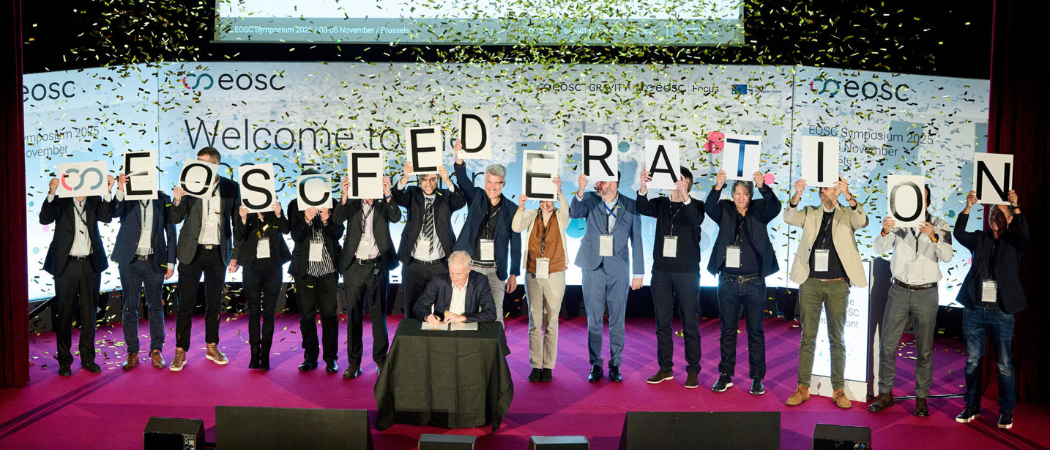
Photo credits: EOSC
As artificial intelligence drives demand for vast, high-quality datasets, the EU has moved closer to creating a unified research data space. This promises to give AI, and scientists, seamless access to information across borders, institutions and disciplines.
On November 3, the European Open Science Cloud (EOSC), an EU initiative, launched the first 14 nodes of its data federation with the signing of a collaborative memorandum. This signals the start of a unified European research data space.
A node is an infrastructure system that provides services and resources. The agreement establishes an operational framework to test, integrate and scale-up cross-border services involving these nodes, laying the foundations for sustainable and interoperable European research data. Access to data is federated, meaning that researchers access datasets through the individual nodes.
According to Matteo Zanaroli, coordinator of the Italian node for the EOSC Federation project, which is hosted by the Italian Research Centre on HPC, Big Data and Quantum Computing (ICSC), participation in EOSC brings multiple benefits. The most significant is that it will allow researchers to “both contribute to and access high-value, multidisciplinary expertise and datasets, improving the quality of heterogeneous data for the development of algorithms,” he told Science|Business. “This topic is particularly relevant for AI developments.”
“With the rise of AI, it has become crucial to bring data together,” said Jessica Parland-von Essen, coordinator of the Finnish node, which joined the EOSC Federation as a pilot project. “One of EOSC’s key functions is to make data available for AI research. We already have powerful computing infrastructure, but without well-described, high-quality data, it cannot deliver results.”
Rich metadata is essential, she added, so researchers understand a dataset’s origin and meaning. “In general, the more data you can work with, the stronger the evidence, especially when data from different countries can be compared or combined.”
Klaus Tochtermann, president of the EOSC Association, said the initiative is key to ensuring European sovereignty over research data. “It's the European data space for research and innovation in Europe. It's from European researchers and infrastructure providers, for European researchers and infrastructure providers,” he told Science|Business.
The launch comes as policymakers intensify efforts to reduce Europe’s dependence on foreign-controlled databases, particularly those in the US. Such reliance makes European researchers and institutions vulnerable to geopolitical shifts and commercial decisions made elsewhere, stakeholders say.
Momentum is also building at the policy level. On November 19, the European Commission unveiled the Digital Simplification Package, an initiative that aims, among other objectives, to improve access to data, including for AI training, as a driver for innovation and competitiveness.
How the EOSC Federation works
Rather than creating a single central platform, EOSC functions as a “system of systems,” Tochtermann said, linking the many existing repositories that already store scientific data. Across Europe, thousands of disciplinary databases hold specialised information; EOSC aims to connect these silos so researchers can draw on data from different domains without navigating multiple platforms. Most importantly, each node retains ownership of its data and the services it provides to EOSC.
Practical examples of data shared through EOSC include satellite and sensor data used to monitor tropical forest recovery and assess climate risks, marine and oceanographic observations collected through different European research infrastructures, and large-scale biodiversity datasets built from both professional and citizen science observations. Other nodes host social sciences and humanities data, such as surveys and qualitative datasets, which are typically fragmented across institutions.
The build-up phase of the EOSC Federation began last March. Tochtermann described the process as a “socio-technological adventure,” noting that before technical connections could be made, the project had to unite researchers, service providers and data specialists across Europe to agree on shared standards and governance principles.
“It needed some time for negotiations on common policies, common standards, before you could start with the implementation,” he said.
The first 14 nodes include the central EOSC EU Node, procured by the Commission, which offers free access to its services, as well as national nodes from Finland, Germany, Italy, the Netherlands, Poland and Slovakia. Several thematic nodes are also part of the launch, among them CERN and the Digital Twin of the Ocean.
What’s next?
While all the services offered by the central EU Node are operational, connections to the remaining 13 nodes is still in a testing stage. Services are being validated in test environments and some components, such as monitoring and logging systems, are still under development.
The next phase will focus on transitioning the system into full production by 2027. will involve providing extensive documentation, clearly defined operational procedures, data protection and privacy policies, and agreed service-level commitments.
Alongside this transition, the federation will expand. A new call for a second wave of nodes to join the EOSC Federation opened on November 3. Some geographical and thematic eligibility criteria will apply to ensure diversity. “If Germany already has a node in the federation, Germany cannot apply for a second node in the second wave,” said Tochtermann. “That also applies to other types of nodes. Thematic nodes covering a certain discipline, for example.”
The ultimate goal, however, is to have a continuous enrolment process, he added.




 Receive the Funding Newswire [full access requires a subscription] each Tuesday, our Policy Bulletin each Thursday, and the fortnightly R&D Express, tracking reforms and investments in central and eastern Europe.
 A unique international forum for public research organisations and companies to connect their external engagement with strategic interests around their R&D system.