Universities could make a major contribution to Europe’s strategic autonomy, if they can retain talent and turn breakthrough science into technology
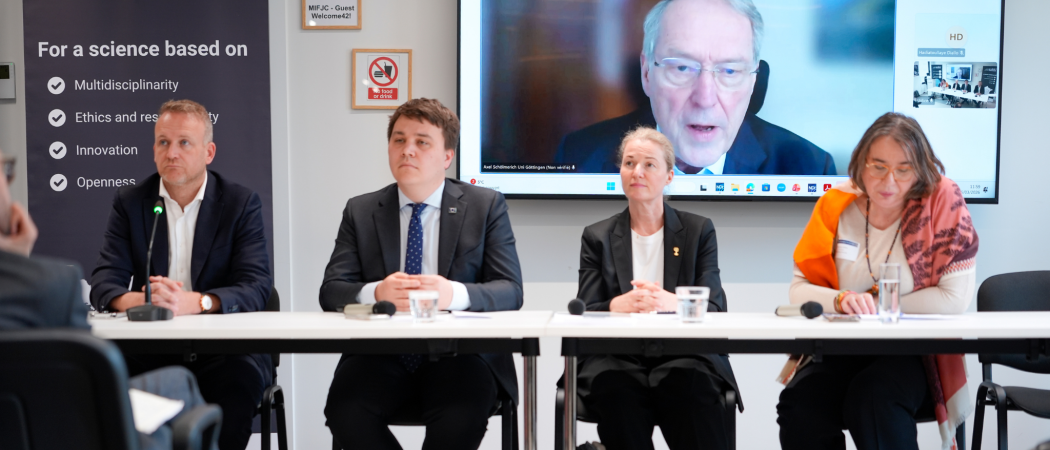
From left to right: Stefan Leijnen, Axel Leisenberg, Katja Schenke-Layland, Frédérique Berrod and Axel Schölmerich (online)
Photo Credits: Fred Guerdin
European universities could play an invaluable role in developing sovereign capabilities that the continent will rely on, particularly artificial intelligence (AI). Many of these centres of learning are already powerhouses of fundamental research. The challenge is translating scientific breakthroughs into market-ready innovations, and giving innovators the tools and the investment they need to scale up in Europe.
To transform academic excellence into technological sovereignty, experts say European universities need to find ways to retain the talent they attract and work more closely with industry, both to turn research into products and also to develop the tools needed to advance early-stage technologies.
“Europe's sovereignty depends on its universities,” Nathalie Drach-Temam, president of the Sorbonne University and Udice, an association of French research-intensive universities, told a forum in Brussels organised by Udice. “They are our greatest strategic assets of knowledge, technology and talent.”
Held on 26 March, the forum focused on how higher education can contribute to Europe’s strategic autonomy. “We must build world-class technological champions while upholding our university values: scientific freedom, cooperation and responsibility,” said Drach-Temam. “It is a delicate balance, but one we must maintain without slowing down.”
Last year, Udice established a partnership with its counterpart in Germany, German U15, to position Europe as a “global competitive force in the race for artificial intelligence.” The partnership has three goals: to build a world-class AI ecosystem, to attract, train and retain top talent, and to develop robust and trusted frameworks for data sharing.
The 26 March forum in Brussels is a milestone in that cooperation. It featured an AI roundtable that included, among others, University of Strasbourg president Frédérique Berrod, Axel Schömerich, president of the University of Göttingen, and Katja Schenke-Layland, vice-president of the University of Tübingen.
Retaining and connecting AI talent
The forum explored how Europe can hold on to its best minds for AI research and development. "We need to attract talent and train talent and circulate talent in Europe,” Axel Leisenberg, policy officer for AI in science at the European Commission, told the forum. “We need to network researchers that work on artificial intelligence, that develop the technology. We need to bring them together with researchers that work in specific disciplines.”
Attracting AI talent and putting it to good use is one thing, but holding onto it is another. Money isn’t everything, but it has a role to play here, noted Stefan Leijnen, international lead for Dutch AI association AI4NL, also one of the panelists of the AI roundtable. “It’s ultimately about attracting the bright minds that are capable of bringing us forward in this race,” Leijnen said. To achieve that, “values themselves are not enough.”
Universities can help by supporting academics who want to enter industry or found startups. “Mobility between academia and industry is essential,” Leijnen added. Allowing “dual careers,” where professors can join startups without losing academic credibility, “can really make a difference.”
Public-private partnerships can help direct people’s skills to industrial applications, Schenke Layland of the University of Tübingen noted. “Specifically in AI, there are so many opportunities there,” but universities should do more to communicate that to talented students. The University of Tübingen works with chambers of commerce to offer young academics career opportunities in industry. “Not everybody can become and wants to become a university professor,” Schenke Layland noted, adding that, besides jobs in established companies, young academics should also have opportunities to start their own companies.
Yet cultural obstacles to entrepreneurship persist, she cautioned. “In Germany, you do not found a company and fail, because you never found one again… We should also be able to learn from failure.”
EU legislators and ministers are discussing new rules that could help. On 18 March, the European Commission proposed a draft law - ‘EU Inc.’ - that would create a new legal framework for starting companies outside the existing rules of the EU’s 27 member states. Dubbed the ‘28th regime,’ the rules would make it “as simple for startups as possible to be founded in whichever country in the EU, and then operate across borders," said Alexander Hobza, advisor to EU industry commissioner Stéphane Séjourné.
Progressing the dialogue with industry
Partnering with industry isn’t only important for graduate career paths: it can also be necessary to advance fundamental research. For example, “sometimes to prove even fundamental research, I need a technological tool that is not there,” Silvia Lasala, associate professor of energy engineering at the University of Lorraine and laureate of several European Research Council Grants, told the forum. That means going to businesses and asking them how the current lab technology can be improved to make a scientific breakthrough. To turn fundamental research into technological development, “you really need to communicate with industry,” she stressed, while also considering the economic viability of the research.
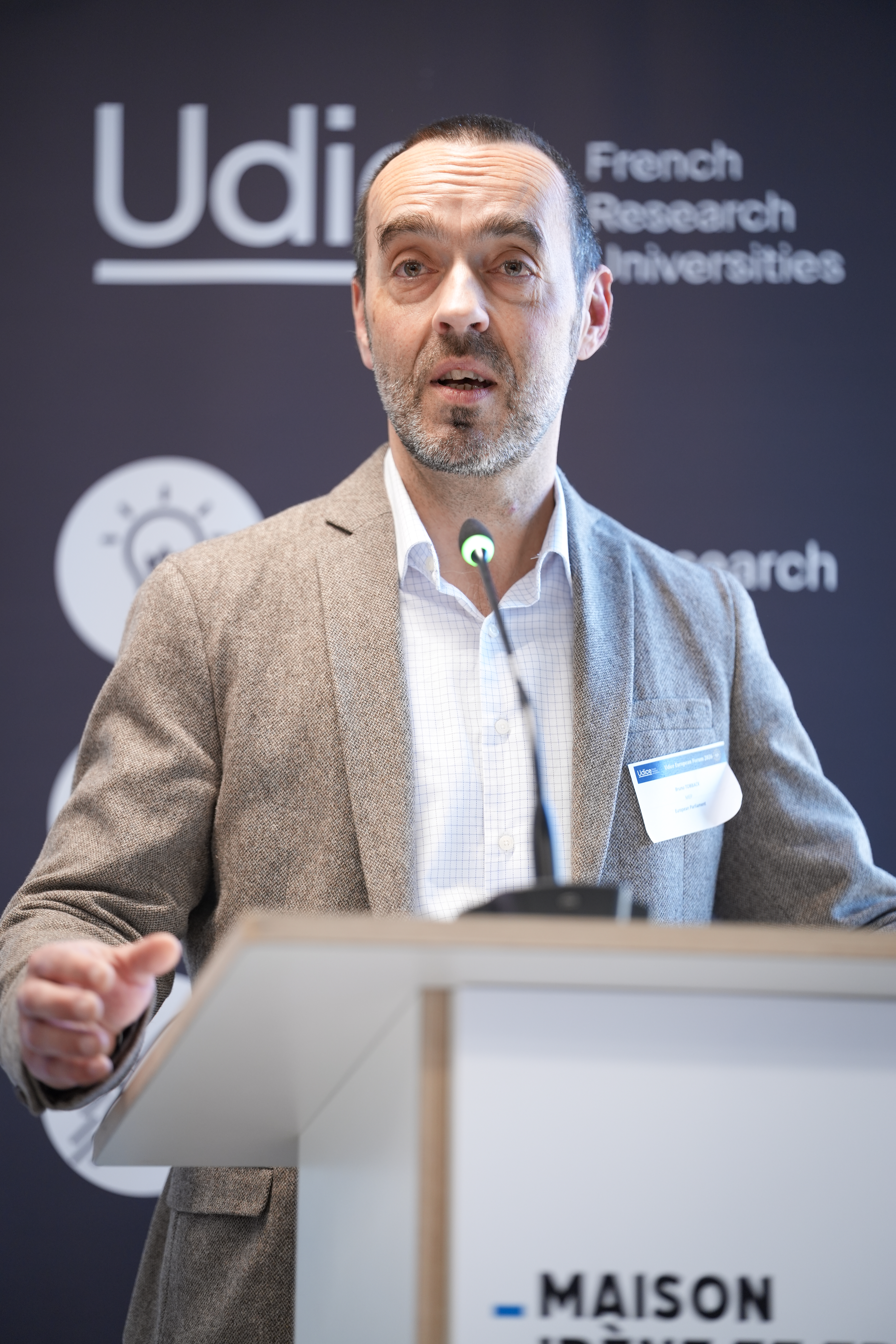
Bruno Tobback, a centre-left member of the European Parliament from Belgium, warned against a European tendency to hedge one’s bets in new technologies. “We are using technological neutrality as a way of getting out of making choices,” he said. He pointed to the car industry, where the EU has funded a variety of competing clean fuel technologies —including batteries, biofuels and hydrogen—without managing to scale-up any of them. “We keep on trying to invest in a little bit of everything.”
“Technological neutrality is a nice idea, but it’s a bad plan,” Tobback added. “We need to make choices that will get us forward.” That includes intelligently linking fundamental research to economic competitiveness. “We need to build a rocket, rather than a Christmas tree.”
Preserving the European way
With the US and China pursuing “techno imperialism” in strategic fields, such as AI, universities face a paradox: reconciling sovereignty with their inherent openness, according to El-Mouhoub Mouhoud, president of Paris Sciences et Lettres (PSL) University, a member of Udice. Europe needs to carve a path that differs from those of the US and China, which are pursuing AI like “éléphants dans un magasin de porcelaine” - or bulls in a China shop - Mouhoud told the forum.
“I think we have to accept that we will trail specifically with technology that's this fast,” added Leijnen of AI4NL. But that’s not necessarily a bad thing: “Otherwise, you move into the Meta territory of ‘move fast and break things.’ I think we made a choice not to do that,” he said.



 Receive the Funding Newswire [full access requires a subscription] each Tuesday, our Policy Bulletin each Thursday, and the fortnightly R&D Express, tracking reforms and investments in central and eastern Europe.
 A unique international forum for public research organisations and companies to connect their external engagement with strategic interests around their R&D system.