Proposed coordination mechanism would react to “military aggressions,” but not anticipate them
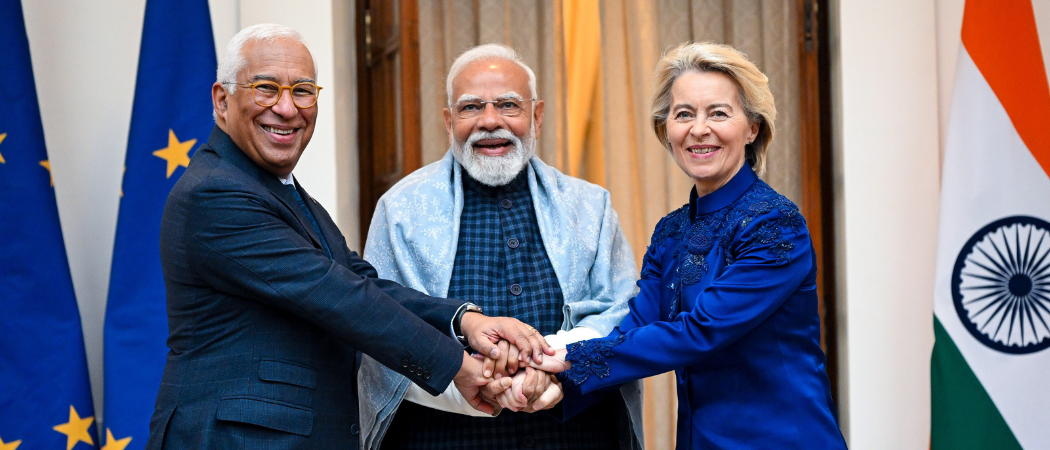
From left to right: António Costa, president of the European Council; Narendra Modi, Indian prime minister; and Ursula von der Leyen, president of the European Commission. Photo credits: Frédéric Sierakowski / European Union
The European Commission has put forward a new framework for EU science diplomacy, as the bloc grapples with how to deal with geopolitically charged science ties. But experts say "willingness to act" is needed to overcome the risk of some states stalling scientific sanctions in a crisis.
One of the key ideas in the Commission recommendation is to create a “coordination mechanism” to negotiate a common EU position in response to “threats to the Union’s economic security, military aggressions or democratic backsliding.”
This call for a more joined-up approach is partly a reaction to Russia’s full-scale invasion of Ukraine in 2022, when the bloc suddenly had to decide whether to cut links with Russia.
At the time, EU states made largely ad hoc independent decisions, with Germany leading the way in ending institutional science ties. Ultimately the bloc broadly cut links with Russia, but in the first few weeks the continent was divided on exactly how to respond.
The idea behind this new proposal is that there would be a forum where countries could hammer out a scientific response to a future crisis.
“This could happen quite fast with ad-hoc and or online meetings,” said an official from a national research ministry, who wished to remain anonymous. It would likely convene as a sub-group of one that already discusses the European Research Area, they added.
However, any consensus would have to be agreed by the EU Council, said the official. “The group itself has no mandate for decisions.”
Consensus could also be blocked by a minority of member states, slowing down any scientific sanctions.
This is a “risk” said Angela Liberatore, a science diplomacy expert at the European University Institute, and one of those who helped draw up a 2025 report that fed into the Commission’s latest plan.
However, “if we have some guidelines and lessons learned and especially if there is willingness to act, the risk should be reduced,” she said. “Some countries and research institutions my take the lead anyhow and pave the way,” Liberatore went on.
Academic freedom
There’s also the question of academic freedom and university autonomy when responding to a crisis. European academics are still allowed, on the whole, to collaborate individually with Russia-based researchers. In Germany, academic freedom, including partnerships, is constitutionally protected. But universities and research organisations have generally cut institutional ties.
“In the case of Russia and Belarus, there was however great willingness in the higher education and research organisations to follow the line recommended by the EU and subsequently the national ministries,” said the official. But in a less clear-cut future crisis, it might be harder to get university buy-in.
Related articles
- Russia severs its last ties with German science
- Europe divided on whether to isolate Russia scientifically
- Europe needs to understand Chinese research – or risks being exploited
However, the proposed coordination mechanism is not about preparing pre-cooked responses to anticipated crises. For example, officials in Brussels and member states are still typically unclear how the bloc would respond scientifically if China blockaded or invaded Taiwan, but the coordination mechanism would only kick in if that situation arises.
Joined up science attachés
The Commission also wants European science attachés across the globe to better pool their knowledge. With 27 member states, the EU has a huge number of science counsellors across the world, but the concern is that they don’t always talk to each other, share intelligence and coordinate their actions.
Member states should “create networks and synergies between existing science and technology attachés” to “maximise their impact and make better use of existing resources,” according to the proposal.
Observers have previously worried that the EU lacks China’s network of intelligence on leading labs across the world, meaning Europe is unable to home in on the most cutting-edge partnerships. Liberatore would like EU states that cannot afford science attachés in some countries to be able to delegate some of their science diplomacy to others.
This Commission proposal will now be debated by member states.


 Receive the Funding Newswire [full access requires a subscription] each Tuesday, our Policy Bulletin each Thursday, and the fortnightly R&D Express, tracking reforms and investments in central and eastern Europe.
 A unique international forum for public research organisations and companies to connect their external engagement with strategic interests around their R&D system.