EU Inc. proposal comes with a new definition of innovative start-ups and scale-ups to enable targeted support
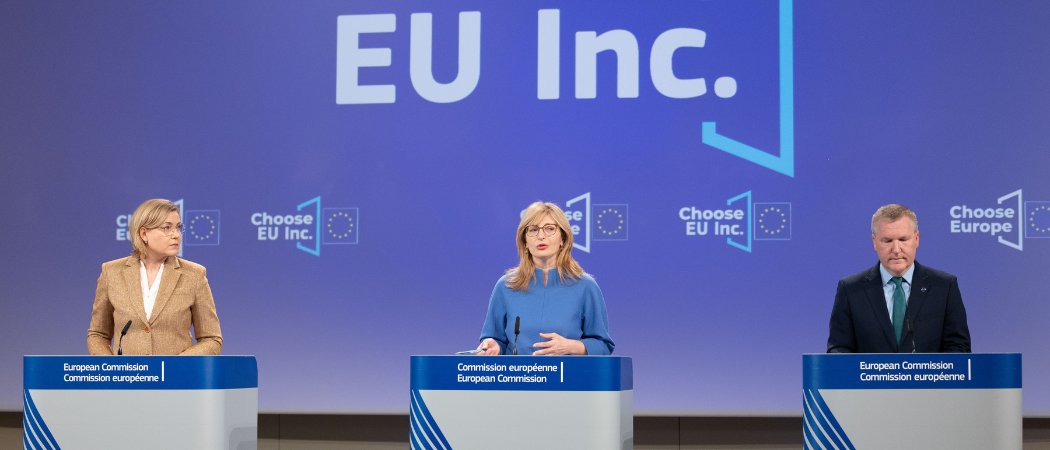
From left to right: Commissioners Henna Virkkunen, Ekaterina Zaharieva and Michael McGrath present the EU Inc. proposal. Photo credits: Bogdan Hoyaux / European Union
Plans presented by the European Commission for an EU-wide corporate regime could be a big step in making Europe a more attractive place to found and scale innovative companies, but some MEPs already point out to gaps in the proposal.
If implemented, EU Inc. would become the bloc’s first harmonised legal form that would allow any company to incorporate within 48 hours, for less than €100, with no minimum share capital, and operate across the EU. The Commission promises fully digital procedures across a company’s lifecycle, from creation to insolvency.
The idea is to make it easier for companies, especially innovative start-ups and scale-ups, to operate across EU borders, and to attract investors who are hesitant to invest in countries without knowledge of the local legislation.
The current patchwork of 27 national frameworks “complicates scaling” and “slows growth,” said justice Commissioner Michael McGrath.
Companies will have the choice of setting up an EU Inc. or an existing national company form. An EU-wide digital platform will connect national business registers and implement a “once-only” principle, meaning companies submit information to national authorities only once. The Commission is promising to set up a new central EU register in a second step.
One of the EU Inc.’s main selling points is a harmonised stock option regime, which will allow companies to offer similar incentives to employees regardless of where they are based. Stock options are seen as an important tool for cash-strapped start-ups to attract talent, but the current rules are fragmented across Europe. Under the new plans, stock options will always be taxed at the point of sale, although the tax rate would still depend on the country.
While any company based in Europe can become an EU Inc, innovative start-ups will have access to simplified insolvency procedures. The idea is to make it easier for entrepreneurs to start again, said Commission President Ursula von der Leyen. “Failure should not be the end of the road; it should be part of the journey,” she said.
What is an innovative company?
Alongside the proposal, the Commission has adopted a recommendation defining innovative start-ups and scale-ups. A company is innovative when R&D costs in the last three years are worth at least 10% of operating costs or at least 5% of total sales.
A company can also be considered innovative if it has or will soon develop a major innovation, which holds risks of market or technological failure.
An innovative start-up is an innovative company less than ten years old with fewer than 100 employees and an annual turnover or balance sheet of less than €10 million. Innovative scale-ups have an annual turnover or balance sheet of more than €10 million, have increased the number of their employees or revenues by 20% in the last two years, and either employ fewer than 750 persons or are not publicly listed.
The move will have wider consequences than the EU Inc. framework. “The definitions will allow the Commission, the national authorities and the European Investment Bank to design policies and programmes specifically for start-ups and scale-ups,” said Ekaterina Zaharieva, EU commissioner for start-ups, research and innovation.
Potential gamechanger
Europe’s innovation actors have high hopes for the EU-wide regime. “EU Inc. is one of the most important building blocks for Europe’s scale-up ecosystem, and, if we get it right, it will accelerate the path from lab to market across the continent and beyond,” said Lisa Ericsson, head of the innovation department and chief executive of the investment arm of KTH Royal Institute of Technology in Sweden.
“However, its success will depend on how effectively it aligns a single, predictable legal framework with access to capital and markets, and on strong alignment in implementation across member states,” Ericsson said. “Without that coherence, we risk reinforcing fragmentation rather than removing it.”
The harmonised stock option regime “is transformative for our ecosystem to retain world-class talent when competing with bigger companies,” Ester Davanzo, senior European affairs coordinator at France Digitale, a network of start-ups and investors, wrote in a social media post.
EU Inc. will also enable investors to identify and back the best projects, regardless of where they are located in Europe, Davanzo added.
Marlene Schörner, policy fellow at the Jacques Delors Centre in Berlin, said EU Inc. could be a “gamechanger” for young, innovative companies with limited capital and human resources. For these companies, the current fragmentation “is very costly to navigate and deters scaling across the EU,” she told Science|Business.
Innovative companies particularly stand to benefit from smoother cross-border operations, as they “often need access to complex value chains and dispersed personnel,” Schörner said. Meanwhile, “deconstructing entry hurdles for founders could encourage more researchers to found companies,” she added. “EU Inc. could be a big step in making Europe a more attractive place to found and scale innovative companies.”
Schörner believes the narrow scope of the legislation, which does not encompass labour law and taxation, is necessary to make it work politically. “The Commission has chosen the right approach by choosing to create a corporate law core first and add other elements later on,” she said.
Parliament position
The European Parliament has already adopted a report on the 28th regime, so named because it would sit alongside the 27 national corporate regimes.
“The competitiveness crisis cannot be tackled with one omnibus after another,” said Parliament’s rapporteur, René Repasi of the Socialists and Democrats. “We must create a space for innovation, risk and entrepreneurship.”
Measures such as digital company creation within 48 hours and harmonised stock option regimes are “vital steps” for integrating the internal market, but important elements from the Parliament’s report are missing from the proposal, Repasi said.
These include “genuine rules on asset locks to prevent killer acquisitions and prevent abuse regarding creditor protection, labour law and employee board participation,” he said.
Von der Leyen insisted the proposal “will, in every way, respect existing social standards and labour law,” including employee rights to participate on company boards.
Related articles
- Momentum builds for EU-wide company status
- EU start-ups cite access to markets and funding as main reasons for relocating
Meanwhile, the Commission proposal urges member states to consider setting up specialised courts to handle disputes on EU Inc. company law. Start-up associations have been pushing for a centralised European court.
The name EU Inc. is taken from the EU-INC campaign, led by start-up founders and investors, which has been lobbying for a pan-European legal entity alongside a centralised business registry and harmonised investment documents.
In response to a leaked version of the proposal last week, EU-INC and two start-up associations, Allied For Startups and European Startup Network, released a joint statement warning that reliance on national courts and registries “undermines the very standardisation the proposal sets out to achieve.”
No need for unanimity
A major question mark in the lead-up to the proposal concerned whether the Commission would opt for a regulation, which would be instantly applicable across the EU but would likely require unanimous approval by EU governments, or a directive, which would be easier to pass but would give national governments more flexibility over implementation.
The Commission decided to pitch a regulation, but using Article 114 of the Treaty on the Functioning of the EU, which only requires a qualified majority in the EU Council, despite previous concerns from start-up associations that this would not be an appropriate legal basis for the 28th regime.
For Schörner, the reason for using Article 114 is clear, as it’s the only option allowing for a regulation without requiring unanimity. However, the Commission is taking a risk, as this legal basis could invite challenges, she said.
If the Commission has indeed found a way to implement a regulation without requiring unanimity, this is the “best case scenario,” said MEP Pascal Canfin, Renew Europe’s shadow rapporteur for the file, as a regulation will be faster and more harmonised than a directive.
As Parliament has already stated its position, “we have everything we need to go fast,” Canfin said. The Commission wants an agreement on the 28th regime by the end of the year. Canfin believes this is possible if the negotiations stick closely to the Commission’s proposal, which he feels is “the most likely scenario.”
The Commission is now pitching EU Inc. as part of a broader 28th regime, to include measures on digitalisation, access to finance, talent and taxation.



 Receive the Funding Newswire [full access requires a subscription] each Tuesday, our Policy Bulletin each Thursday, and the fortnightly R&D Express, tracking reforms and investments in central and eastern Europe.
 A unique international forum for public research organisations and companies to connect their external engagement with strategic interests around their R&D system.