Swedish investment firm EQT has been appointed manager, ahead of an official launch in early June
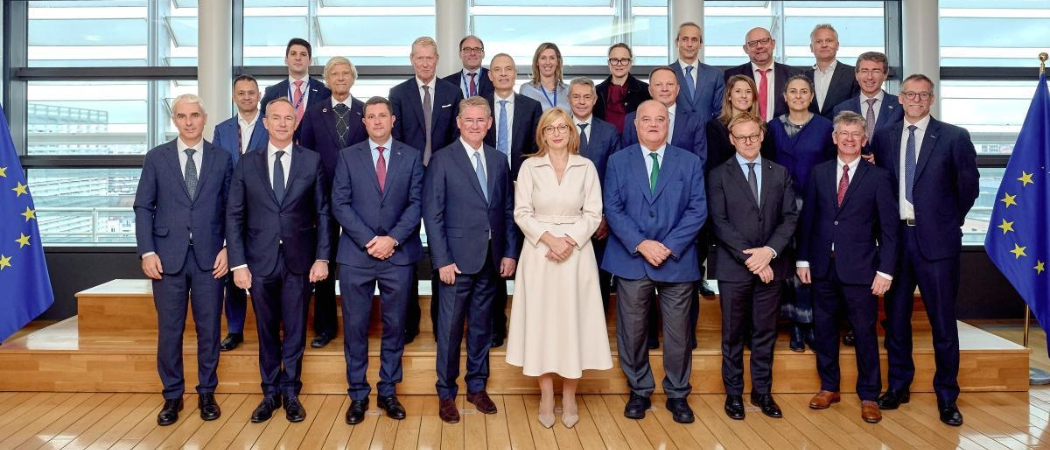
EU research commissioner Ekaterina Zaharieva meets potential Scaleup Europe Fund investors in October 2025. Photo credits: Frédéric Garrido-Ramirez / European Union
The EU will officially launch its €5 billion investment fund for scaling up future European tech giants on June 3. The preparations are in full swing, and this week the EU’s main innovation agency, the European Innovation Council (EIC) named Swedish investment firm EQT the manager of the new fund. Here are five things we know about the Scaleup Europe Fund so far.
It will by Europe’s largest technology growth fund
First things first, the basics. The fund is the latest instrument in the EU’s mission to help its companies grow from start-ups to tech leaders without jumping ship at the scale-up phase to move to the US. This is the usual pattern for European scale-ups, who struggle to find financing at home once their investments needs approach nine figures.
To fill the gap, the Scaleup Europe fund will directly invest in strategic technology companies from Series B onward, with investments in the range of €100 million. The aim is to catalyse Europe-led funding rounds in the range of several hundred million euros.
This is big step up for the EIC, which will oversee the fund, whose largest investments until now were capped at €30 million. These investments are managed by the Luxembourg-based equity firm Alter Domus within the EIC Fund, the EIC’s venture capital arm. The Scaleup Europe fund will be managed by a separate “compartment” within the EIC Fund.
The total size of the Scaleup Europe Fund is foreseen to be €5 billion, of which €1 billion will come from Horizon Europe, the EU’s research and innovation programme. The rest will come from private investors. Sifted reports that, by the end of 2025, private investors had already committed €1.5 billion.
If it reaches the target of €5 billion, the Scaleup Europe Fund would surpass the largest European technology growth funds.
The fund will be managed by one of Europe’s largest private markets investors
After a months-long selection process, the EIC board this week named the Swedish investment firm EQT the new manager of the Scaleup Fund.
Having a professional manager will allow the fund to run like a large private-market investment vehicle, bringing in expertise in sourcing and evaluating investments, structuring deals, attracting institutional co-investors and managing portfolios and exits.
The EIC’s pick for manager, EQT, claims to be Europe’s largest private market investor, with €269 billion in total assets under management. It already runs its own early-stage investment platform, which is active across ventures, growth and life sciences, and promises to leverage its own AI-driven sourcing and portfolio intelligence system, Motherbrain.
The firm will manage the Scaleup Europe fund’s investments as well as commit a “significant” amount of its own capital to the fund.
In addition to being privately managed and co-financed, the fund will be profit-making, EU research Commissioner Ekaterina Zaharieva said last year.
According to the EIC work programme, the manager “will be responsible for implementing the investment strategy and guidelines, including sourcing, due diligence, investment recommendations and decisions, investment management and divestments.”
It will make sure that companies stay in Europe
The new fund is intended to be a strategic autonomy tool, ensuring that important technologies stay in Europe, not only for the sake of making money but also ensuring global leadership.
"When implementing investments, the Scaleup Europe Fund will ensure that supported companies retain the majority of their value creation, including intellectual property, within the EU or Horizon Europe associated countries,” the EIC work programme says.
Related articles
- Investors back plans for €5 billion Scaleup Europe Fund
- EU start-up strategy gets warm welcome, but now founders want action
The way it will do this is by giving preference to European exits, as well as maintaining economic security safeguards that will be dictated by the fund’s investment guidelines and the terms of the investments, to be adopted soon.
Co-investors have already signed up
In addition to EQY itself, a number of co-investors have already expressed a willingness to work with the Scaleup Fund, including Novo Holdings, the Export and Investment Fund of Denmark, CriteriaCaixa and Santander.
The mix of partners includes both investment groups and philanthropic foundations, such as Italy’s Fondazione Compagnia di San Paolo, which aims to align its goal with Italian, European and UN strategies. “This is a way to enhance the impact of our activities,” its secretary general Alberto Anfossi told Science|Business last year.
Plus, becoming a founding investor allows these investors to help shape its strategy. “It’s rare that you get the opportunity to be a founding partner in something where the intention is to be transformational to the ecosystem within Europe,” said Nigel Govett, chief financial officer of Novo Holdings.
Its inner workings are largely still a mystery
So far, little detail has been released about how the fund will work in practice and what the application process will be, but the EIC work programme suggests that the manager will have the key say in who gets financed.
"Applications for investment support will be submitted directly to the Scaleup Europe Fund and will be assessed and decided by the independent investment adviser and portfolio manager, ensuring an open, transparent and fair selection process,” the work programme says.
The strategic sectors in which the fund will invest are:
- Digital and intelligent systems, including AI, quantum and semiconductors
- Physical and industrial systems, including clean energy, advanced manufacturing and materials, space and mobility technologies
- Life and health sciences, including biotechnology, medical technologies and agritech.
In a nod to the EU’s increasing focus on boosting defence innovation, investments in dual-use technologies will be allowed.
But the specific terms of each investment will be considered on a case-by-case basis, in accordance with the fund’s investment guidelines.


 Receive the Funding Newswire [full access requires a subscription] each Tuesday, our Policy Bulletin each Thursday, and the fortnightly R&D Express, tracking reforms and investments in central and eastern Europe.
 A unique international forum for public research organisations and companies to connect their external engagement with strategic interests around their R&D system.